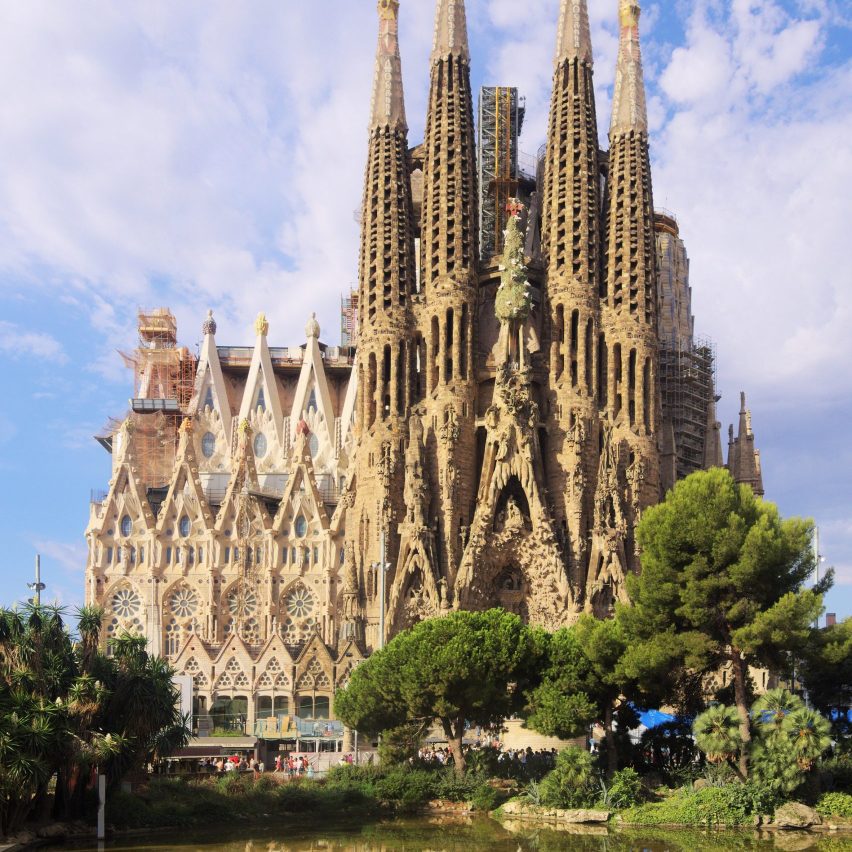
The Sagrada Família is topping out this year, a century after Antoni Gaudí was hit by a tram and died three days later. A hundred years is enough distance to ask the honest question: how much of what we build now actually descends from him?
Not much. That is the interesting part.
Dezeen marked the centenary with a feature arguing Gaudí was, in their words, "less influential than his fame might suggest" — their features editor Nat Barker laying out why a man this famous left so few heirs (Dezeen, In Depth, June 2026). We would put it harder. The line that won the twentieth century — the one running through Breuer, Tange, Rudolph and Ando, and landing on the job sites we run in Brooklyn — is the plain one. Structure left legible. Material left alone. Ornament treated as an admission that the thing underneath couldn't carry the building on its own.
Gaudí is the opposite proposition, and it is worth being precise about why, because the easy reading is wrong. The easy reading says he was a fantasist. He wasn't. He was one of the great structural minds of his century. The catenary arches, the upside-down funicular models hung with weighted strings to find a form in pure compression — that is engineering of a high order, arrived at without a computer. Anyone who has tried to make a vault stand without steel should respect it.
But his structure and his ornament were one substance. You cannot strip the surface off a Gaudí column and keep the column; the bone and the skin are poured together. That is exactly what the modernists refused. They kept the structural honesty and threw the skin away. Breuer's concrete says concrete. Ando's wall is a wall and a window and nothing else. The discipline wasn't a lack of imagination — it was a harder kind of imagination, the kind that has to make a plain surface carry all the feeling.
This is not a museum argument. It is the argument we have on site every week. When we specify board-formed concrete, brick left unrendered, tadelakt that shows the hand that troweled it, cork that still smells like cork — the position underneath every one of those calls is the same. Let the material be the finish. Don't dress it. A surface that has to be decorated is usually a surface that wasn't resolved.
The most useful thing in Dezeen's centenary issue isn't even the Gaudí piece. It's the company they put it in — an interview alongside it with Diébédo Francis Kéré, who builds schools out of clay and local labor and the climate they sit in. Kéré is the living end of the plainer line. No ornament, total richness, every decision legible from across the room. That is the inheritance that actually compounded. Gaudí built one impossible church for a hundred years. Kéré builds the argument that the material you already have, used honestly, is enough.
So mark the centenary. The Sagrada Família is a miracle of stubbornness and it should be finished. But don't mistake fame for lineage. The architecture that won wasn't the most decorated. It was the most resolved.
That's the lens this journal reads everything through. More soon.
Sources & Credits
- Antoni Gaudí centenary, Dezeen In Depth, feature by Nat Barker, June 27 2026 — https://www.dezeen.com/2026/06/27/gaudi-centenary-impact-dezeen-in-depth/
- "Is Gaudí the greatest architect ever?", Dezeen Weekly podcast, June 26 2026 — https://www.dezeen.com/2026/06/26/gaudi-dezeen-weekly-podcast/
- Diébédo Francis Kéré interview referenced via Dezeen In Depth, June 2026.
Photography of the Sagrada Família and related work appears at the sources above, credited to Dezeen. No Common Projekts imagery is used in this post.