Listen: every building begins as a decision to take something out of the ground. Sand and gravel and the limestone that gets burned into cement, and the iron that gets cooked into steel, and the trees, and the copper, and the long quiet centuries it took the earth to make any of it. We move all of this around the planet on ships, and we mix it, and we pour it, and we call the result new. It is not new. It is the oldest stuff there is, rearranged at great cost and held in a shape for a while.
So it is a small relief to hear a room full of architects say out loud that the best thing you can build is sometimes nothing at all.
That was the argument at the third episode of designboom's Room For Dreams podcast, recorded live at Milan Design Week 2026, where a panel of architects sat down to talk about adaptive reuse and, in designboom's framing, "why the ultimate form of sustainability means building as little as possible" (designboom). The panel cut past the usual preservation pieties and got into the real work, which is not sentimental at all: deciding what to keep, what to update, and the moment a piece of an old building has to be replaced because it is no longer safe to stand under. They landed on the "bare shell" as a strategy, a structure deliberately left open and unfinished so it can change its mind about what it wants to be over the next fifty years without anyone having to knock it down.
Here is what we noticed, having spent a good amount of time inside buildings that were one thing and are now another: this is not a new idea wearing a carbon halo. It is the oldest idea in the trade. It is truth to materials, pushed back one step further, to the truth that the material is already here.
The brutalists understood the first half of this. You pour the concrete and you let it be concrete, plywood grain and all, and you do not apologize and you do not paint it. Paul Rudolph combed his until it stood up in ridges. What the reuse argument adds is the part that comes before the pour, the part where you walk the site and see that the walls you need are mostly standing already, and that the most honest move is not to express a new material truthfully but to not summon a new material at all.
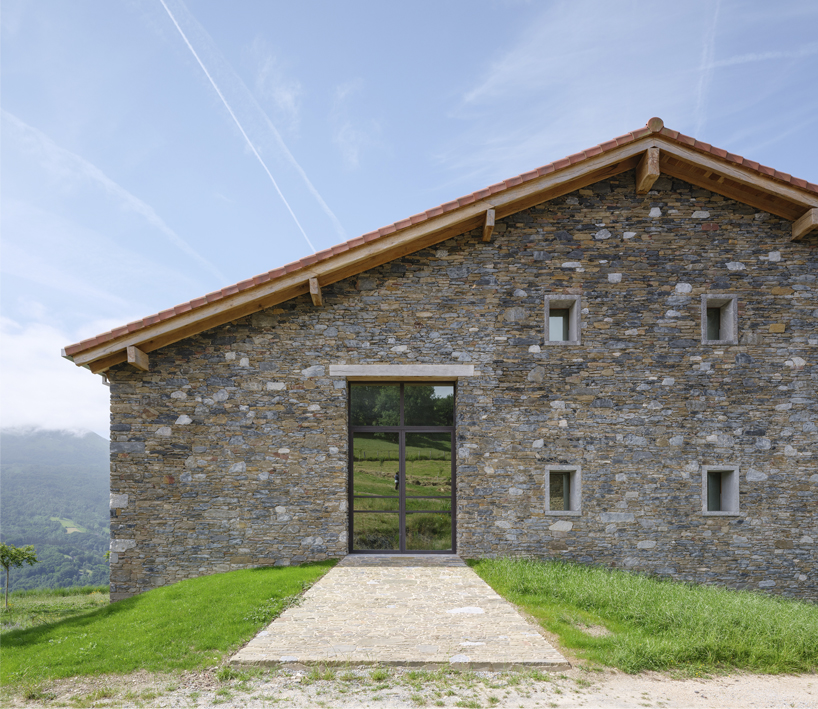
You can watch this happen in plain sight. On a hilltop in the Basque Country, the studio zU-studio took a farmhouse that had once been divided into four equal homes for four families and made it one house again, and they rebuilt the north and south facades "in stone, reusing materials from the original farmhouse," recomposed into a new wall with the openings cut where the new rooms wanted light (designboom). The structural idea is almost rude in its plainness. Four parallel walls and a roof. The stone that holds up the house today is the same stone that held it up a hundred years ago. It remembers the hill. Nobody had to dig a new one.
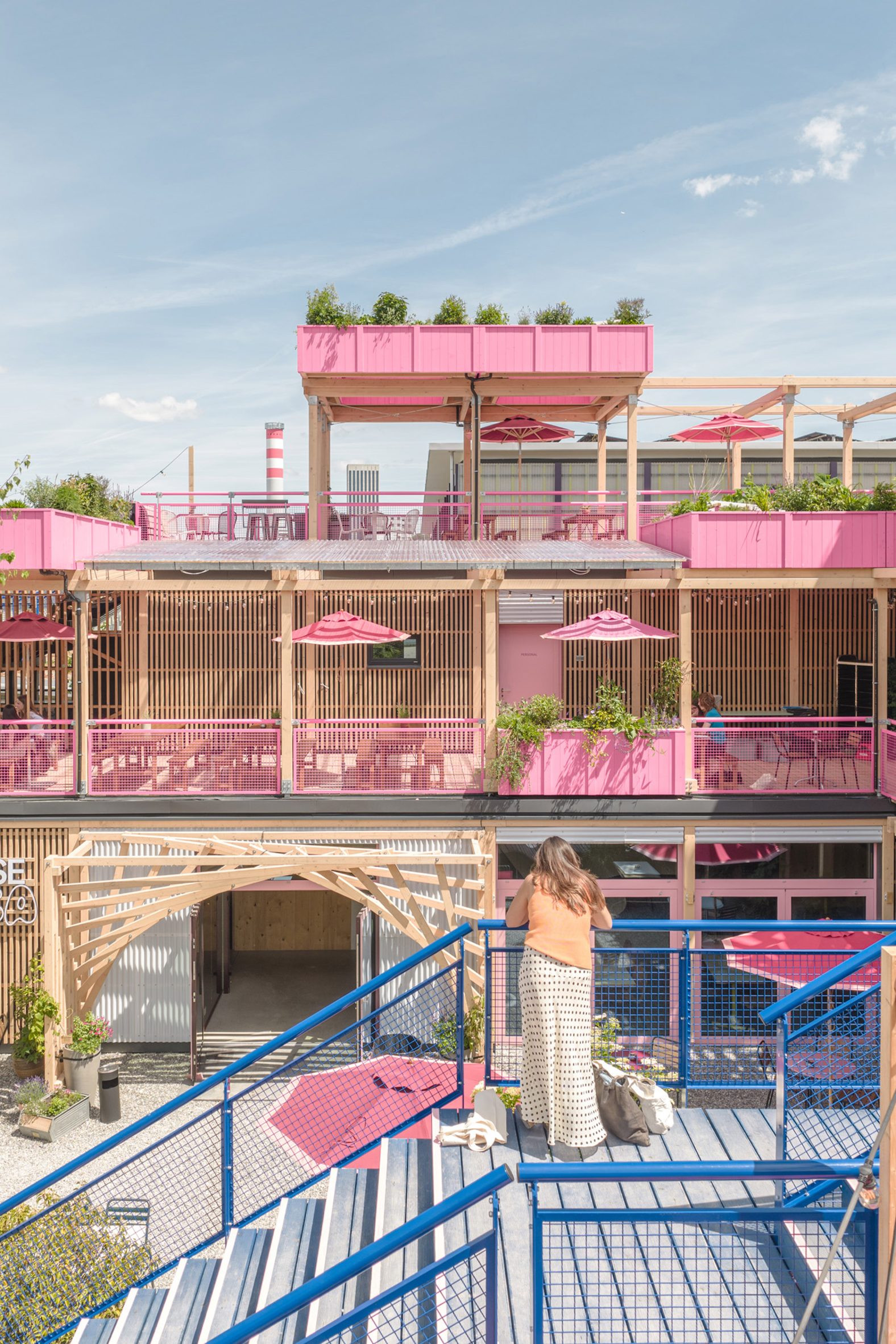
Or look at what Hello Wood did to a dead freight yard in Zurich West, where they dropped a three-level dining and events complex called Remise Rosa onto land the trains had abandoned, built in cross-laminated timber, demountable, light on the ground it sits on. The lead architect Balazs Szelecsenyi told Dezeen they wanted "a building that would pop out from its industrial and colourless surroundings with elegant confidence." It is louder than anything we would build. The staircases are the color of children's toys. But the bones of the argument are sound: take the forgotten ground, add the lightest structure that will do the job, and make none of it permanent, because permanence is just a bet that the future will want what you wanted, and the future rarely does.
We should be honest about the trap here, because the language of reuse has already been captured by the same people who captured "sanctuary" and "curated" and "artisanal." A renovation can burn through as much carbon as a teardown if you gut it to the studs and start over inside. A bare shell can be an excuse to defer every real decision and call the deferral a philosophy. And a salvaged brick flown across an ocean to look rustic is not salvaged anything. The discipline is not in the word. The discipline is in the restraint, in the willingness to do less than you are capable of, which is the hardest thing to ask of anyone who designs for a living.
That is the whole of it. The most sustainable wall is the one that was already there. The most radical material is the one you never pour. Ando builds rooms out of bare concrete and one long rectangle of sun, and they feel like the safest places on earth, and the reason is not the concrete. The reason is that he stopped adding things at exactly the right moment. He was paying attention.
The hill keeps the stone either way. The least we can do is not make it carry more than it has to.
Sources & Credits
- "adaptive legacies: why the ultimate form of sustainability means building as little as possible," Lisa Kostyra, designboom, 29 June 2026. https://www.designboom.com/architecture/adaptive-legacies-sustainability-room-for-dreams-podcast/
- "reclaimed stone and timber reshape a basque farmhouse adapted for contemporary living," zU-studio, designboom, 29 June 2026. https://www.designboom.com/architecture/reclaimed-stone-timber-basque-farmhouse-contemporary-living-zu-studio/
- "Hello Wood transforms abandoned railway site in Zurich with 'indoor-outdoor cultural hub,'" Rheanna Hopkins, Dezeen, 24 June 2026. https://www.dezeen.com/2026/06/24/remise-rosa-hello-wood/
Photography (not CP imagery): Basque farmhouse, via designboom; Remise Rosa, via Dezeen; Room For Dreams panel, via designboom.