A Building That Refuses to Stay New
Here is a thing we do to buildings, and it is a strange thing, and we almost never say it out loud.
We photograph them on the day they are finished, when the glass has never been rained on and the concrete has no stain and the copper is still the bright wrong color of a new penny, and then we spend the whole rest of the building's life trying to keep it looking like that photograph. We wash it. We seal it. We touch it up. We treat the day of completion as the peak from which everything after is decline, as though a building were a person and every year were something to be fought off with product, and we call the fight maintenance and we put it in the budget and we never once ask whether the building agreed to any of this.
There is a concert hall above Lake Geneva that took a different position, and it is worth sitting with.
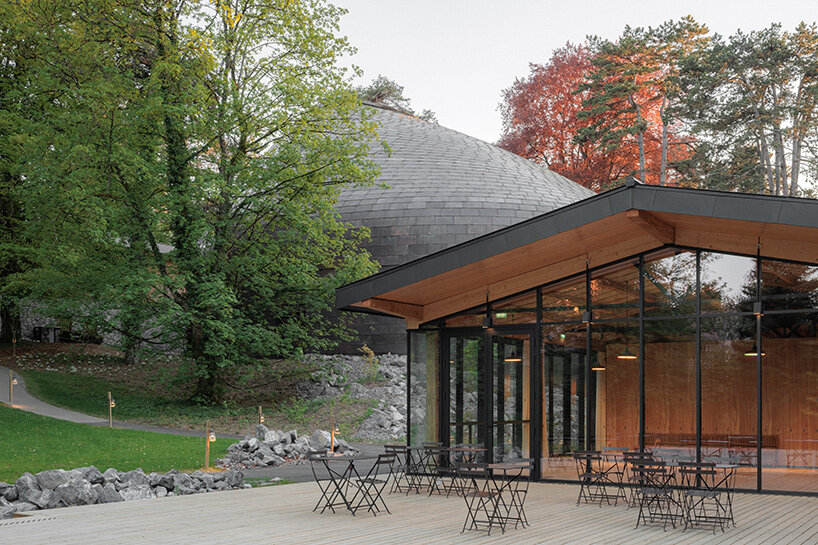
It is called La Source Vive, on the wooded heights above Évian, and it was made by Patrick Bouchain and Philippe Chiambaretta with the studio PCA-STREAM, with engineering by Bollinger+Grohmann, and it opened after the French safety commission signed off in November of 2025. Designboom ran it this week and the pictures are of a rounded, scaled thing sitting among the trees like something that grew there. The skin is copper. Small copper tiles, lapped like the scales of a fish or the shingles of an old barn, wrapping the curve.
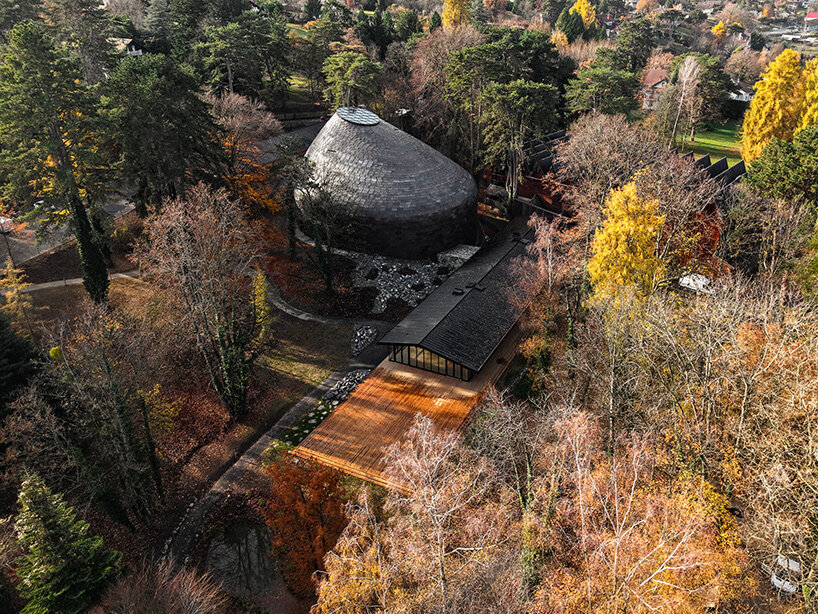
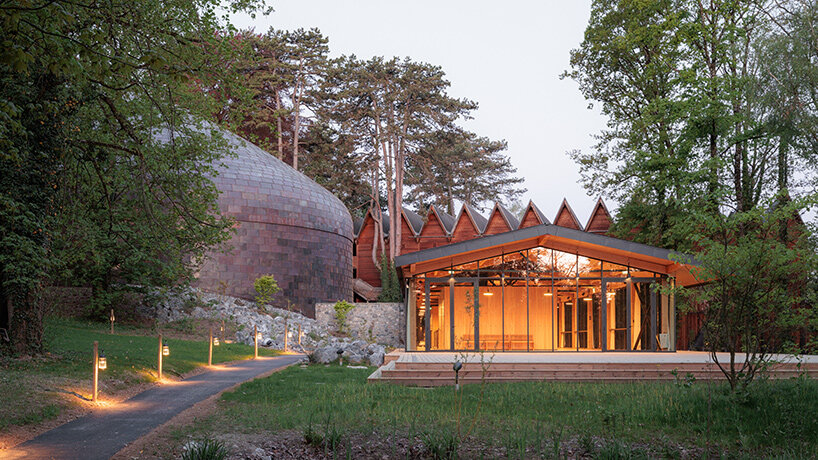
And here is the part that matters. The copper was pre-patinated. It was aged before it went up, on purpose, so that it did not arrive bright and then have to be defended against time, but arrived already partway into its long life and free to keep going. It is designed, in the plain words of the people who made it, to shift as it weathers among the trees. Nobody is going to climb up there and polish it back to a penny. It is allowed to become what copper becomes, which is that deep and quiet green you have seen on every church roof and every good old dome, the color copper chooses for itself if you let it. The building was handed its own aging, up front, as a gift rather than a threat.
This is the honest position, and it is the same position a bare concrete wall takes, which is why we are the ones writing about it.
A concrete wall does not pretend. You pour it against the plywood and it takes the grain of the plywood, and it takes the little seams where the forms met, and it takes the round dark points where the ties held everything together against the pressure of the wet pour, and it keeps all of that, forever, out in the open, because it has no way to lie about how it was made and no wish to. We spent most of a century being embarrassed by this and painting over it. The people who did not paint over it, Ando and Rudolph and the rest, are the ones whose walls we still drive across cities to stand in front of. Copper that is allowed to weather is doing the concrete thing. It is telling the truth about time instead of fighting it.
Now let us not float away, because the voice inside every good building is skeptical and we should keep ours. A scaled copper hall in the trees above a lake, paid for by a patron, is a luxury object, and the poetry of honest weathering is easier to afford when you have the budget for pre-patinated copper and a hillside to put it on. Fair. But strip the money off it and the idea underneath is free, and the idea is this: pick materials that get better, or at least truer, as they age, and then do not stand in their way. Brick does this. Stone does this. Good timber does this. Bare concrete does this. Weathering copper and steel do this. They cost less to keep, not more, precisely because you have stopped paying to keep them looking like the lie of day one.
There is more to the building than its coat, and it is worth naming, because the honesty runs all the way in. Under the copper is a technical gap, and under the gap an acoustic concrete shell, and the inside of that shell is lined not in some sprayed acoustic product but in raw molded plaster, shaped for the sound. Concrete, plaster, timber, copper. Four materials that all age in public, stacked one inside the next, tuned to hold a room full of people listening. The reported form is an oval in plan pulled up into a cone in section, a hybrid of the old shoe-box hall and the terraced vineyard hall, giving each listener roughly eleven cubic meters of air to sit inside. That is a lot of considered geometry wrapped in a skin that has made its peace with getting old.
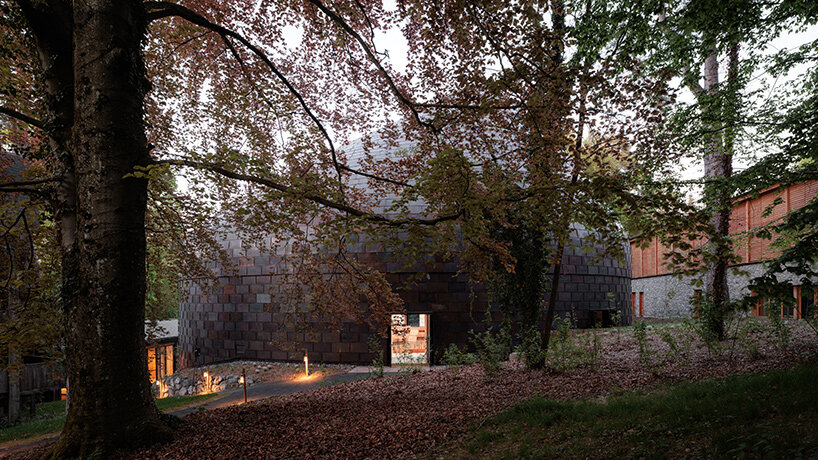
The building will not look the way it looks today. In twenty years the copper will have gone darker and quieter and more like the trees, and in fifty it will be green, and the people who come to hear music in it will have no idea it was ever a new penny, and they will be right not to care, because it was never trying to be new. It was trying to be true, which lasts.
Let the surface remember. Stop fighting the weather. The building was going to age anyway. The only choice you ever had was whether to let it do so with any dignity.
Sources & Credits
- Reporting and project images: designboom, "copper shingles wrap curving concert hall 'la source vive' in évian, france," by Kat Barandy. https://www.designboom.com/architecture/copper-shingles-curving-concert-hall-la-source-vive-evian-france-philippe-chiambaretta/
- Additional project detail (architects Patrick Bouchain and Philippe Chiambaretta / PCA-STREAM; patron Aline Foriel-Destezet; engineering by Bollinger+Grohmann; concrete base and acoustic concrete shell lined in raw molded plaster; outer skin of pre-patinated copper tiles set to weather; oval plan with conical section, roughly eleven cubic meters per listener, hybridizing shoe-box and vineyard hall types; safety approval 6 November 2025): PCA-STREAM project page, https://www.pca-stream.com/en/projects/la-source-vive/, and Archello, https://archello.com/project/la-source-vive
- Hero image (layout reference only, not CP imagery): designboom. Photography via designboom, credit per the source article.
All facts about the project belong to the sources above. The reading of them is Common Projekts.