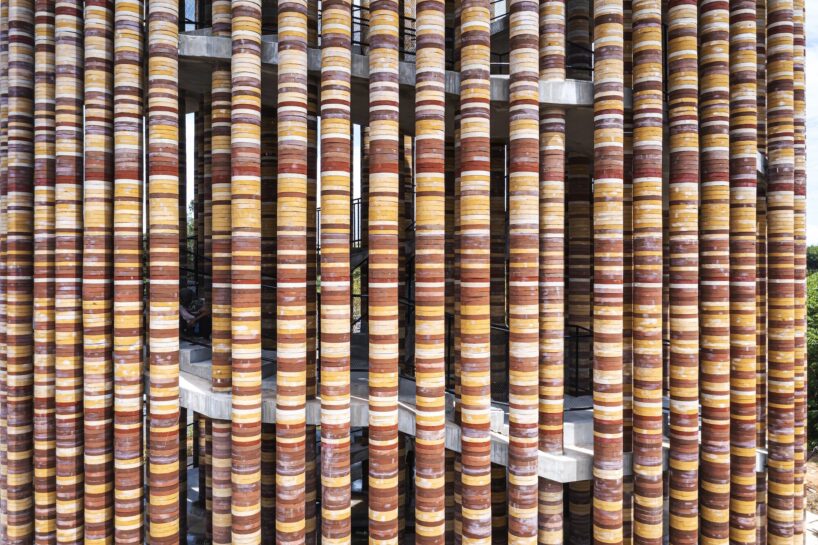
Start with the brick, because everything here starts with the brick.
It is round, about a foot across and two inches thick, and it is made of elephant dung. Not fired. Never near a kiln. It is pressed by hand and set out in the sun and left to the sun and the air and the time it takes, and it comes out in one of five natural colors depending on what the elephant ate and how the light treated it while it cured, and then a person picks it up and threads it onto a steel rod like a bead onto a string, and then another, and then a few thousand more, and the stack becomes a column and the columns become a tower you can walk up inside. This is Goya Tower, in Khao Lak, in Phang Nga, in southern Thailand, designed by Boonserm Premthada with Bangkok Project Studio and reported by designboom. It is named after a female elephant born nearby.
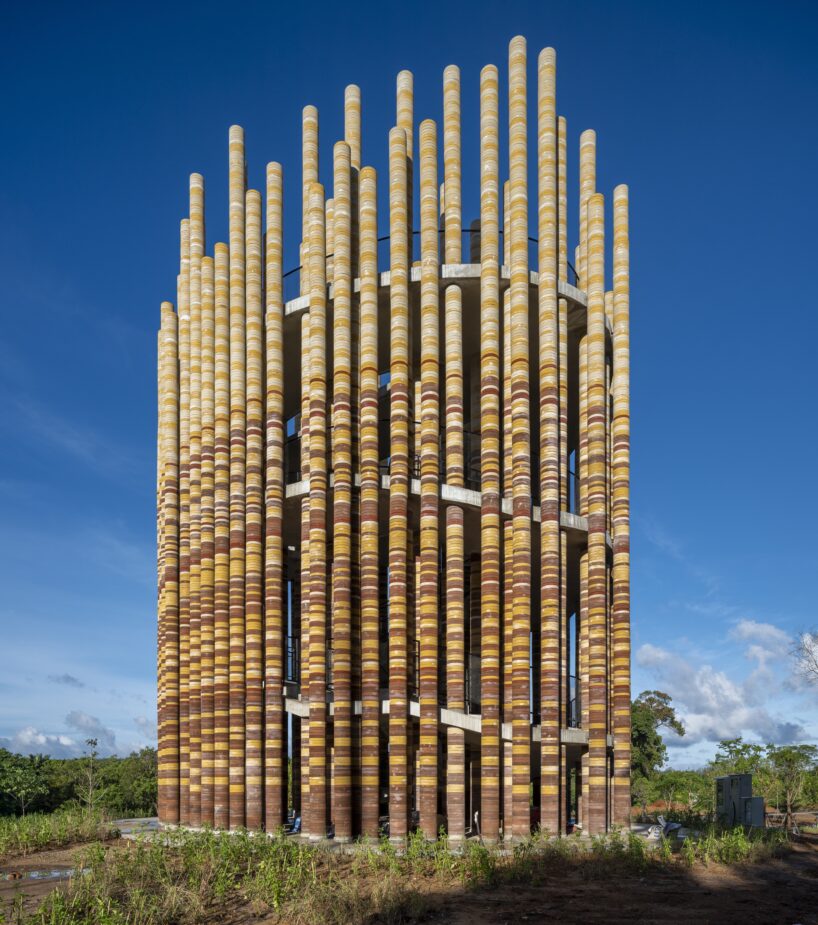
Premthada has been working this material for years. There was the elephant dung brick that won him a social-impact prize in 2021, and the elephant theater of animal-waste brick, and a whole practice built around the animals of Surin and the people who live with them and the mountains of manure they produce every single day, which most of the world treats as a problem and he treats as a quarry. The dung is mostly fiber. An elephant is a poor digester of grass, which turns out to be excellent news for a bricklayer, because what comes out the far end is already halfway to being straw-and-earth, the oldest building mix there is, the one the Egyptians used, the one your grandmother's grandmother's house was made of on whichever continent she came from.
So the radical thing and the ancient thing are again the same thing. Hold that. It keeps happening.
We should say what the tower is not. It is not a clever object in a museum, behind glass, captioned. Premthada took the research all the way out to full scale and made it public, a lookout at the entrance to a larger project, something a visitor can enter and touch and climb and stand inside while the light comes through the gaps between the bricks and lands on the curved walls in bars. You are inside the material. You are inside the elephant, a little, if you want to be honest about it, and honesty is the whole point of the thing.
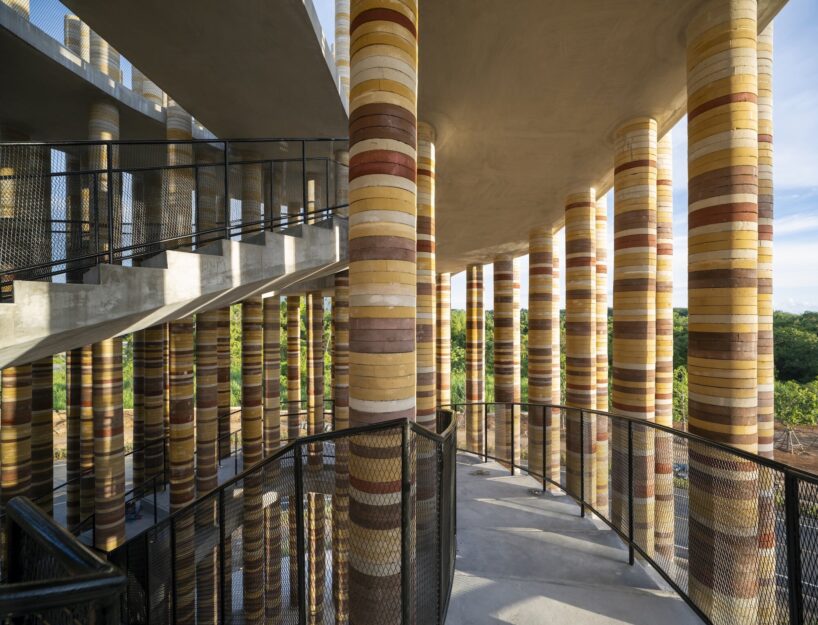
This is where the tower and our own influences shake hands. Paul Rudolph combed his concrete into corduroy ridges so the wall would show exactly how it was made and refuse to apologize for it, and people called those buildings ugly, and the buildings are still standing. Goya Tower is doing the same job in a warmer register. The brick is not clad. It is not painted. It is not pretending to be stone or trying to look expensive. It is the structure and the surface and the story all at once, which is the brutalist proposition stated as plainly as it has ever been stated: the building is made of what it is made of, and it will tell you so, and it will not blush.
There is the mass argument too, the one we keep coming back to. A thick wall of earth in a hot climate is a thermal battery. It takes the heat of the Thai afternoon slowly and lets it go slowly, so the inside of a heavy brick tower is not the inside of a glass one, and Premthada knows this the way builders in hot places have always known it, in the body, before it was ever a line on a consultant's spec.
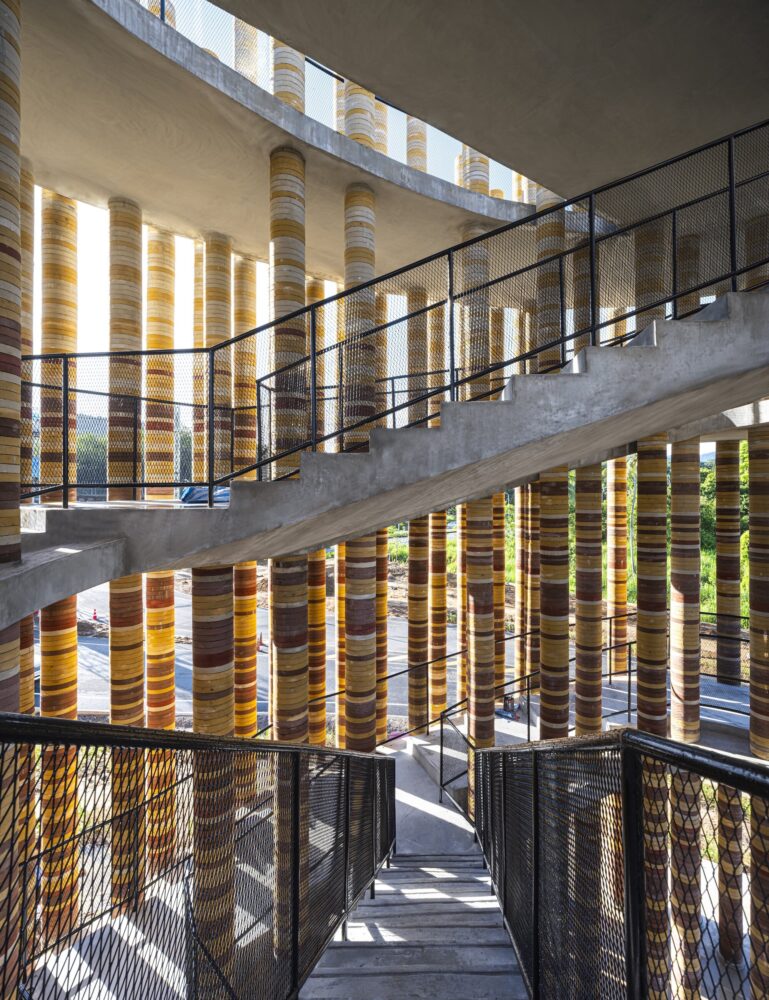
We will resist the temptation to make this precious. It is dung. It smells like nothing much once it cures, and it will not solve the housing of the world, and one handsome tower at the mouth of one project in one province is not a movement. Premthada would probably be the first to wave off the sermon. What he has done instead is quieter and better than a sermon. He found a material that a whole industry was throwing away, and he treated it with the seriousness you would give marble, and he asked people to climb inside it and look at the sky through the seams.
The elephant did the first part without being asked. Everything after that was the hand. A brick, and another, and a few thousand more, and a rod to hold them true, and the sun to do the firing that no kiln did, and at the end of it a room you can stand in. It does not need to be called brutalist to be brutalist. It just needs to tell the truth about how it was made. This one does. And still it stands.
Sources & Credits
- Boonserm Premthada with Bangkok Project Studio, Goya Tower, Khao Lak, Phang Nga, Thailand (design 2025, completion 2026), reported by designboom: "handmade elephant-dung bricks make boonserm premthada's goya tower rise in southern thailand." https://www.designboom.com/architecture/handmade-elephant-dung-bricks-goya-tower-southern-thailand/
- Background on Premthada's earlier elephant-dung brick work via designboom archive: https://www.designboom.com/architecture/boonserm-premthada-elephant-dung-bricks-thailand-12-31-2021/
- Photography: images courtesy designboom / Bangkok Project Studio. Individual photographer credits not specified by the source at time of writing.