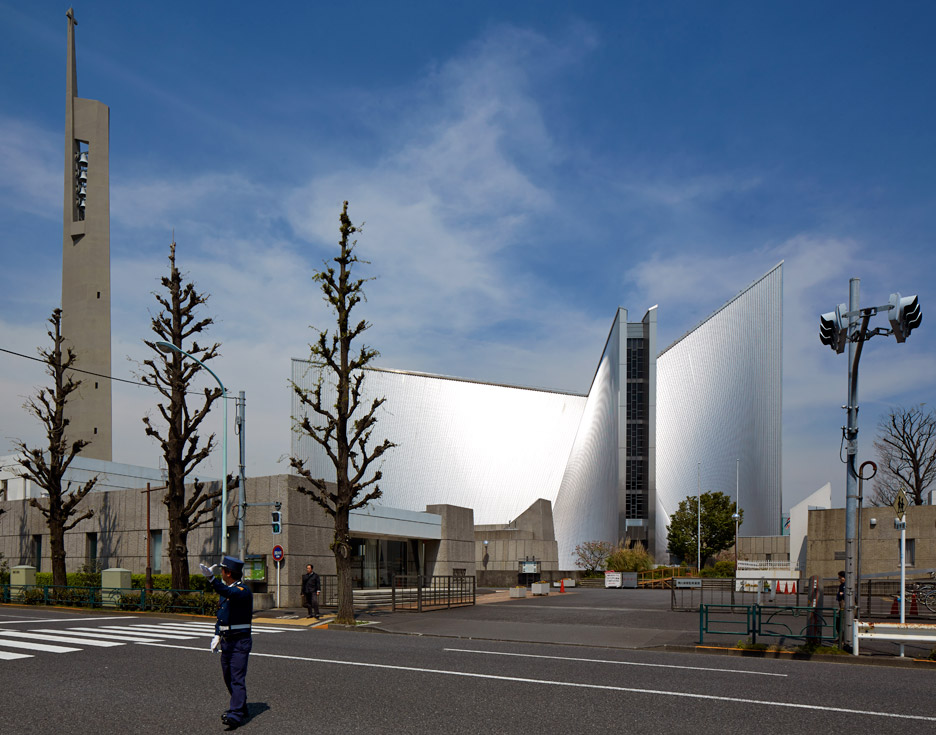
A hyperbolic paraboloid is a saddle. It curves upward along one axis and downward along the other at the same time, and that doubled curvature is the entire point, because a surface bent in two directions at once stops behaving like a sheet and starts behaving like a structure. You can rule it out of straight lines. You can make it startlingly thin. The formwork is miserable and the mathematics is beautiful, and for about two decades in the middle of the last century it was the most exciting shape available to anybody.
Kenzo Tange put eight of them over Tokyo.
St Mary's Cathedral went up in the Bunkyo district between April 1963 and December 1964, on ground where a wooden Gothic cathedral had stood until the wartime air raids took it. Eight shells, set so the plan reads as a cross, and arranged so that the place where they decline to meet becomes a cross cut into the roof and filled with glass. Each wing rises to a different height, which tilts the glazing, which means the daylight comes in from four directions at four angles and none of it through a window you could stand at and look out of. Inside it is dark concrete. Outside it is stainless steel. Edmund Sumner photographed it in April 2015, and when Dezeen ran the pictures he called the building a "modernist brutal classic" and said it was "something I had been meaning to shoot for years," a building he considered "a classic but still not as widely known as it should be."
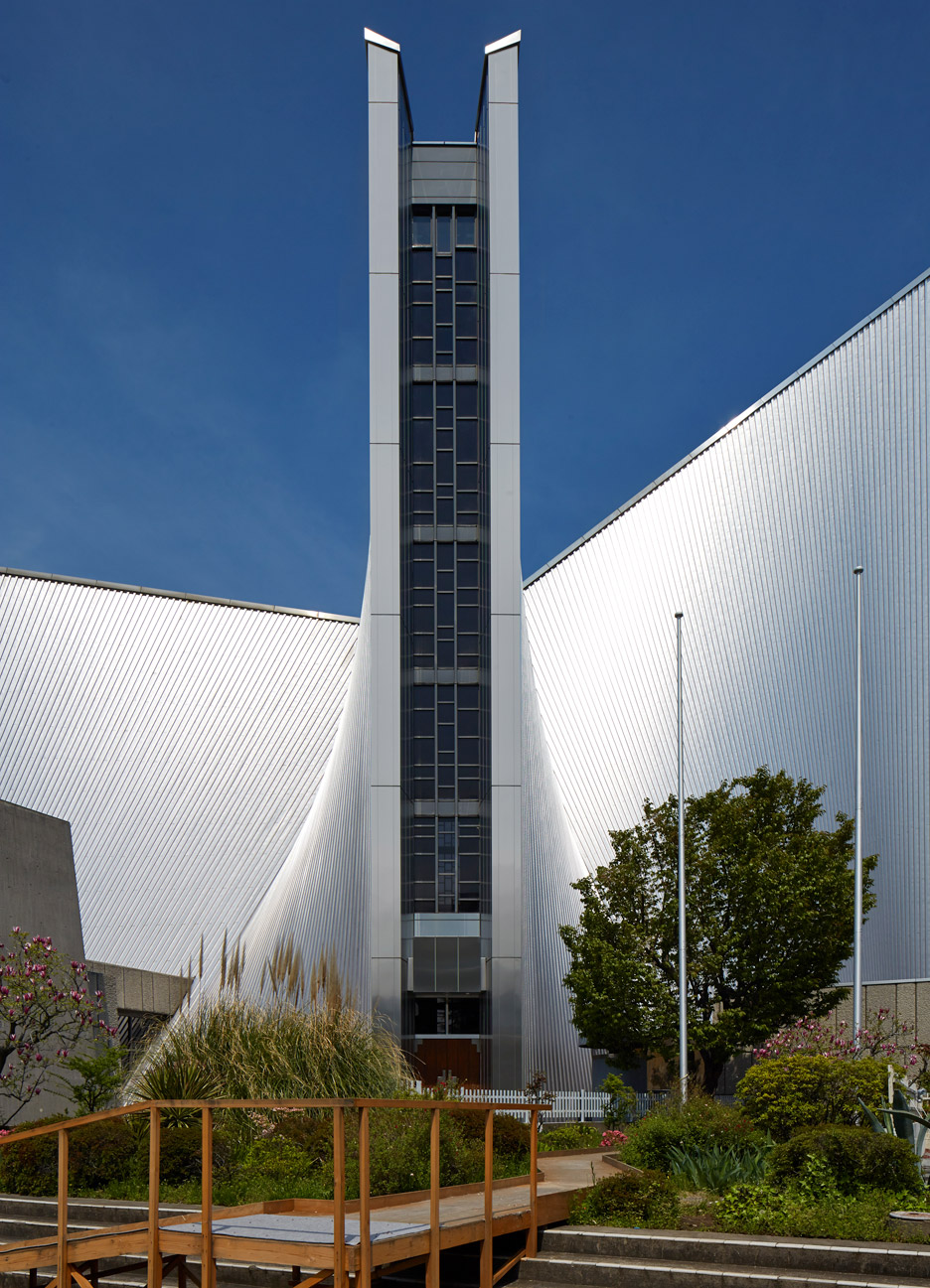
Dezeen reports that Tange meant the shape to reference the lightness of a bird and its wings, and we have no reason to doubt that he said so. It is also the kind of sentence that gets written onto a presentation board after the hard part is finished, and the hard part here was not the bird. Eight doubly curved shells, each one a different height, all of them leaning in toward a hole in the middle where the structure would most like to have some material: that is not a metaphor, that is a set of simultaneous equations about where the loads go when you take away the one place they want to go. Somebody had to solve it. His name was Yoshikatsu Tsuboi, he was the structural engineer, and he is the reason the roof is above you rather than around you.
We keep doing this to ourselves as a profession. We credit the form to the man who drew it and we file the man who made it stand under consultants, and then we are surprised a generation later when the renderings get thinner and the buildings get more expensive and nobody can quite say why. Tange knew better. Tsuboi was on the Yoyogi gymnasiums the same year, which is to say the two most structurally audacious buildings in Tokyo in 1964 came out of the same working relationship, and the shells were never a style. They were an answer. A shell is one of the only structures that gets stronger by getting more curved and more honest by getting thinner, and it will punish you immediately for anything decorative you hang on it. That is why we are still looking at it sixty years later, and why nobody has managed to fake one.
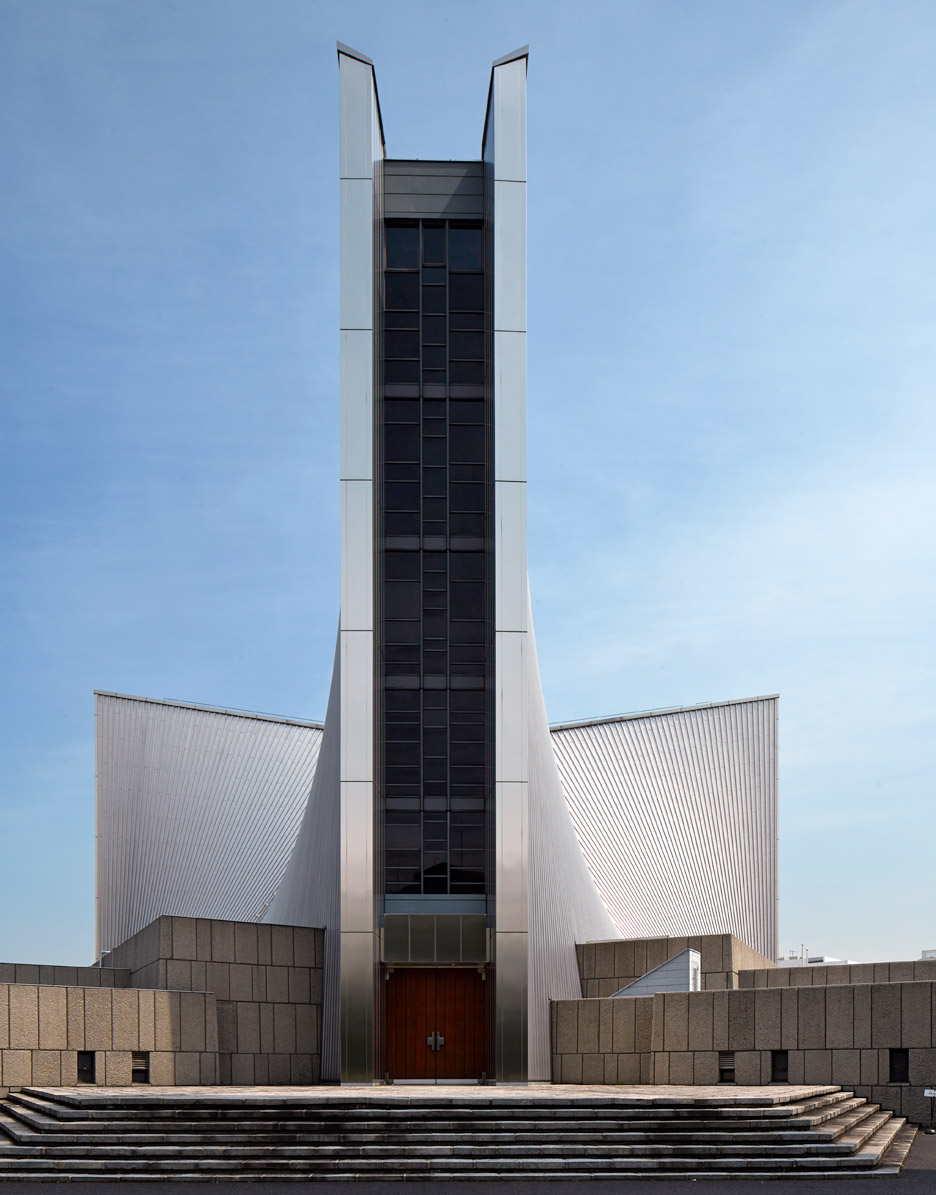
And now the unglamorous part, which is the part we find most instructive. The stainless steel is not expression. It is a raincoat. A thin shell curved in two directions has an enormous surface area, a great many joints, and almost nowhere for water to sit still and behave itself, and the cathedral leaked. Not briefly. The building record shows a comprehensive renovation in 2007 that renewed the stained glass and the steel shell and finally dealt with rain leakage the cathedral had been carrying for years. Four decades of buckets and patching and somebody on a ladder on a Monday morning, under a roof designed to look like flight.
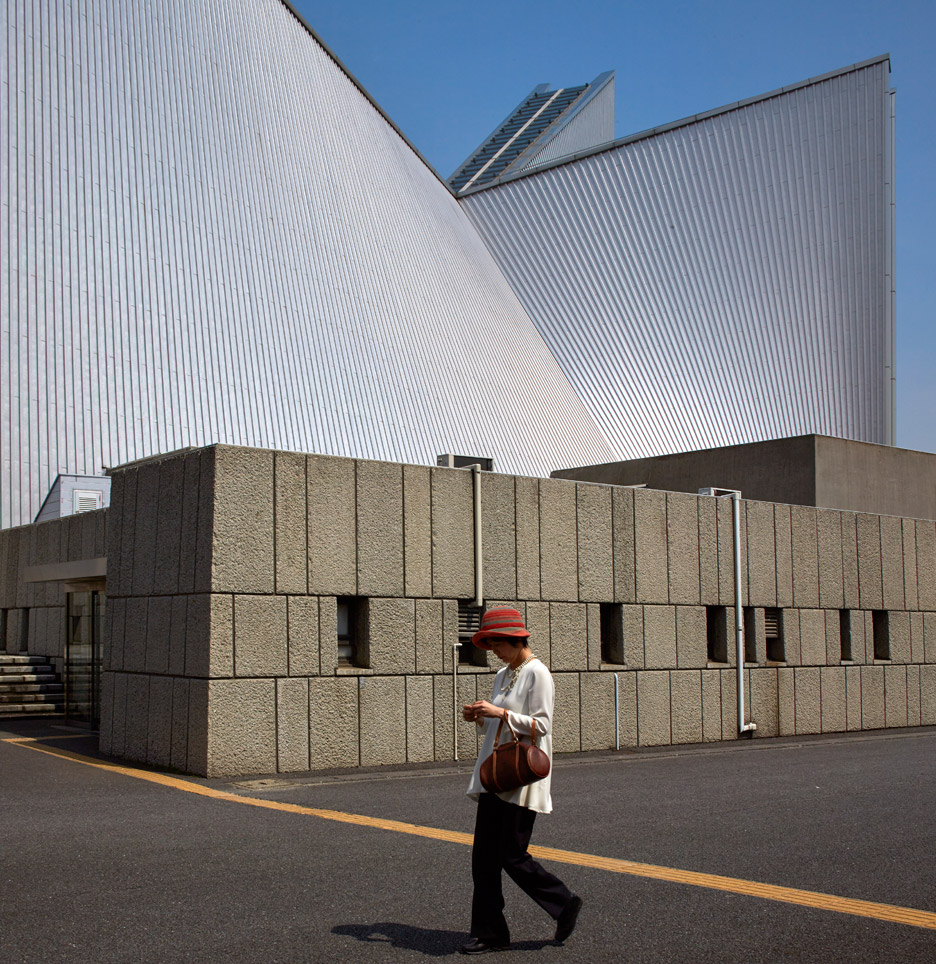
We are not telling this to be clever at a great building's expense. We are telling it because this is what ambition actually costs, and because the profession has a bad habit of quoting the ambition and skipping the invoice. The shells were worth the leaks. We would specify them again. But anybody going into this work should know that a double-curved surface is a maintenance contract with a very long term, that the detail which keeps water out of a shell is harder to draw than the shell, and that the people who live with the answer are the parish, not the architect.
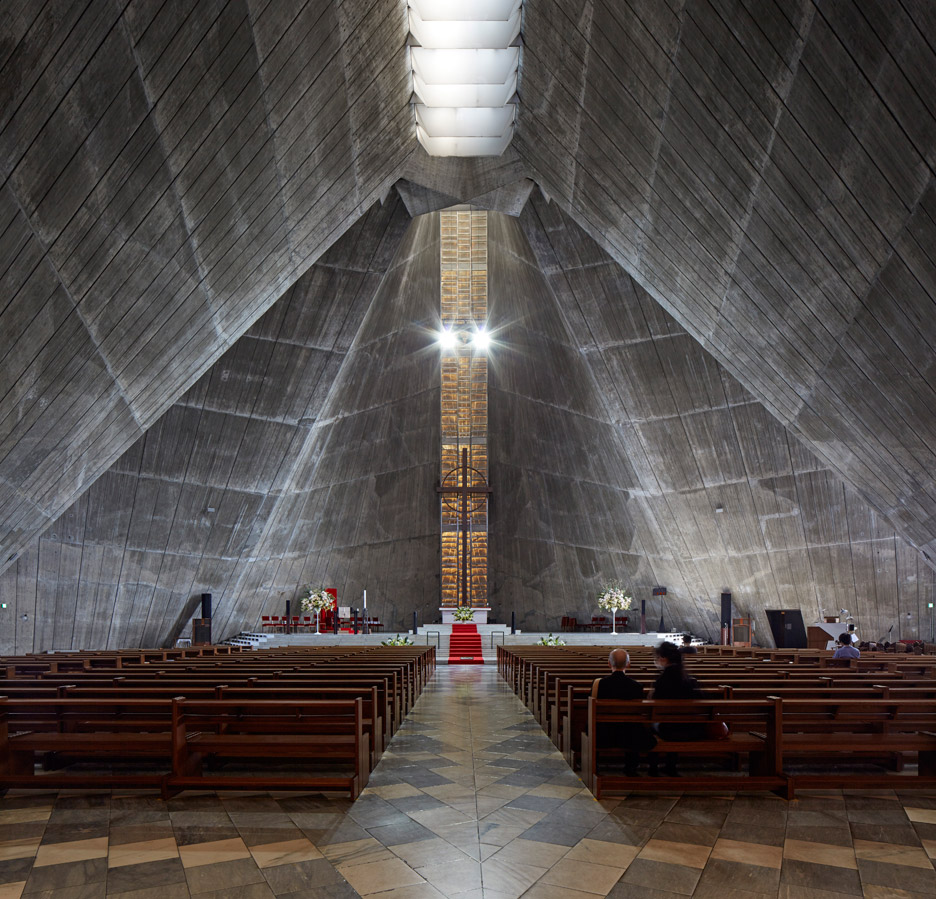
Which brings us to the only measure that finally counts. For sixty years people have walked in off a Tokyo street, out of the noise and the heat, into a dark concrete room with light coming down from four directions at four different angles and no view of anything outside at all, and they have sat down. Some of them were burying a parent. Some of them were getting married. Most of them were not thinking about ruled surfaces or about who did the calculations, and a few of them, on the bad days, were probably watching a damp patch spread quietly across a corner of the vault.
The building held anyway. It is still holding. The bell tower is 61.6 metres of nothing but height, standing a short walk from the shells, doing no structural work whatsoever and ringing on time.
Sources & Credits
- "Edmund Sumner photographs Kenzo Tange's 'brutal classic' St Mary's Cathedral," Eleanor Gibson, Dezeen, 18 July 2016. https://www.dezeen.com/2016/07/18/kenzo-tanges-brutal-classic-st-marys-cathedral-edmund-sumner-photography-tokyo-japan/
- Quoted lines are Edmund Sumner's, given to Dezeen in that article.
- Building record consulted for construction dates, structural description, the structural engineer, cladding material, bell tower height and the 2007 renovation: St Mary's Cathedral, Tokyo. https://en.wikipedia.org/wiki/St.Mary%27sCathedral,_Tokyo
- Photography: Edmund Sumner, via Dezeen, https://www.dezeen.com/2016/07/18/kenzo-tanges-brutal-classic-st-marys-cathedral-edmund-sumner-photography-tokyo-japan/
The reporting and the quoted lines are Dezeen's. The argument about structural authorship, about the raincoat, and about who pays for ambition is CP's.