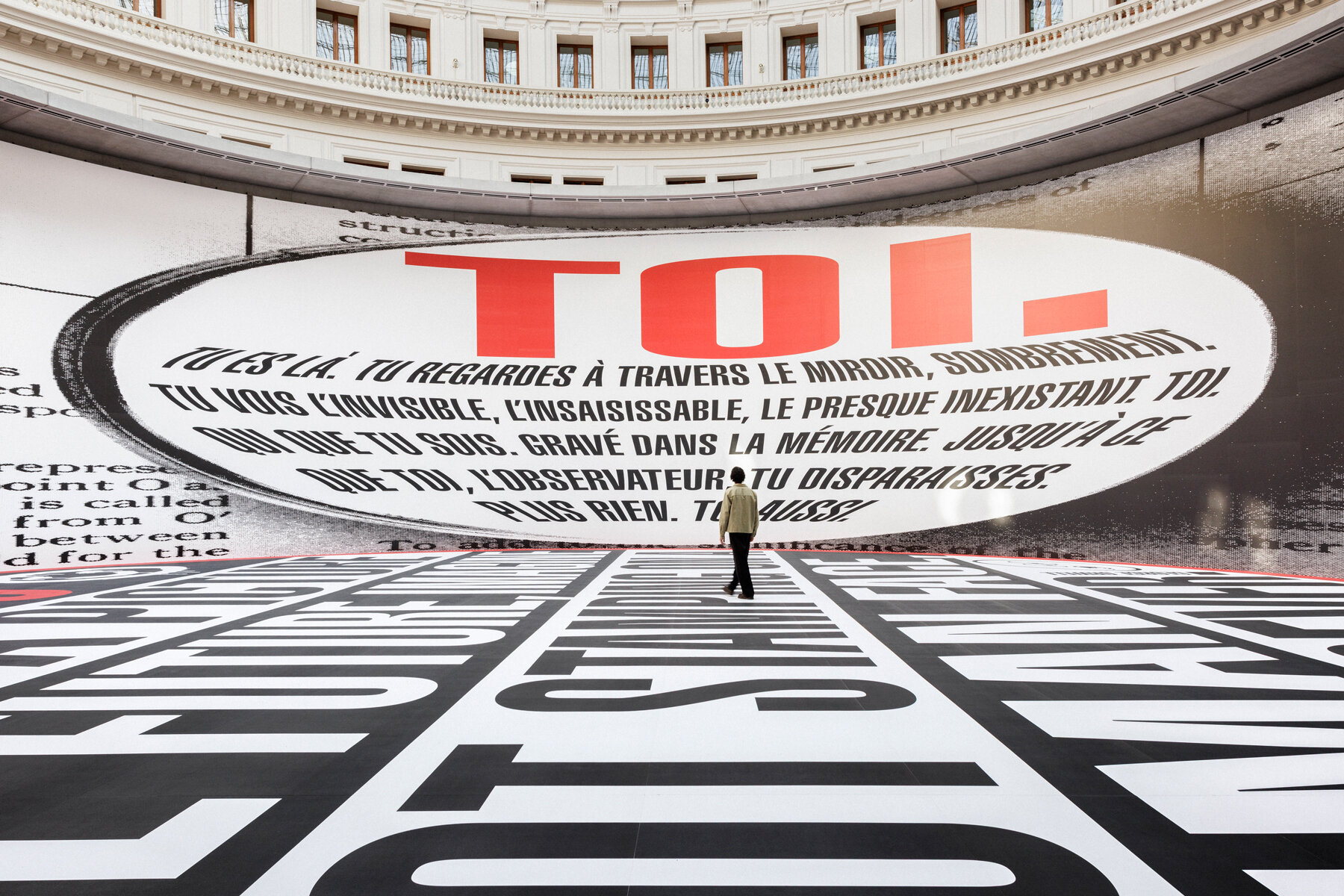
Thirty metres across, nine metres high, and until this week there was nothing written on it. Tadao Ando's cylinder inside the Bourse de Commerce in Paris is a concrete drum set down in the middle of a nineteenth century grain exchange and held clear of the old walls so that it leans on nothing and explains nothing, and for five years it has done the oldest job a wall can do, which is to stand up and let you look at it. Now Barbara Kruger has used it as a page.
Her installation The History of Tears opens Remember Me, the Pinault Collection's survey marking two hundred years of photography, and it runs to 18 January. Two enormous white ellipses sit on the inner face of the drum, one in French and one in English, each headed by a single red word, TOI and YOU. A band of alternating black and white lines runs the full circumference, listing what the work is about: love and desire, shame and hatred, who gets what, who owns what, who is remembered and who is forgotten. The type has been enlarged until the letters come apart into visible halftone dots. At the centre sits a line from Aimé Césaire's Journal of a Homecoming, written in 1947: "a life is not a spectacle, a sea of miseries is not a proscenium." Césaire addressed those words to his own body and soul. They now face people who bought a ticket, which, as designboom points out, is a change Kruger made without touching a word of the original.
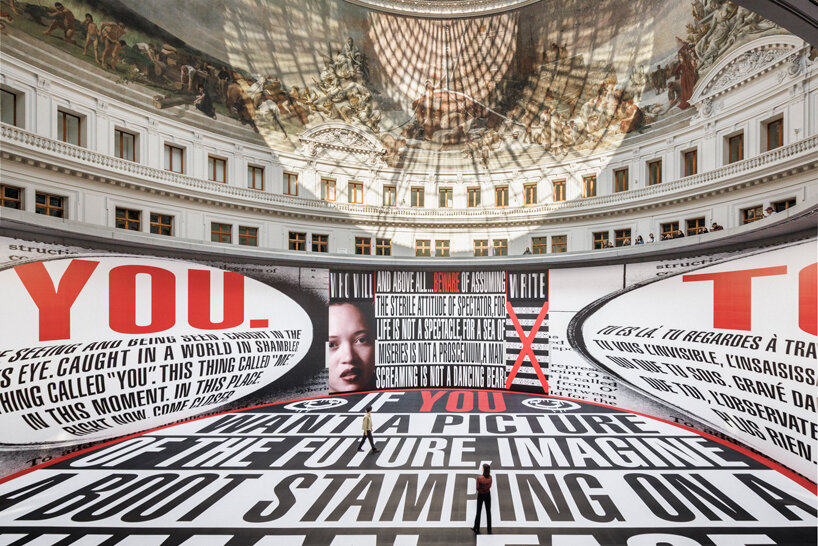
Every write-up of this will say that an artist has transformed a building. The building was never untransformed. Ando's drum has been a page since the day the formwork came off, and the only thing he did differently from Kruger is decline to write on it. We draw walls like that and clients ask what goes on them, and the honest answer is that the wall is already doing something, that anything added to it becomes a second author, and that the second author should be chosen with roughly the care you gave the first. A blank is an absence. That wall is a decision.
Here is the part worth taking. The second quotation, from Orwell, lies on the floor across its full width, and Kruger set the letters at a size nobody standing in the room can read. You have to go up a storey and look down before the sentence resolves itself into "a boot stamping on a human face, forever." That is not graphic design. That is a sectional device, the sort of thing an architect does with a double-height void and a gallery rail, and it means the only way to receive the work is to move through the building the way the building already wanted to be moved through. Most artists handed a famous room treat it as a backdrop. She treated it as an instrument.
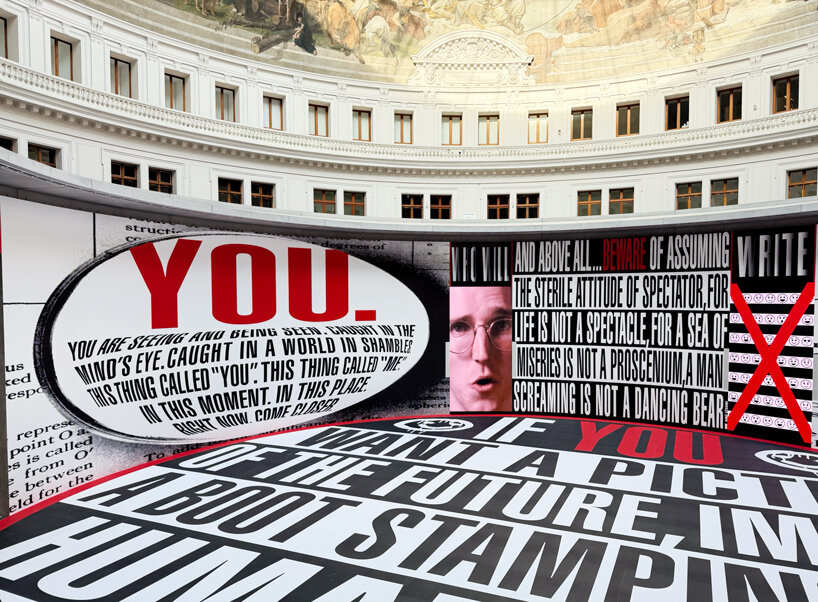
The halftone is the other half of it. Blow type up far enough and the screen shows through: the letter stops being a letter and becomes a field of dots that a machine laid down in rows. Concrete does the same trick at full size. Stand close to a wall Ando has poured and the thing you are reading is not the shape, it is the record, the panel joints and the small round holes where the ties went through and the faint line where one day's work met the next. One trade confesses in dots and the other in holes, and both are saying the same unglamorous sentence, which is that somebody made this, on a particular day, with equipment.
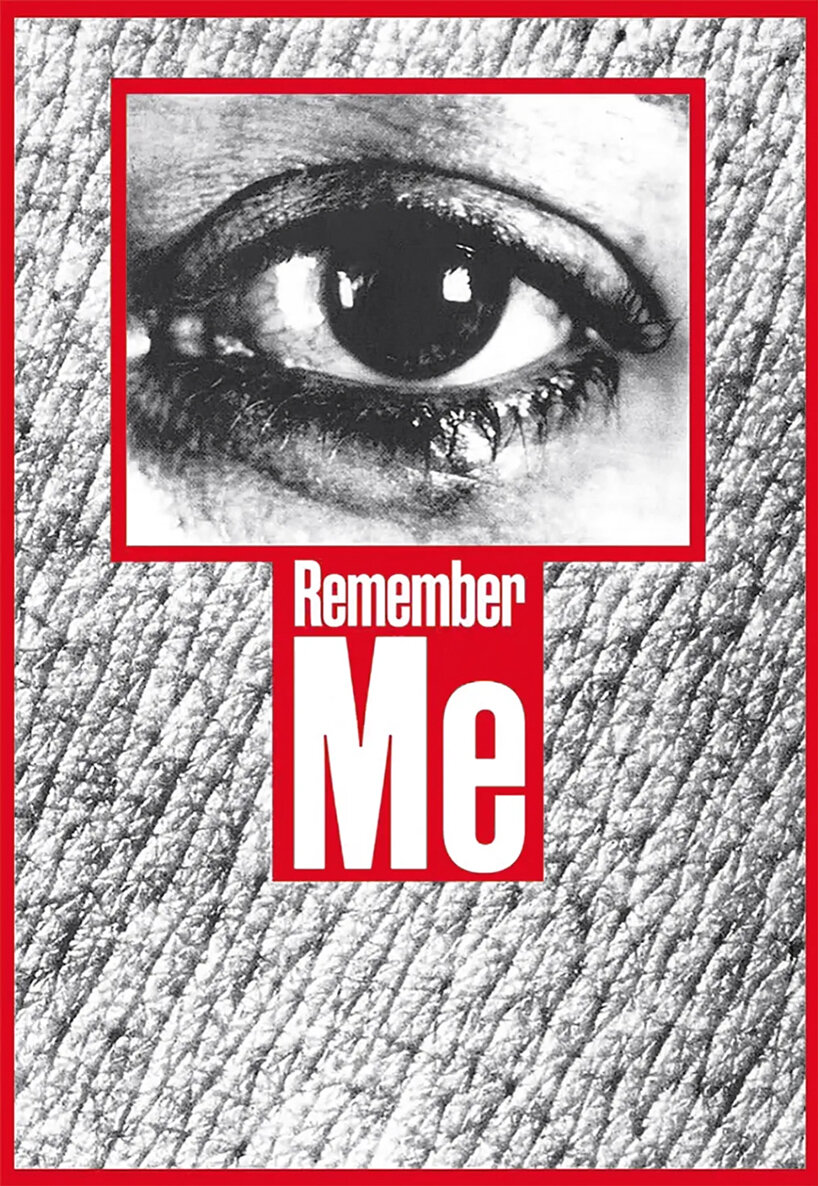
The show borrows its name from Untitled (Remember me), which Kruger made in 1988 and rebuilt in 2020 as an LED panel. In 1988 that kind of sentence worked like a thrown brick, aimed at advertising from a position just outside it. In 2026 the same artist's text is spread across the walls of a collection assembled by one of the wealthiest men in France, and she is using it to ask who owns what and who gets remembered. You can file that as a contradiction. Filing it is cheaper than noticing that she put the question in the one room where asking it costs something.
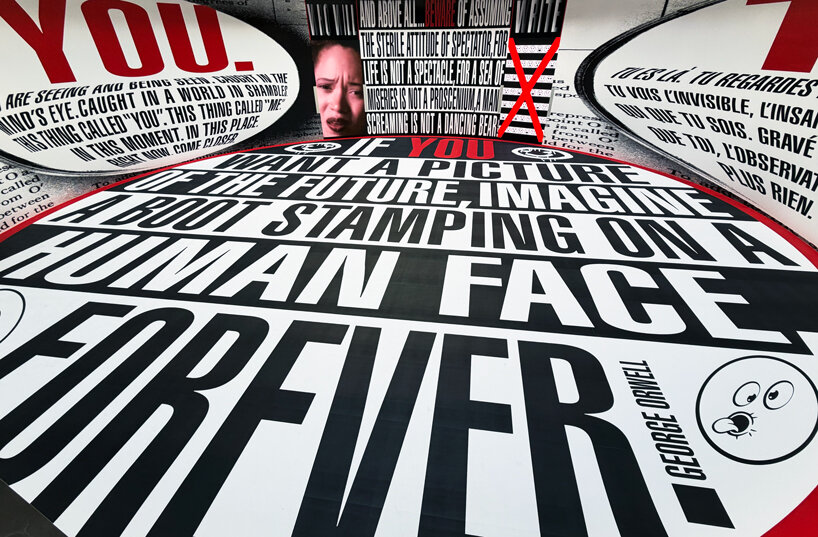
Kruger calls the work "an ongoing deluge of the eyes," which reads better at three metres tall than it does in a paragraph. The thing itself is plainer than its description. You walk into a round grey room and the room is shouting at you, and then you look down and find you are standing on a sentence about a boot and a face, and you shift your feet a little before you can stop yourself. Text alone cannot do that. The floor had to be there, and the height above it had to be there, and somebody poured both.
The exhibition comes down on 18 January, and by February the drum will be grey again, thirty metres across and nine high, waiting for whatever gets written on it next. The building does not care. That is exactly what makes it useful.
Sources & Credits
- Sofia Lekka Angelopoulou, "'for life is not a spectacle' barbara kruger wraps tadao ando's rotunda in monumental texts," designboom, 6 October 2026. <https://www.designboom.com/art/life-spectacle-barbara-kruger-tadao-ando-rotunda-monumental-texts-bourse-de-commerce-paris-remember-me-exhibition/>
- Remember Me, Bourse de Commerce, Paris, 7 October 2026 to 18 January 2027. Curated by Matthieu Humery with Lola Regard. Artwork: The History of Tears by Barbara Kruger.
- Quoted: Aimé Césaire, Journal of a Homecoming (1947), and George Orwell, 1984, both as quoted in Kruger's installation and reported by designboom. Barbara Kruger quoted via designboom.
- Rotunda dimensions (30 m diameter, 9 m height) as stated by Tadao Ando and reported by Dezeen, 24 March 2020. <https://www.dezeen.com/2020/03/24/tadao-ando-bourse-de-commerce-paris-gallery/>
- Photography: images courtesy of the Pinault Collection unless marked © designboom, via designboom, <https://www.designboom.com/art/life-spectacle-barbara-kruger-tadao-ando-rotunda-monumental-texts-bourse-de-commerce-paris-remember-me-exhibition/>
- No Common Projekts imagery appears in this post.