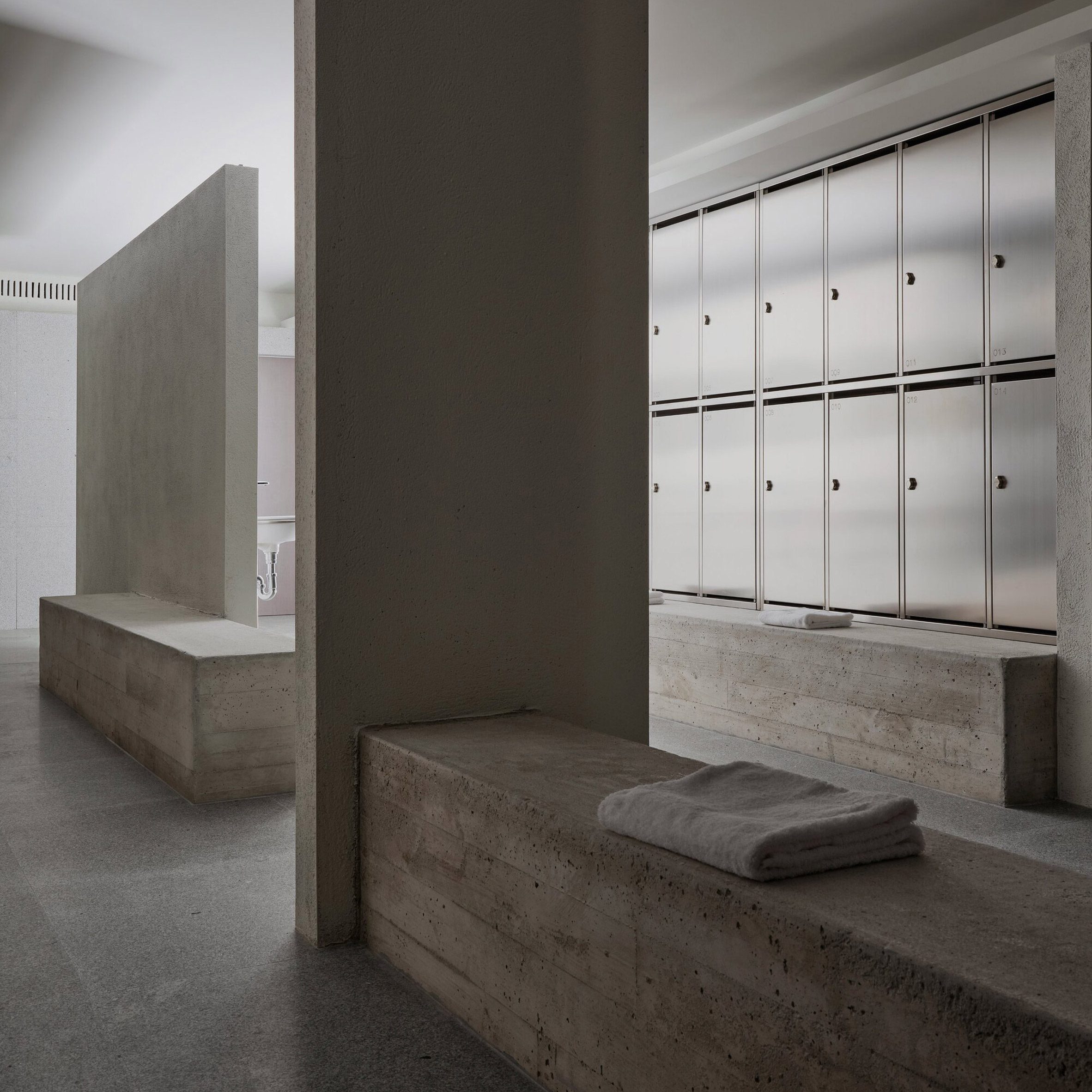
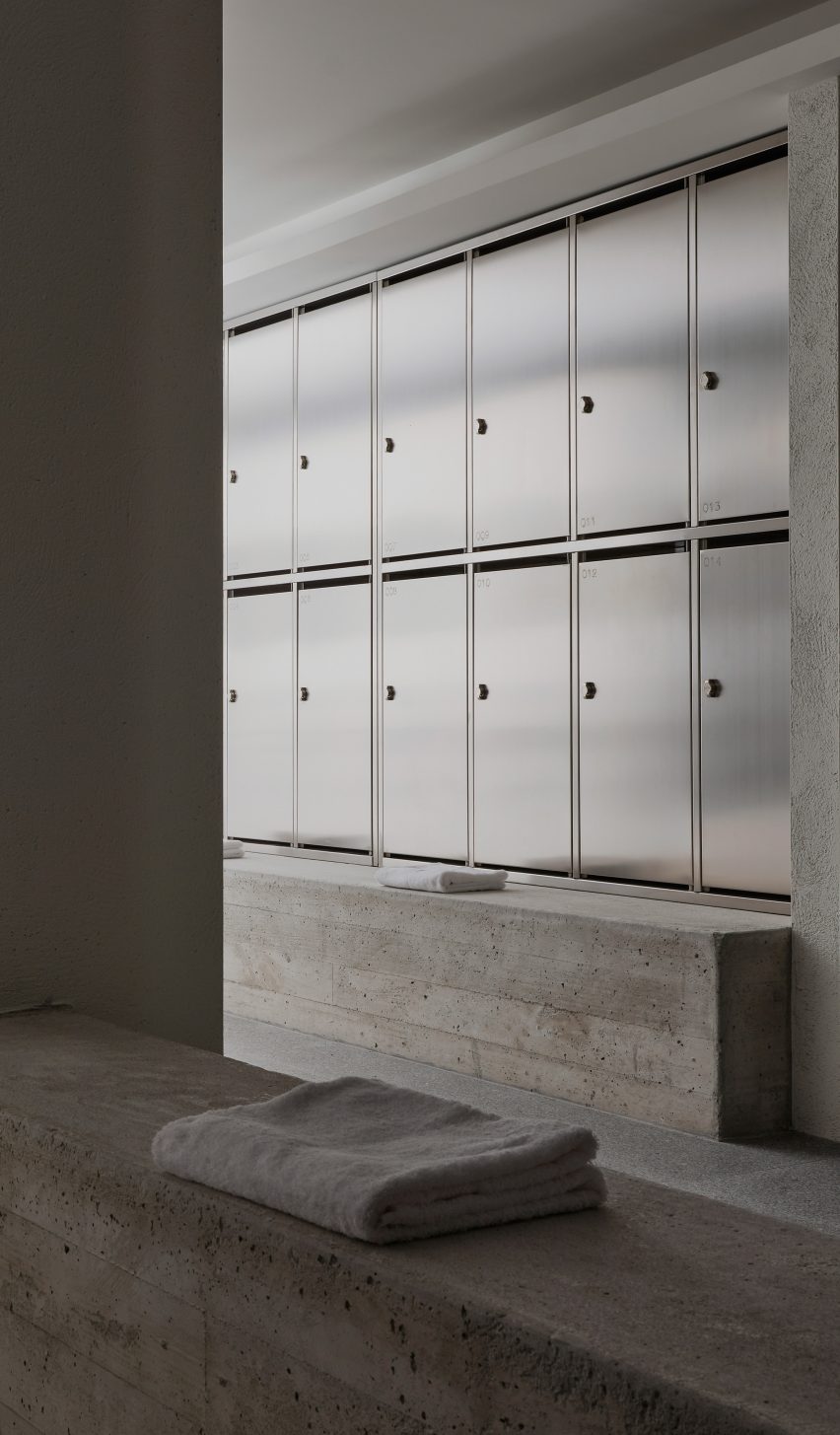
Somewhere in San Sebastian, at the end of a shift, a factory worker opens a locker faced in satin stainless steel, and the number on the door is not printed on a plastic tag or stuck on with adhesive but etched into the metal itself, and the bench where they sit to untie their boots is board-formed concrete that still remembers the grain of the wood it was poured against. Nobody famous will ever pose for a photograph in this room. It may be the most faithful brutalist building of the year.
The project is by Ortega Diago, the Spanish studio founded by Gonzalo Sánchez Ortega and Armando Diago, and Dezeen reported it this morning: one end of a warehouse, long and narrow, with access at a single end, converted into changing rooms for more than 100 employees of a mobility technology company. The brief was the oldest problem in the book, which is how to move a crowd through a tube twice a day without the tube feeling like a tube.
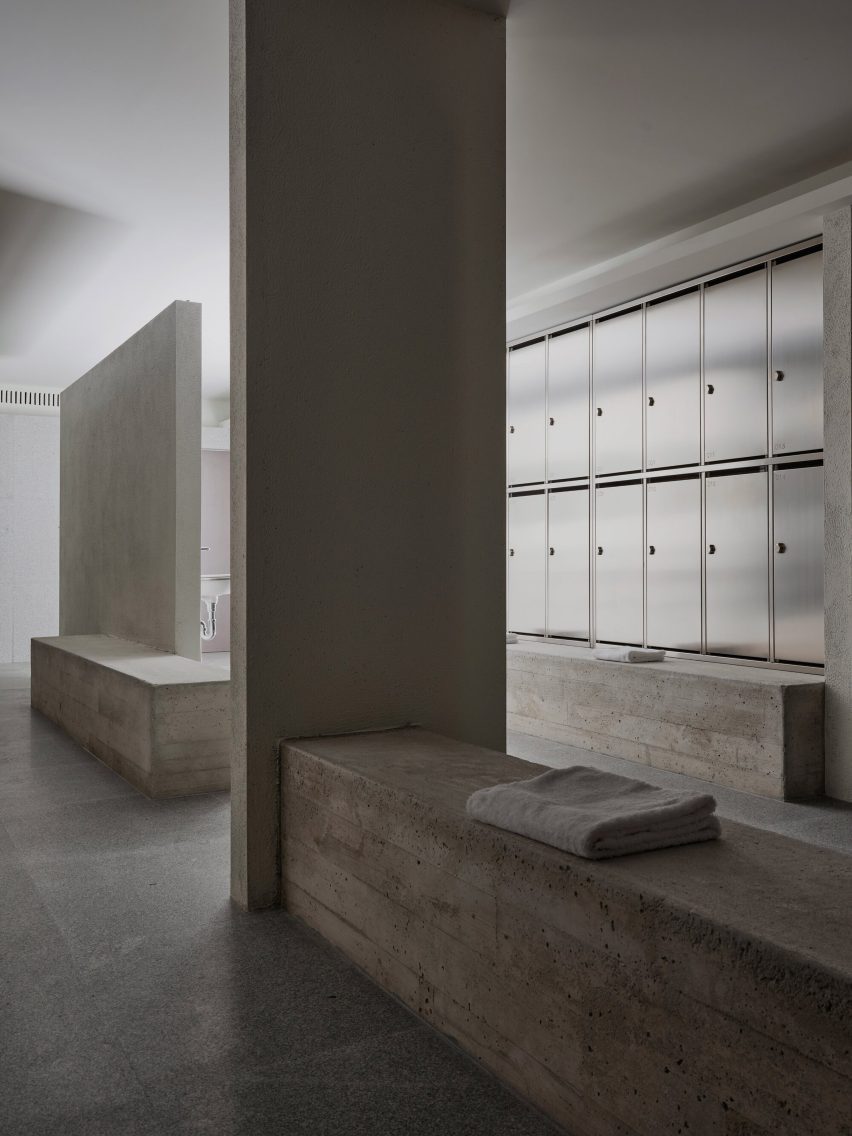
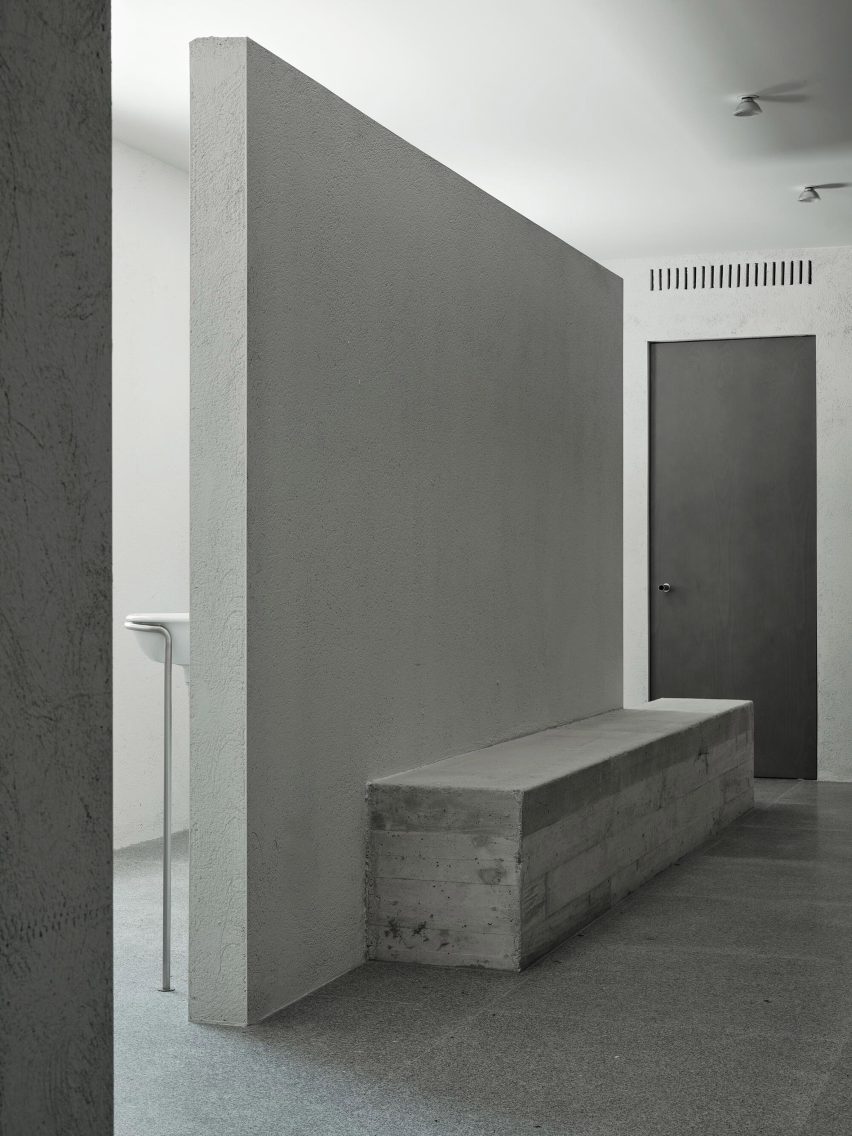
Their answer was a set of freestanding walls of varying heights that break the space without sealing it, so daylight slides over the tops and around the ends while the changing areas stay out of view. "The main objective was to maximise the amount of natural light within the interior," the architects told Dezeen. The partitions, they said, had to "allow light to pass through while simultaneously concealing the changing areas from the circulation spaces." That is the whole parti, and it is a good one: privacy by geometry, light by subtraction, no doors slamming anywhere.
The palette is granite, steel, concrete, and wood, and that is the entire list. Granite runs across the floors and up the partitions and through the doorways, honed in some places and bush-hammered in others, so the same stone does different work depending on what your hand or your boot needs from it. The lockers are satin stainless steel, which catches the daylight and hands it back softly. The plinth under them is board-marked concrete. The doors are stained hardwood. In the washroom, ceramic basins sit on slender chrome legs with their traps exposed, because a pipe that works has nothing to be ashamed of. Per the architects, the materials were chosen to "establish hierarchy and order among the partitions," with tone and texture doing everything that color and decoration were not asked to do.
Here is why this small room matters more than most of what got published this week. Brutalism did not begin as an aesthetic. It began as an ethic, and the ethic was roughly this: ordinary buildings for ordinary life, made of what they are made of, and unembarrassed about it. Schools, housing blocks, bus stations, civic halls. Concrete for everyone. Then the style was declared ugly, and a generation of those buildings came down, and then the style was declared beautiful again, and it came back as coffee-table books and hashtags and lobbies described as brutalist-inspired in buildings where a studio rents for a sum that would have made the Smithsons sit down. Brutalism became a look. The look got sold to people who never punch a clock.
And now here it is in San Sebastian, clocking in. A changing room is a threshold room: you walk in as a commuter and walk out as a worker, and eight hours later the transformation runs in reverse. Most industry treats that threshold as leftover square footage, a fluorescent afterthought with a wet floor. Ortega Diago treated it as architecture. The granite does not know it is in a factory. The etched numbers will outlast every employee who ever gets assigned one. At the far end, a window gives the whole room back to the greenery outside, so the last thing you see before the shift is not a wall.
The modernists this firm keeps faith with believed good material was not a reward for wealth. Paul Rudolph combed his concrete into corduroy for a state government center, not a penthouse. A hundred workers in the mobility sector now change their boots in a room that tells the truth about how it was made, and their work, as it happens, is making things, so the room and the people are in the same trade.
The building does not care who photographs it. It holds the light, and the lockers, and the quiet. That was always the job.
Sources & Credits
- Ortega Diago creates Brutalist changing rooms for San Sebastian factory, Dezeen, by Alyn Griffiths, 20 July 2026. All quotes as reported by Dezeen.
- Photography: David Zarzoso, via Dezeen, https://www.dezeen.com/2026/07/20/ortega-diago-san-sebastian-factory-changing-rooms/