The Kiosk That Became a DJ Booth
In 1966 a Slovenian designer named Saša Mächtig drew a plastic box with rounded corners and called it the K67. It was about four square metres. It came in orange and red and yellow and white. You could bolt several of them together into an L or a run, and you could put one down on a street corner in a day, and inside it a person could sell newspapers or cigarettes or lottery tickets or coffee, or wait for a bus out of the rain, or take your parking money, or run a small business that was not quite legal in a system that had opinions about small businesses. They made thousands of them. They went up all over Yugoslavia and then well past it, and they are still standing in courtyards and lots from Ljubljana to Warsaw, sun-faded, mossy, mostly abandoned, occasionally full of someone selling burek. The Museum of Modern Art in New York owns one. So do a few Serbian teenagers, who bought theirs for the price of hauling it away.
That is the object. Now here is what happened to it.
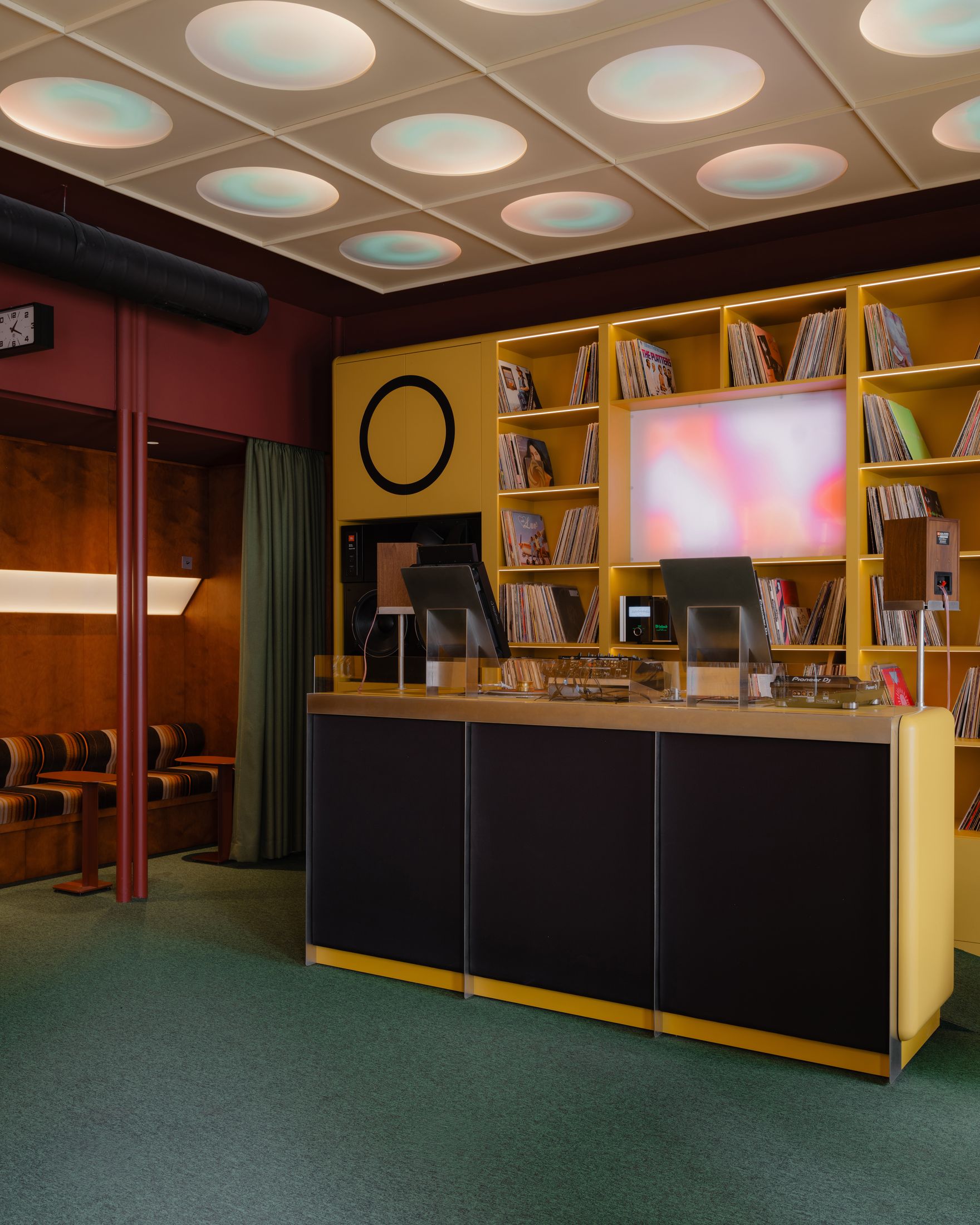
Esthetic Joys Embassy opened this spring in a 1920s building on Dobračina in Dorćol, in Belgrade, inside the boutique Pavilion Hotel. It is a dining room, a discothèque, a listening bar and a hotel to come, roughly 250 square metres of it, designed by Supaform, the studio of Maxim Scherbakov. The collective behind it, Esthetic Joys, formed in Moscow in 2016, left in 2022, and opened its first Embassy in Yerevan the same year. Yellowtrace reports that the team describes each Embassy as built on "cultural ping-pong," a fresh conversation with each new city rather than a copy of the last one.
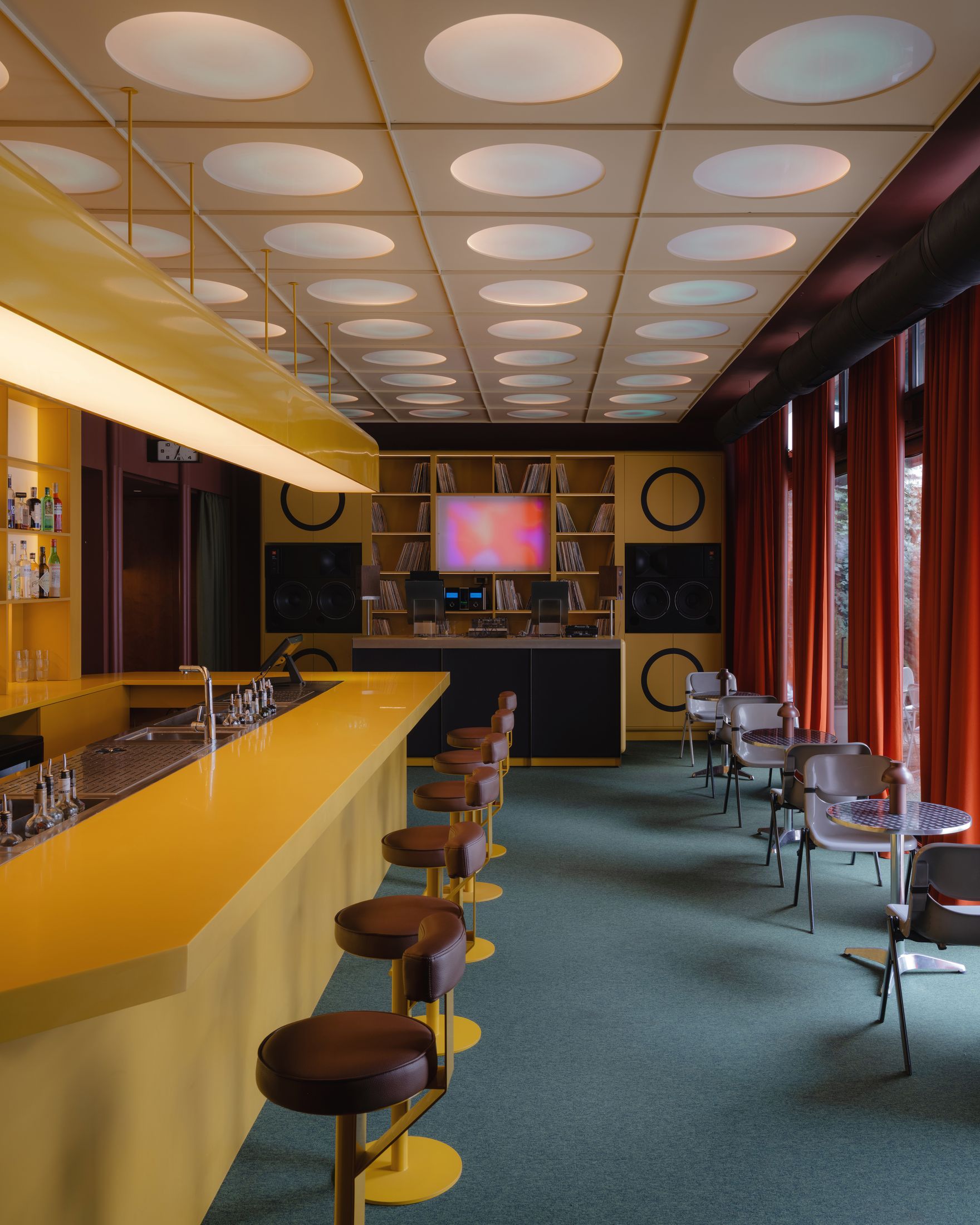
And the conversation Scherbakov is having with Belgrade is with the K67. Yellowtrace calls the spatial concept "a speculative dreamscape that filters Yugoslav modernism of the late 1950s and early 1960s through a postmodern, mildly hallucinatory lens," and names Mächtig's kiosk as the key reference, "whose rounded geometry looks equally at home on a Belgrade street corner or a lunar crater." Oval light panels wash the ceiling. Deep yellow runs through everything. The DJ booth is a direct homage to the kiosk.
So a mass-produced module for newsstands is now the thing the DJ stands in.
The easy reading is that this is a theft, and that a piece of socialist street infrastructure built for everybody has been laundered into a place with a door policy. We are not going to make that argument, partly because it is lazy and partly because it is not true of this room. But the discomfort in it is real and worth sitting with, because the K67 was not a style. It was a supply chain. It was fibreglass-reinforced polyester, moulded, stackable, shippable, cheap enough that a municipality could buy forty. Its rounded corners are the shape a mould wants, not the shape a designer wanted. Everything that made the K67 look the way it looks was a consequence of how it had to be made and how many of it there had to be. That is the part we love, and that is the part a quotation cannot carry, because a DJ booth is made once, by hand, for one room.
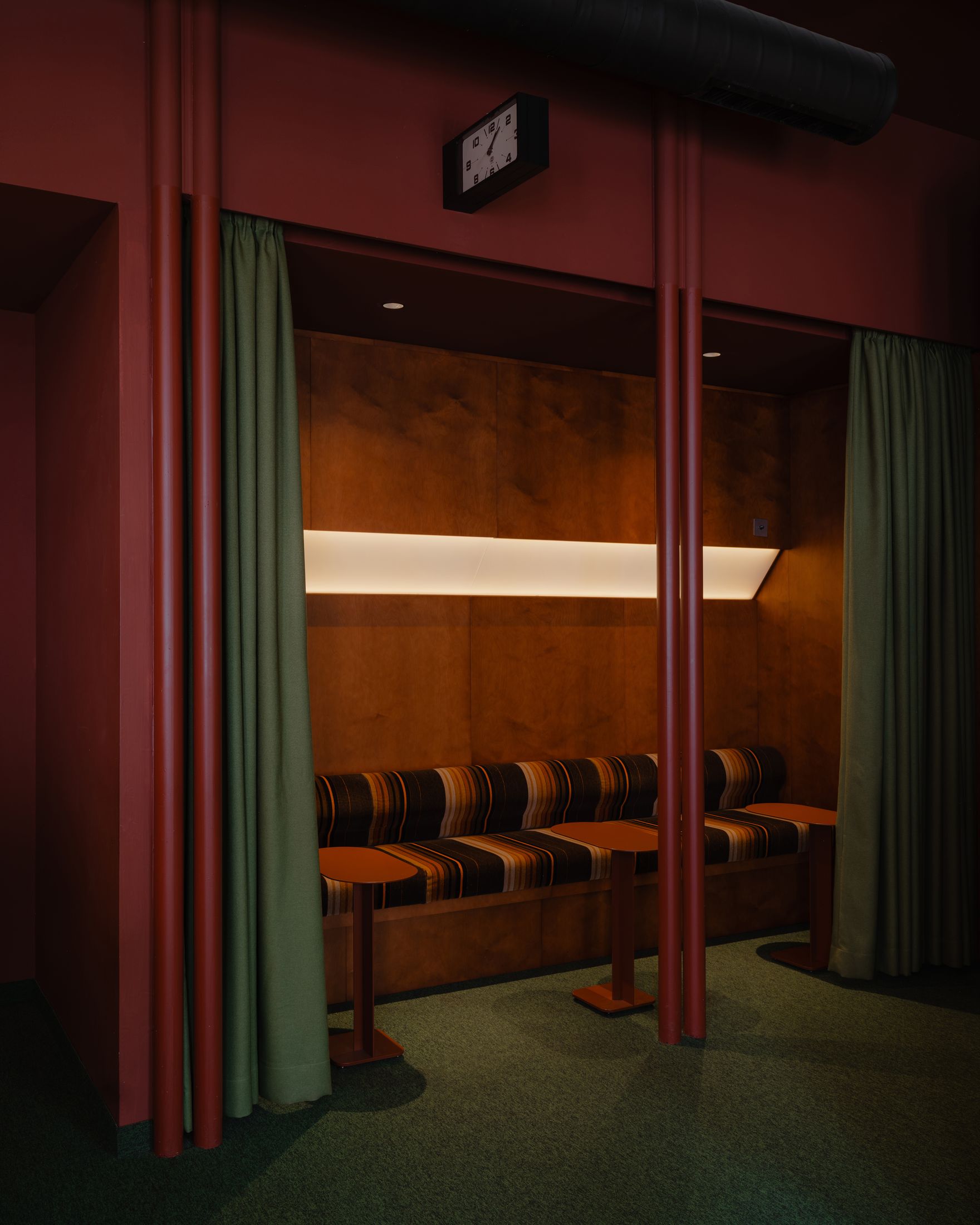
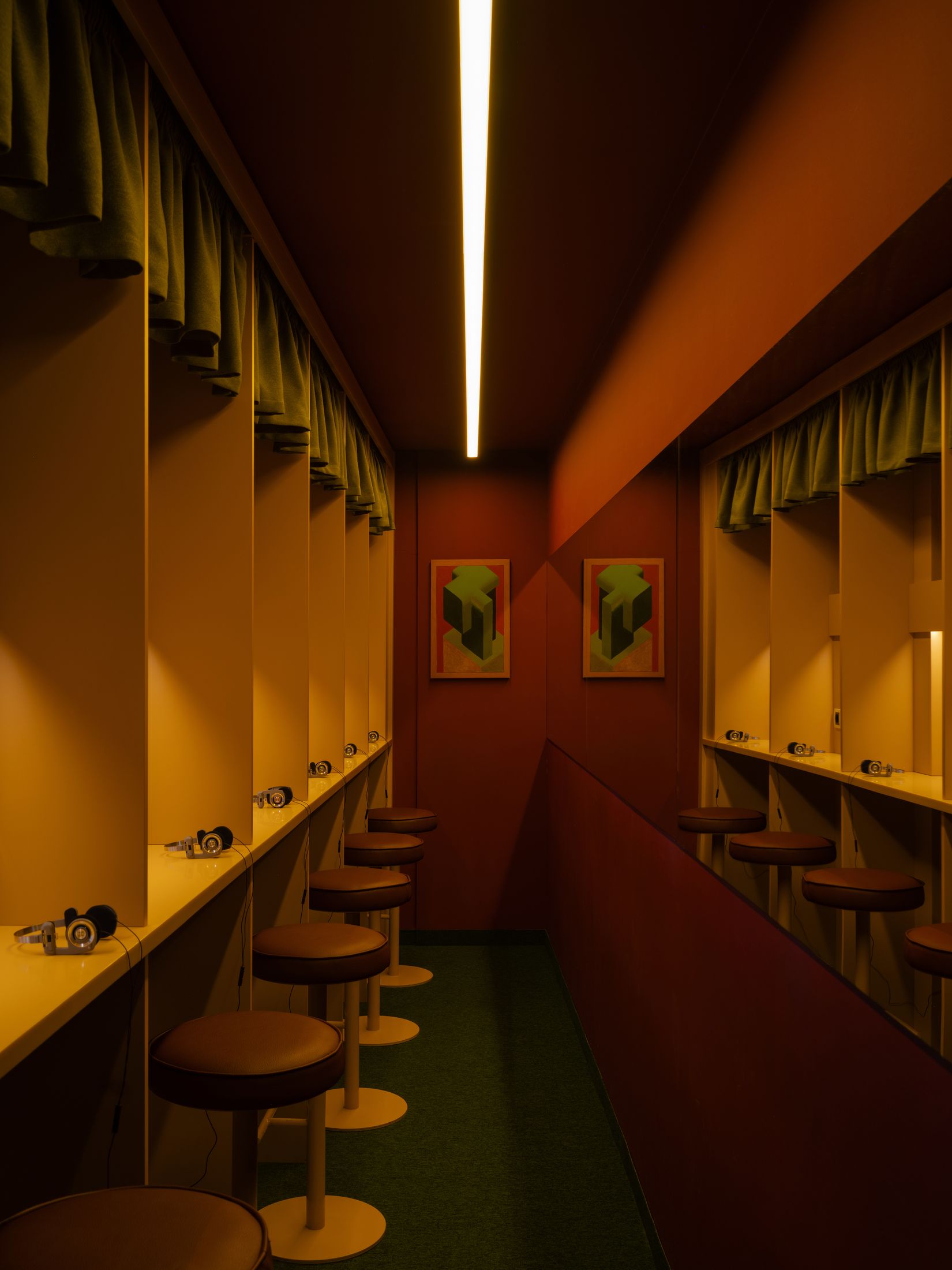
What redeems it, and what we think actually makes this project good rather than clever, is that the room does not stop at the reference. It builds. On the far side of the bar are six booths, ichiran-style, where you draw a curtain and put on headphones and disappear. A pair of vintage JBL 4435 studio monitors and a vinyl library anchor the space in the Japanese listening bar tradition, which is a room organised entirely around the ritual of hearing music on serious equipment with your full attention. The sofas are upholstered in original London Underground moquette, the last run of Misha Black's District line pattern, bought straight from the mill. The kitchen is a yoshoku one, run by the Moscow-based chef Katsuhiko Kobayashi, and the menu puts bisque ramen next to hambagu, which is more or less the Japanese cousin of the Serbian pljeskavica.
Read that list again and notice what it has in common. A kiosk drawn around a mould. Subway upholstery specified to survive ten million people a year. A studio monitor built to tell an engineer the truth in a control room. A hamburger patty that emigrated and got a new name. Every single one of those things was designed for volume, for wear, for a public, for use, and none of them was designed to be beautiful, and every one of them is beautiful, and Scherbakov has put them in one room. That is not nostalgia. Nostalgia would be a K67 in the corner with a plant in it. This is a working argument that things made for everybody, under constraint, without a mood board, end up with more character than things made to have character.
We build in a register that is not far from this. Mass, restraint, materials that show their making, an interior that does not apologize for the structure holding it up. And the failure mode we watch for in our own work is exactly the failure mode this project sidesteps: brutalism as a palette. Board-formed concrete because it photographs well. A raw finish applied over a frame that is neither raw nor honest. The word brutalism came from béton brut, raw concrete, and it meant that the thing you were looking at was the thing doing the work. The moment it becomes a colourway, it is over.
There is still the question of scarcity, and we do not think it has a clean answer. Mächtig's kiosk was democratic because there were thousands. This room is one room, in one city, and you will need to get in. Something is genuinely lost in that conversion, and pretending otherwise would be dishonest. But something is also kept, which is the memory of a way of designing: solve the problem, accept what the material and the process want, make it in numbers, do not decorate it. Belgrade has hundreds of buildings that were made that way and were called ugly for forty years. A bar full of people who came from elsewhere to sit inside a version of that logic is not the worst thing that could happen to it.
The kiosks are still out there, most of them empty. Somebody is going to buy one for the price of the truck.
Sources & Credits
- Yellowtrace, "Yugoslav Modernism Meets Japanese Listening Bars at Esthetic Joys Embassy Belgrade," 25 June 2026. https://www.yellowtrace.com.au/esthetic-joys-embassy-belgrade-supaform-maxim-scherbakov-yugo-futurist-listening-bar/
- Photography: Varvara Toplennikova, via Yellowtrace, https://www.yellowtrace.com.au/esthetic-joys-embassy-belgrade-supaform-maxim-scherbakov-yugo-futurist-listening-bar/
No CP imagery. All photographs belong to their credited sources.