The Weather Mies Kept Out
A glass building is an argument about weather. That is the part nobody says out loud, because it sounds too simple to be architecture, but it is the whole proposition. You put up steel, and you hang glass on it, and you run enough mechanical equipment through the floor to hold sixty-eight degrees against whatever Berlin is doing outside, and then you stand in the middle of the room and look at a snowstorm you cannot feel. The wall is not there to keep the weather out. The wall is there to keep the weather visible and irrelevant at the same time, which is a much stranger thing to want, and which most of the twentieth century wanted very badly.
Ludwig Mies van der Rohe finished the Neue Nationalgalerie in 1968. A steel roof that appears to be resting on nothing, eight columns, a glass room underneath, and around it a sculpture garden. It is the most confident building on the argument's side. It does not hedge. And now the artist Fujiko Nakaya has filled its 90-metre sculpture garden with fog.
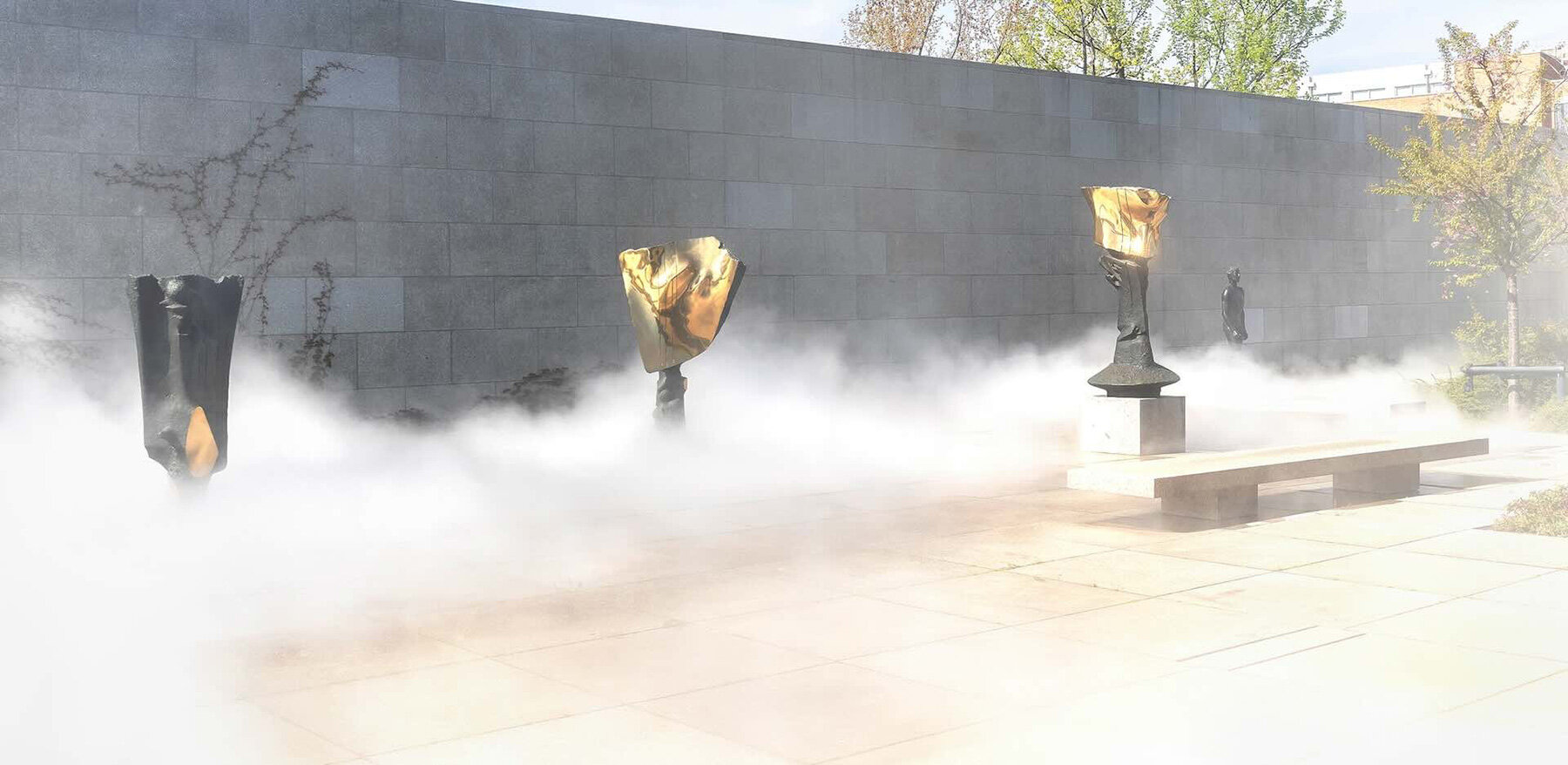
Nakaya was born in Sapporo in 1933. Her father was a physicist who made the first artificial snow crystals, which is either a coincidence or the least coincidental biographical fact in modern art. She built her first fog sculpture for Expo '70 in Osaka, using nothing but water pushed through nozzles at pressure, no chemicals, no smoke, and she has spent fifty-six years since then treating weather as something you can carve. At the Neue Nationalgalerie the fog runs on the hour and the half hour between 11am and 5pm, eight minutes each time, through October 25th. It moves between the trees and the permanent sculptures by Henri Laurens, Wolfgang Mattheuer and Alicja Kwade, and then it dissolves into the sky from the middle of the garden. According to designboom, her installations "never settle into a fixed composition," because "wind, humidity, temperature, and the movement of visitors continually alter their shape."
So here is a building that was drawn to a sixteenth of an inch, sitting inside a sculpture that cannot be drawn at all.
You could make this into a story about a smart artist embarrassing a dead architect. A lot of people will. The setup is right there: the tyrant of the grid, the cold German rationalist, and along comes a Japanese woman with a garden hose to prove that nature wins. It is a satisfying story and we do not believe a word of it. Mies was not afraid of weather. Mies was a bricklayer's son who understood damp and frost and the way a joint fails, and the reason the Neue Nationalgalerie looks effortless is that a great deal of unglamorous thinking went into the parts you cannot see. What he was after was not the abolition of weather. It was a room so unencumbered that anything put inside it would read clearly. He called it universal space and he meant it literally: a room that would take whatever you gave it.
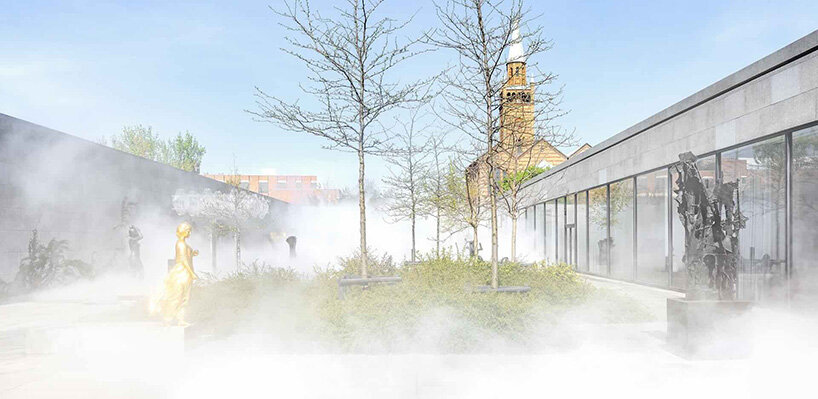
Nakaya gave it fog. The room took it.
That is the thing that interests us, and it is not a small thing. Every architect we care about built a frame and then invited something uncontrollable into it. Tadao Ando pours a concrete box and cuts one slot and the sun does the rest, and the sun is different in April than it is in November, and Ando does not get a vote. Marcel Breuer stacked mass and then let shadow do the modelling. Paul Rudolph combed his concrete into ridges so that light would have something to catch and lose. None of them controlled the second half. They built the first half well enough that the second half could show up.
Which is why the fog is not a rebuttal. It is a demonstration that the building was correct.
There is a version of minimalism, and we see it constantly, where the restraint is the entire product. Nothing on the walls, nothing on the counters, nothing in the room but the room, and a photograph taken at ten in the morning in a month the photographer chose. Those spaces do not survive weather, or a family, or a Tuesday. They are not frames. They are pictures, and a picture cannot hold anything, because it is already finished. The Neue Nationalgalerie is not finished. It is an unfinished sentence with an enormous steel roof over it, and for fifty-eight years people have been walking in and completing it differently, and this summer the thing completing it is a cloud.
We think about this on every project, usually while arguing about a window. The temptation with a strong plan is to specify the experience: this is where you will stand, this is what you will feel, here is the light at 4pm in October. That is not architecture, that is set design, and it fails the first time somebody wants to read in the wrong chair. The better move is harder and less photogenic. You build the frame honestly, and you make the openings correct, and then you get out of the way and let the weather and the people finish the job however they finish it. The building does not care. That is not a criticism of the building. That is the point of the building.
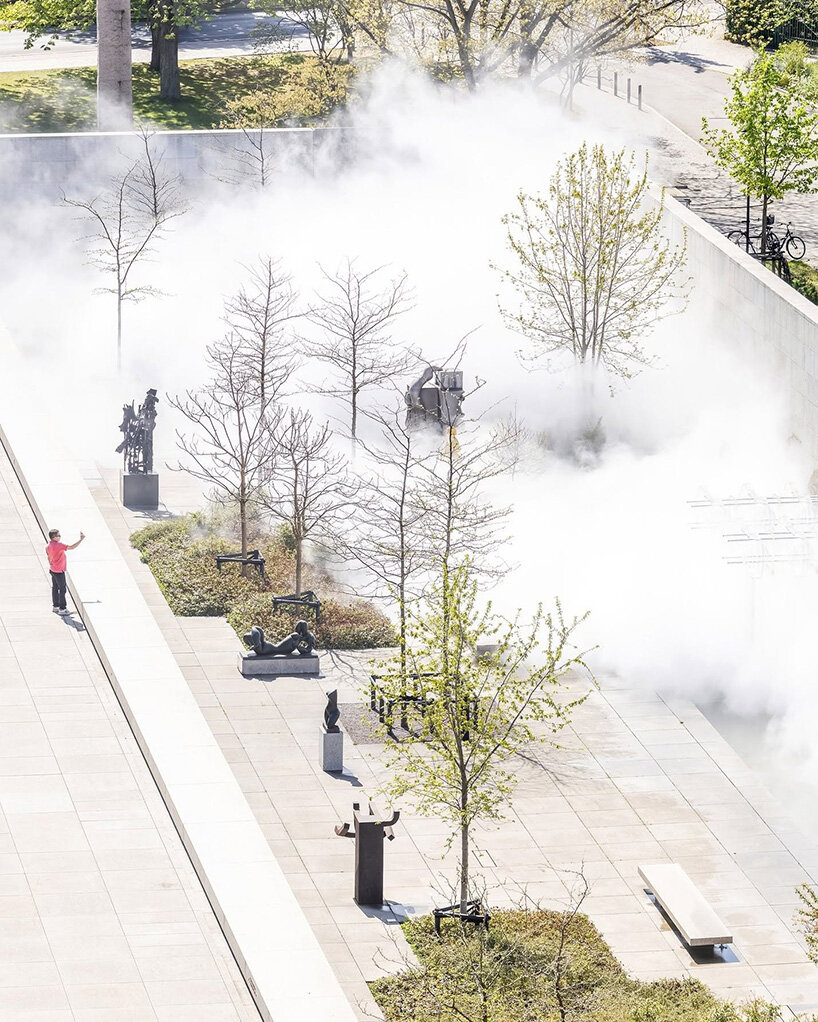
Eight minutes is a good length for this. Long enough that you stop taking pictures and start standing there, short enough that you cannot get used to it. Then the mist thins and the columns come back and the sculptures come back and the roof is exactly where it was, holding up nothing much, over a garden that is briefly clear again.
Nakaya is ninety-two. Mies has been dead since 1969. The building goes on doing what it was asked to do, which is to stand up and be clear, and this summer it also does something nobody asked it to do, which is to disappear on the hour and the half hour and come back again. Both of those were always in the design. Only one of them was drawn.
Sources & Credits
- designboom, "fujiko nakaya turns mies van der rohe's berlin sculpture garden into a landscape of fog," 6 July 2026. https://www.designboom.com/art/fujiko-nakaya-mies-van-der-rohe-berlin-sculpture-garden-landscape-fog-neue-nationalgalerie/
- Staatliche Museen zu Berlin, exhibition listing, "Fujiko Nakaya: Fog Sculpture in the Sculpture Garden of the Neue Nationalgalerie." https://www.smb.museum/en/exhibitions/detail/fujiko-nakaya-fog-sculpture-in-the-sculpture-garden-of-the-neue-nationalgalerie/
- Photography: via designboom, https://www.designboom.com/art/fujiko-nakaya-mies-van-der-rohe-berlin-sculpture-garden-landscape-fog-neue-nationalgalerie/
No CP imagery. All photographs belong to their credited sources.