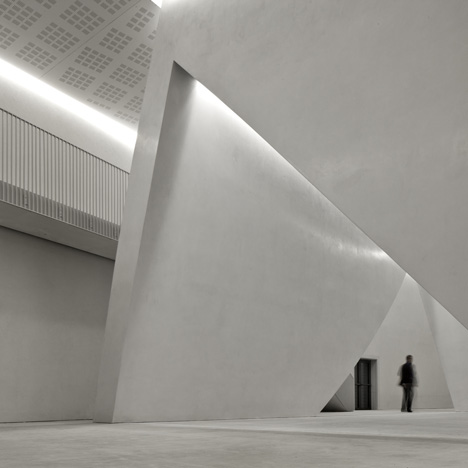
Behind the Palazzo Grassi in Venice there was a garden, and then there was a theatre where the garden had been, and then, from 1983, there was nothing. The theatre closed and stayed closed. Thirty years is a long time for a room to sit in the dark in a city that has never had enough rooms, and it is the kind of fact that gets one line in a press release and then gets forgotten, so we are going to start with it and stay with it a while.
In 2013 Tadao Ando finished the third phase of his work for François Pinault at the Palazzo Grassi, and the third phase was this: a 220-seat auditorium, the Teatrino, built on the site of the dead theatre. Dezeen's report at the time put the method in one sentence. "Only the facade of the original building remains, with the new structure erected behind" (Dezeen, 2013). That sentence is the whole argument, and most people read past it.
Keeping a facade and replacing everything behind it has a name in our trade, and the name is not a compliment. Facadism is what developers do when the planning office will not let them demolish and the pro forma will not let them restore, so they prop up a skin of old brick on steel and pour a new building behind it and call the result heritage. We have seen it done in London and Melbourne and, closer to home than we like, in Manhattan. The old wall becomes a mask. The building behind is a stranger wearing it.
So the question is whether Ando did the same thing in Venice with better concrete, and the honest answer is: mostly no, and the reason is worth having.
A facade in Venice is not a decorative front. It is a promise made to a canal or a campo, and the promise is about the line of the street, the height of the eave, the rhythm of the openings, the light that reaches the pavement opposite. That promise has a lifespan measured in centuries, because the city around it is measured in centuries. The room behind the facade makes a different promise, to the people inside, about how well they can hear and see and get out in a hurry, and that promise has a lifespan measured in decades, because the technology of hearing and seeing and getting out keeps changing. A theatre's room is obsolete every forty years. Its wall is obsolete never. When the two promises come apart, which they always do, you keep the wall. The sin, when there is one, is pretending the wall was the building.
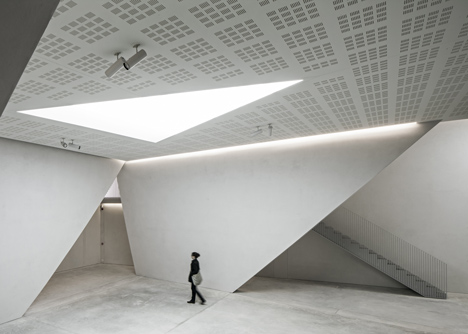
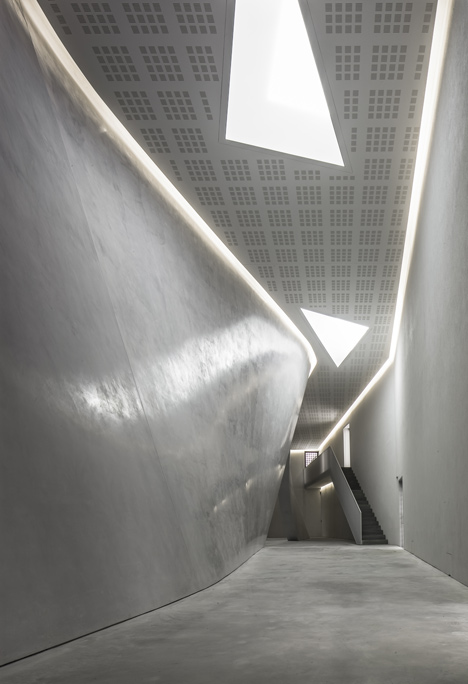
Ando does not pretend. Step through the retained front and the new work announces itself in the one gesture Venice almost never makes, which is a curve. Venetian walls are straight because Venetian walls sit on property lines that were argued over for six hundred years and on timber piles that do not like surprises, and a room in Venice takes the shape of its lot the way water takes the shape of a glass. The Teatrino's lobby wall curves anyway. It is a long sweep of smooth grey concrete, with the light raked along it so that the surface reads as something between plaster and skin, and it tells you before you have read a single sign that this room owes nothing to the plan it sits inside. The old facade holds the street. The new curve holds the audience. Nobody is asked to believe they are the same thing.
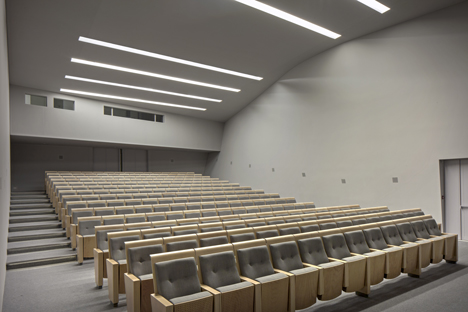
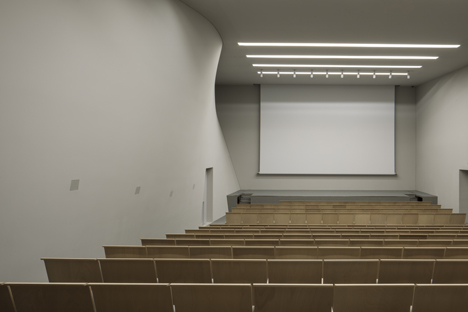
Above the curve, a suspended ceiling of perforated panels, and cut into the ceiling, triangular skylights, and along the seam where ceiling meets wall, a line of concealed light, so that the concrete appears to be lit from a slot rather than from a fixture. The lobby is, if we are being plain about it, the most theatrical space in the building. That is the joke, and Ando delivers it flat. The auditorium itself is a long plain box with rows of pale timber seats and bars of fluorescent light in the ceiling, and it is very good at being an auditorium, and it is not trying to be photographed. The drama is in the foyer. The work is in the hall.
We keep coming back to insertion as a discipline because it is the hardest one we practice, and because most of our own work in Brooklyn is exactly this: an old shell, a new room, and a client who wants both to be true at once. The rules we hold ourselves to are the rules the Teatrino follows. The new work should be legible as new. It should touch the old fabric as little as it can and should be removable in principle even if nobody will ever remove it. And it should not apologise for being a different age from its wrapper. A curved concrete room behind a Venetian facade is honest in a way that a fake-old room behind the same facade would not be.
Now back to 1983, because we said we would stay with it.
For thirty years this was a room nobody could use, in a city where the ordinary residents are leaving because there is nowhere for them to live, and the fix, when it came, was paid for by one of the richest men in Europe so that his art foundation would have somewhere to hold conferences. We do not say this to be sour about it. The room is good and the city is better for having it and Ando did his job well. We say it because the building does not know any of this. It does not know who paid or who waited or who left. It knows that it was dark and now it is lit, and that a wall which stood through the whole thirty years is still standing, with a new room breathing behind it. And still it stands.
That, in the end, is the case for keeping the wall. Not sentiment, and not the planning office. The wall kept the promise to the street through three decades when nobody was keeping any promise to the room. It earned its place. Ando gave it a room worth guarding.
Sources & Credits
- Amy Frearson, "The Teatrino of Palazzo Grassi by Tadao Ando," Dezeen, 14 October 2013. https://www.dezeen.com/2013/10/14/the-teatrino-of-palazzo-grassi-by-tadao-ando/
- Photography: via Dezeen, https://www.dezeen.com/2013/10/14/the-teatrino-of-palazzo-grassi-by-tadao-ando/ (photographer not credited in the stored record; confirm before publishing)
- Note on images: the stored Dezeen archive files are 468 px wide. They are the only verified images on file for this story. Larger versions would improve the header.