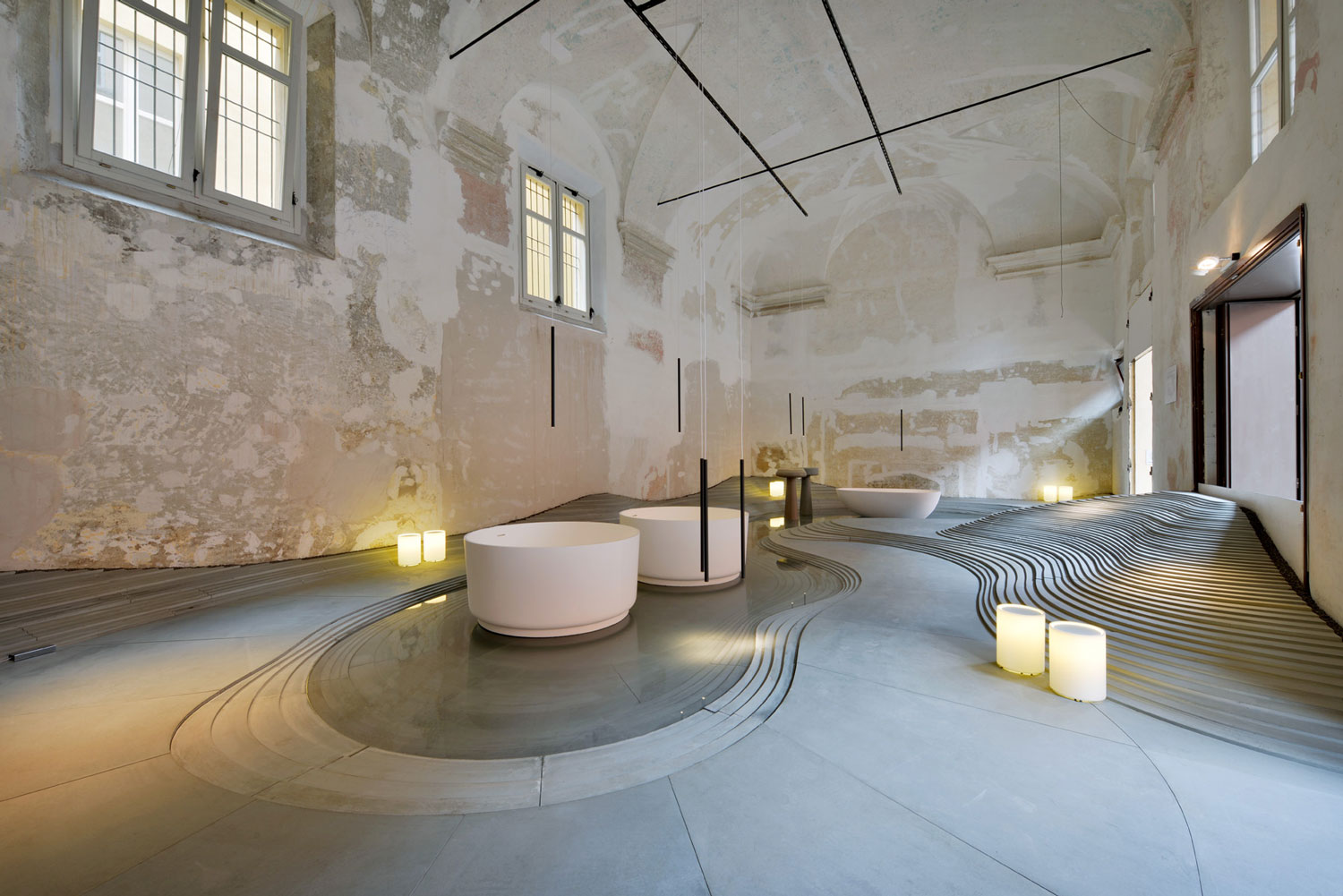
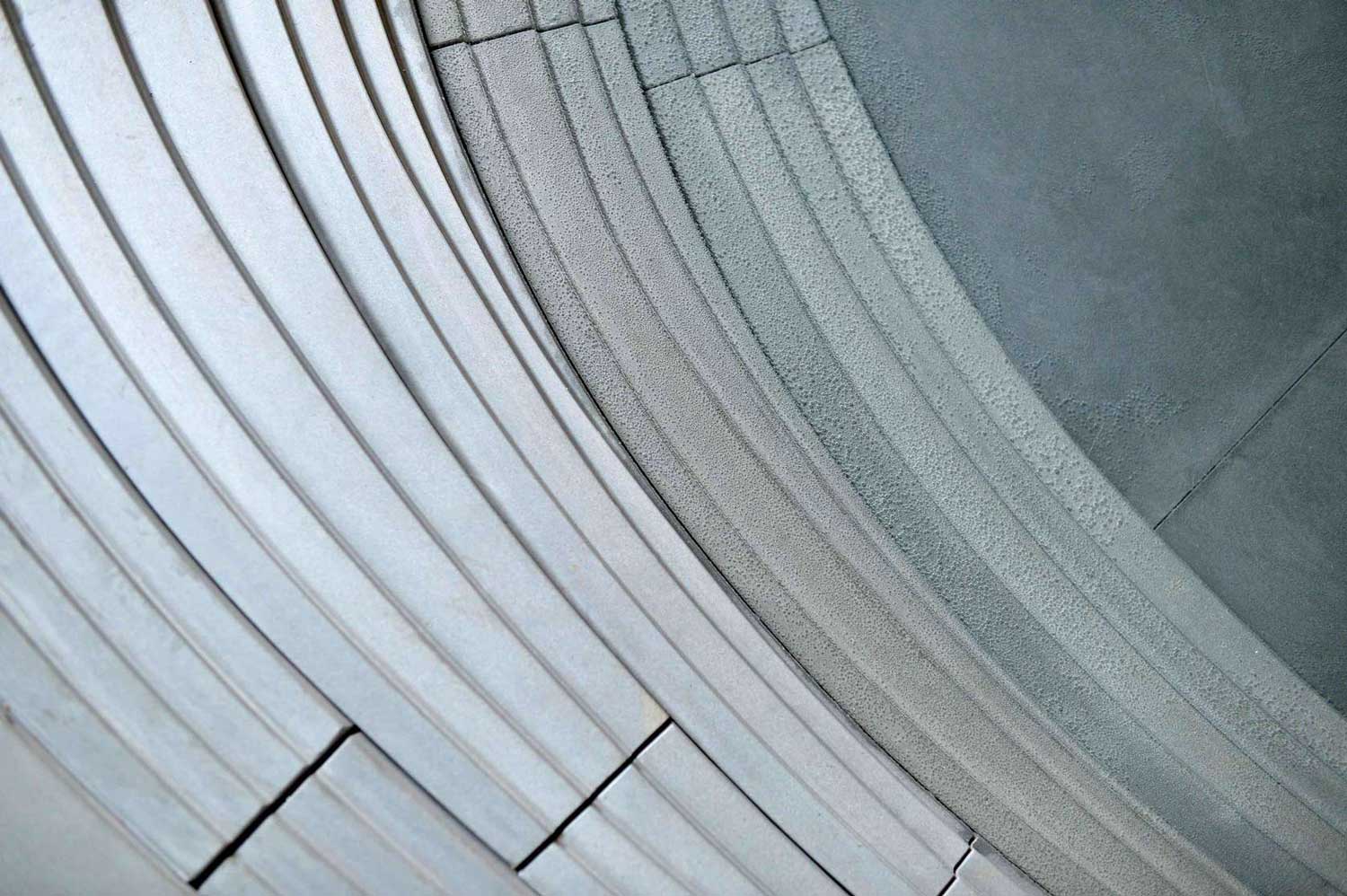
A trade fair is a place where several thousand people who make things stand next to the things for a week and hope. It is, if you have never worked one, a very long day in a very bright room, and the rooms are built on Monday and gone by Sunday, and what gets built in them is mostly carpet and lightboxes and a counter with a bowl of mints. Into one of these rooms, in Bologna in 2013, Kengo Kuma brought several tons of Pietra Serena, which is the grey sandstone Brunelleschi used for the ribs of Florence, and he cut it into terraces, and he ran water down the terraces, and he set the client's objects among the stones the way you would set a teacup on a rock by a stream. Then he did it again in Milan, in a new office block, with plants and bamboo and gravel. The installations were called Stonescape and Naturescape. They were booths.
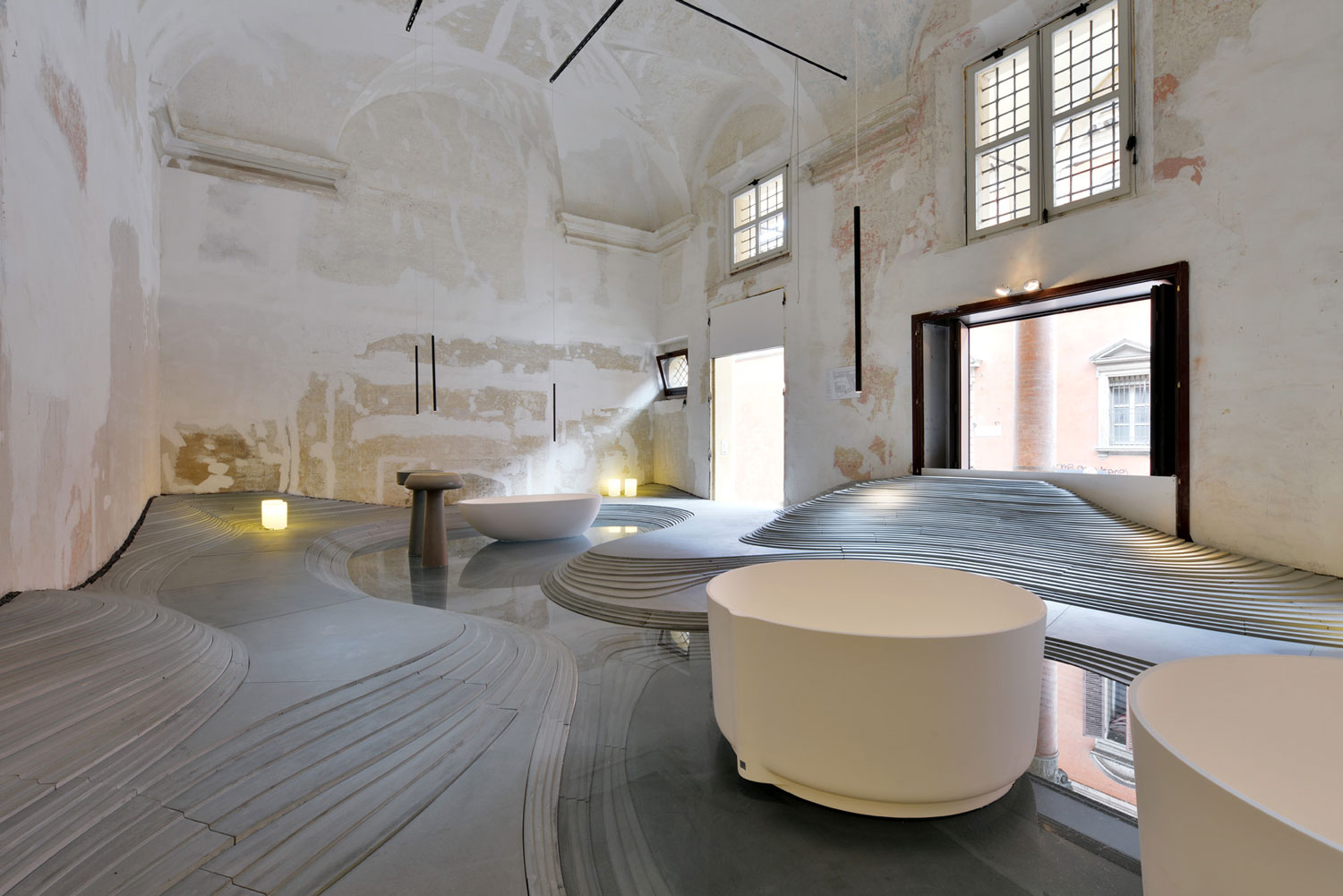
Yellowtrace, which covered them in 2015, quotes the architects on what the stone was for: "The clean and pure Pietra Serena stone is used so as to recreate a topography that, as in real landscapes, moulds the shape of water, guides our walking and gives a context to the objects to better admire them." Read that last clause slowly. The garden exists so that you admire the objects better. The objects, going by the tags on the Yellowtrace piece, came from Agape and Davide Groppi, which is to say bathtubs and lights. Somebody built a mountain to sell a bath.
We want to be fair to the mountain, because the mountain did nothing wrong.
Here is what a Japanese garden actually is, underneath the incense the design press waves over it. It is a set of instructions for walking. The stones tell your feet where to go and how fast, and the water tells your eyes where to rest, and the whole arrangement is a machine for slowing a person down without asking their permission. Kuma knows this in his bones, and the quote says it plainly: the topography "guides our walking." That is not poetry. That is circulation. It is the same problem a fair booth has, which is that people walk past, and the same problem a bathroom showroom has, which is that nobody wants to stand and stare at a tub with a stranger. A garden solves both. It gives you somewhere to put your feet and something to do with your face.
So the booth was not a garden pretending to be a booth. It was a booth that admitted what a booth is, and then used the oldest crowd-control technology in the world to do the job.
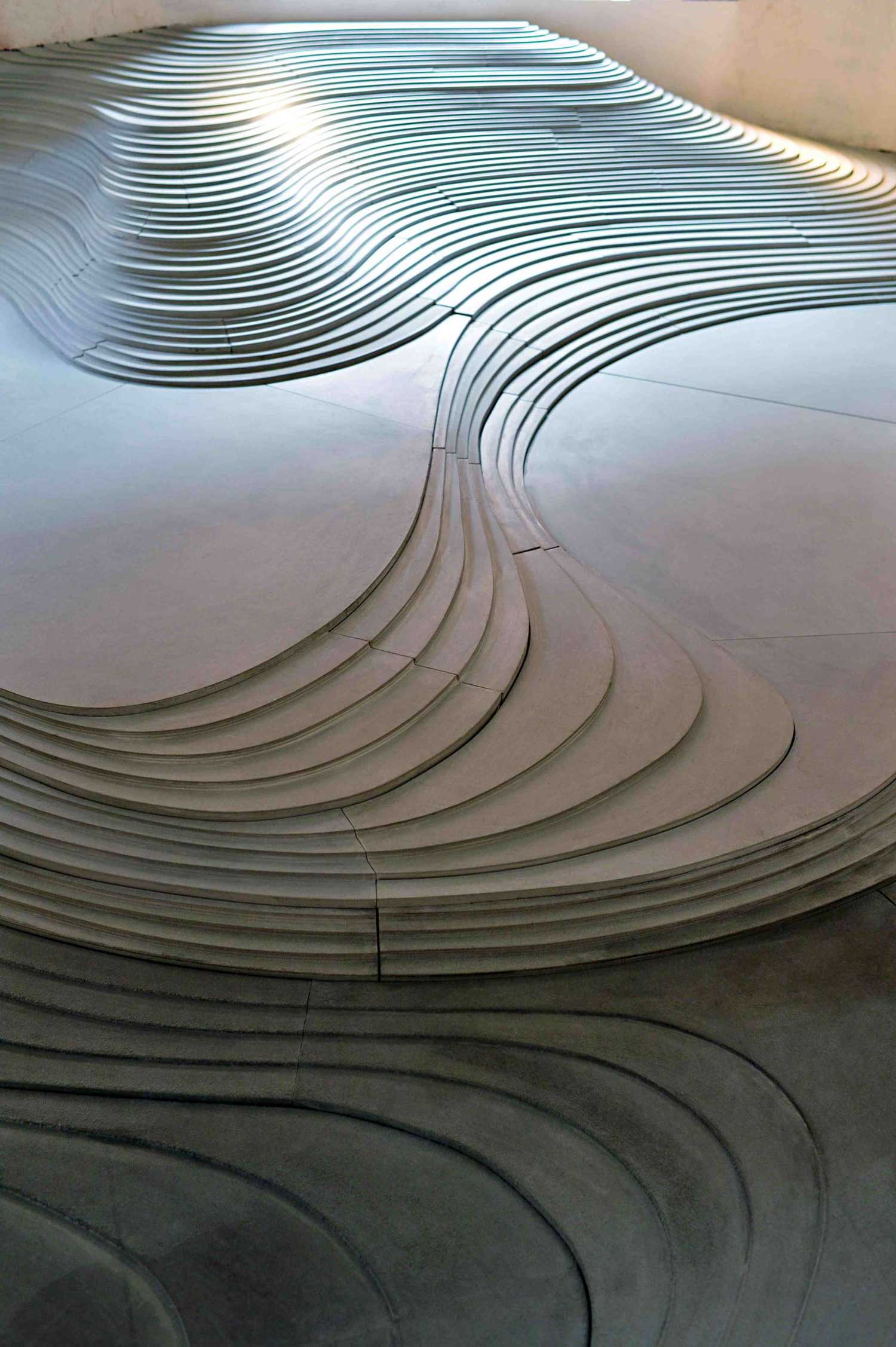
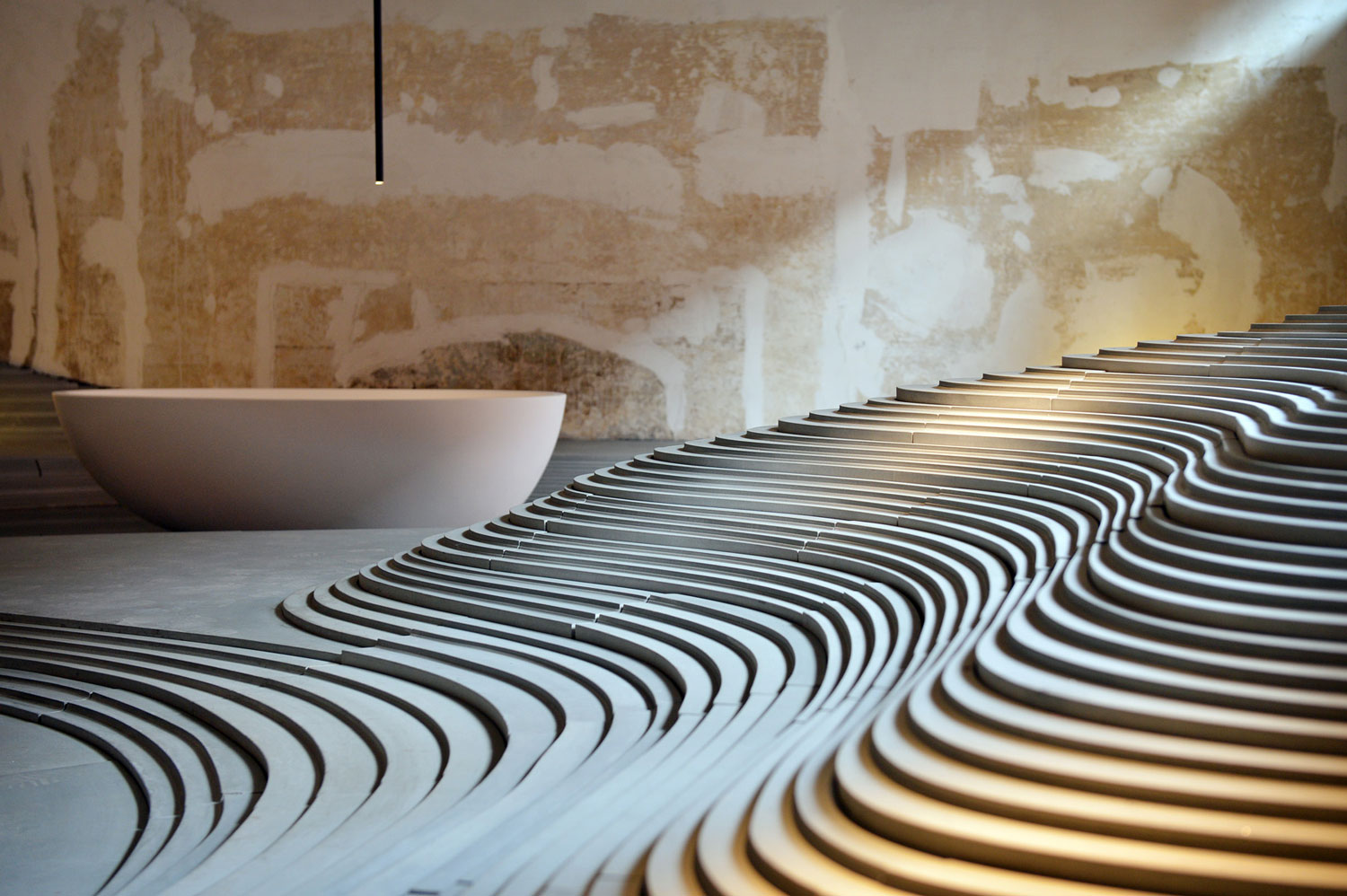
The stone is the part we keep coming back to. Pietra Serena is not a fair material. It is heavy, and it is soft enough to weather, and it is the stone of columns and stair treads and cloisters, and it belongs to buildings that plan to be there in four hundred years. Yellowtrace notes that Stonescape went up inside the former Hospital Bastardini, which is a monumental old complex, and Naturescape inside a brand-new office building by Kohn Pedersen Fox. So in one city the four-hundred-year stone sat in a four-hundred-year room, and in the other it sat in a room that smelled of new carpet, and in both cases it was there for a week. Somebody trucked it in. Somebody trucked it out. The stone did not know the difference, and that is the point about stone, and it is why we specify it and why we argue with people who want to print a photograph of it onto a porcelain tile instead. The tile is a picture of a rock. The rock is a rock. Your feet can tell.
There is a version of this story where we sneer, and it is an easy version to write. Zen simplicity in the service of a plumbing brand, tranquility by the square metre, the sacred garden reduced to a backdrop for a soaking tub with a price on request. Yellowtrace's own copy leans that way, with its talk of visitors invited to "experience the elegance, tranquility and wisdom of Zen simplicity." We have read that sentence in a hundred press releases and it means nothing in all of them.
But we have also stood in fair halls, and we have watched what people do in them, and here is what we think actually happened in Bologna. A person with sore feet and a lanyard walked into a room where the floor was suddenly uneven and wet and grey and real, and they slowed down, because the floor made them, and for ninety seconds they were in a garden. Then they looked at a bathtub. The bathtub was fine. It was the ninety seconds that Kuma sold, and the client paid for them, and the person got to keep them. That is a fair trade. It is a fairer trade than most of what happens at a fair.
What we take from it for our own work is narrower and more useful than a philosophy. A room that has to sell something should first give something, and the thing it gives should be physical, and it should reach the body before it reaches the eye. Stone underfoot does this. Water within earshot does this. A change in level does this. None of it needs a story, and all of it works on a tired person in a bright room, which is, when you think about it, most people most of the time.
The garden came down on Sunday. The stone went somewhere. Somewhere in Italy there is a pile of terraced Pietra Serena that was a mountain for a week, and it is still stone, and it does not mind.
Sources & Credits
- Dana Tomić Hughes, "Stonescape & Naturescape by Kengo Kuma & Associates," Yellowtrace, 30 November 2015. https://www.yellowtrace.com.au/kengo-kuma-stonescape-naturescape/
- Photography: via Yellowtrace, https://www.yellowtrace.com.au/kengo-kuma-stonescape-naturescape/ (all images; photographer not credited in the stored record, confirm before publishing)
- The attribution of the objects to Agape and Davide Groppi is drawn from the tags on the Yellowtrace piece, not its body text. Pietra Serena's Florentine history is general knowledge.