A task lamp has one job that is not about light at all. It has to hold its own arm up, all day, at whatever angle you left it, without a hand on it, and it has to let you move that arm again with one finger when you come back. Everything else, the shade and the finish and the name on the base, is decoration on top of that problem. In 1972 Richard Sapper solved it for Artemide with a lamp called Tizio, and the solution was so complete that for the next fifteen years the rest of the industry was mostly answering him.
Tizio has no springs. It has counterweights, small black blocks at the short ends of two long arms, so that the arms balance the way a seesaw balances, and the head stays wherever you put it because the physics has nowhere else to go. It also has no wires in the arms. The arms are the wires. The low-voltage current for the little halogen bulb runs through the metal itself, so the joints can be bare hinges and the whole thing reads as a drawing of a lever rather than a drawing of a lamp. Sapper came out of the Mercedes-Benz styling studio before he came to Italy, and Tizio is what happens when a car man is allowed to leave the mechanism out in the open and call it finished.
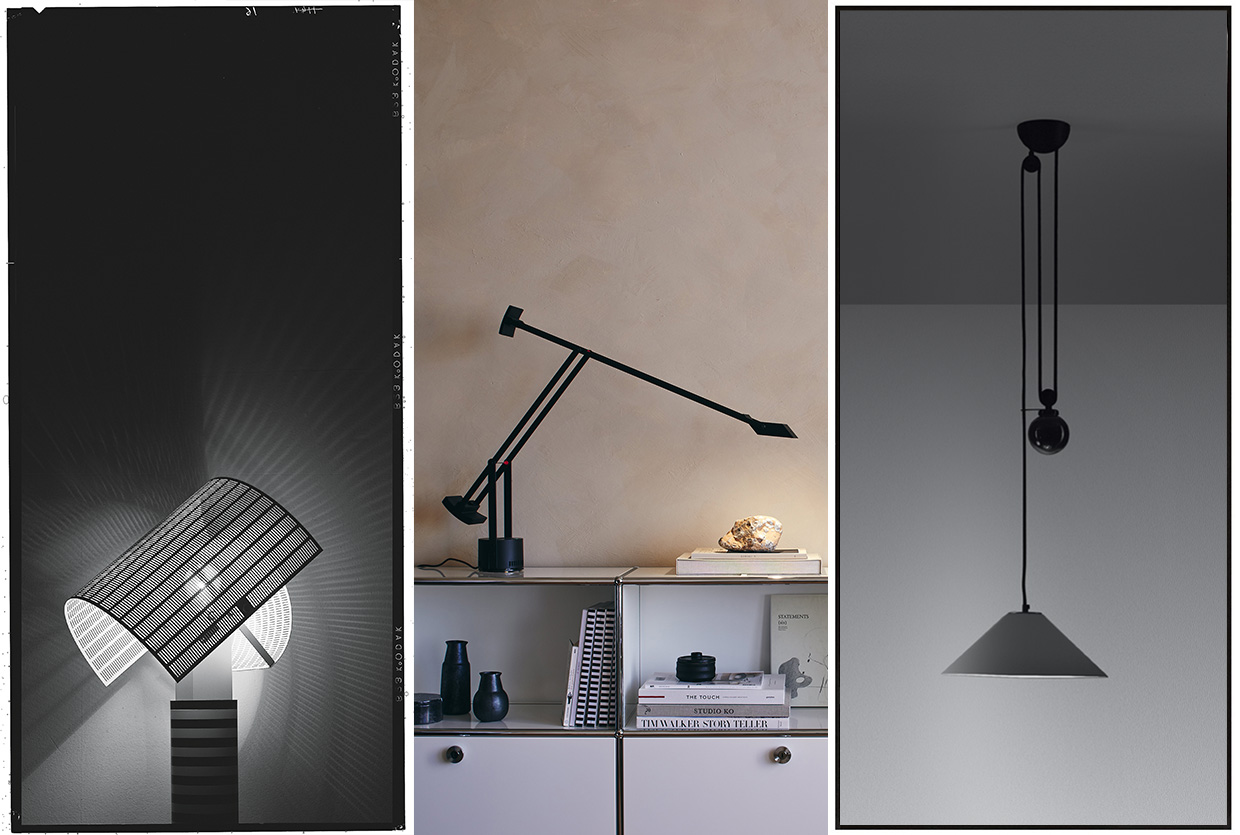
The story that brought all of this back across our desk is a 2021 brand profile on Yellowtrace, written when the Australian distributor Stylecraft took on the Artemide range. It opens with the roll call, "Tolomeo, Tizio, Shogun, Demetra," and states, fairly, that "No lighting brand looms quite as large as Artemide" (Yellowtrace, 2021). Then it does what brand profiles do, which is describe each lamp as an ingenious combination of something and something else. We are not going to do that. We are going to look at three of those lamps as three answers to the arm problem, because the answers line up in time, and the line they make says something about how objects lose their reasons.
Answer one is Tizio, 1972: balance by counterweight, current by structure.
Answer two arrives in 1987, and it is Tolomeo, by Michele De Lucchi and Giancarlo Fassina. Tolomeo holds its arm up with a spring, and it does not hide the spring. A steel cable runs the length of each arm on the outside, in plain view, in tension, and the polished aluminium tubes are there to be pushed apart by it. Where Tizio is a lever, Tolomeo is a crane. It won the Compasso d'Oro two years later and went on to become the default desk lamp of a certain kind of office, and for a while a Tolomeo on a desk meant roughly what a Tizio had meant fifteen years earlier, which was: someone here has read about lamps.
A year before Tolomeo, Mario Botta gave Artemide the Shogun, the one on the left of the photograph above, a perforated sheet-metal shade you rotate to change the light. It does not belong in this argument, because Shogun has no arm. We mention it because 1986 and 1987 were the moment Artemide had the lever, the crane and the shade in the catalogue at once. That was the high water mark of the mechanism as the design.
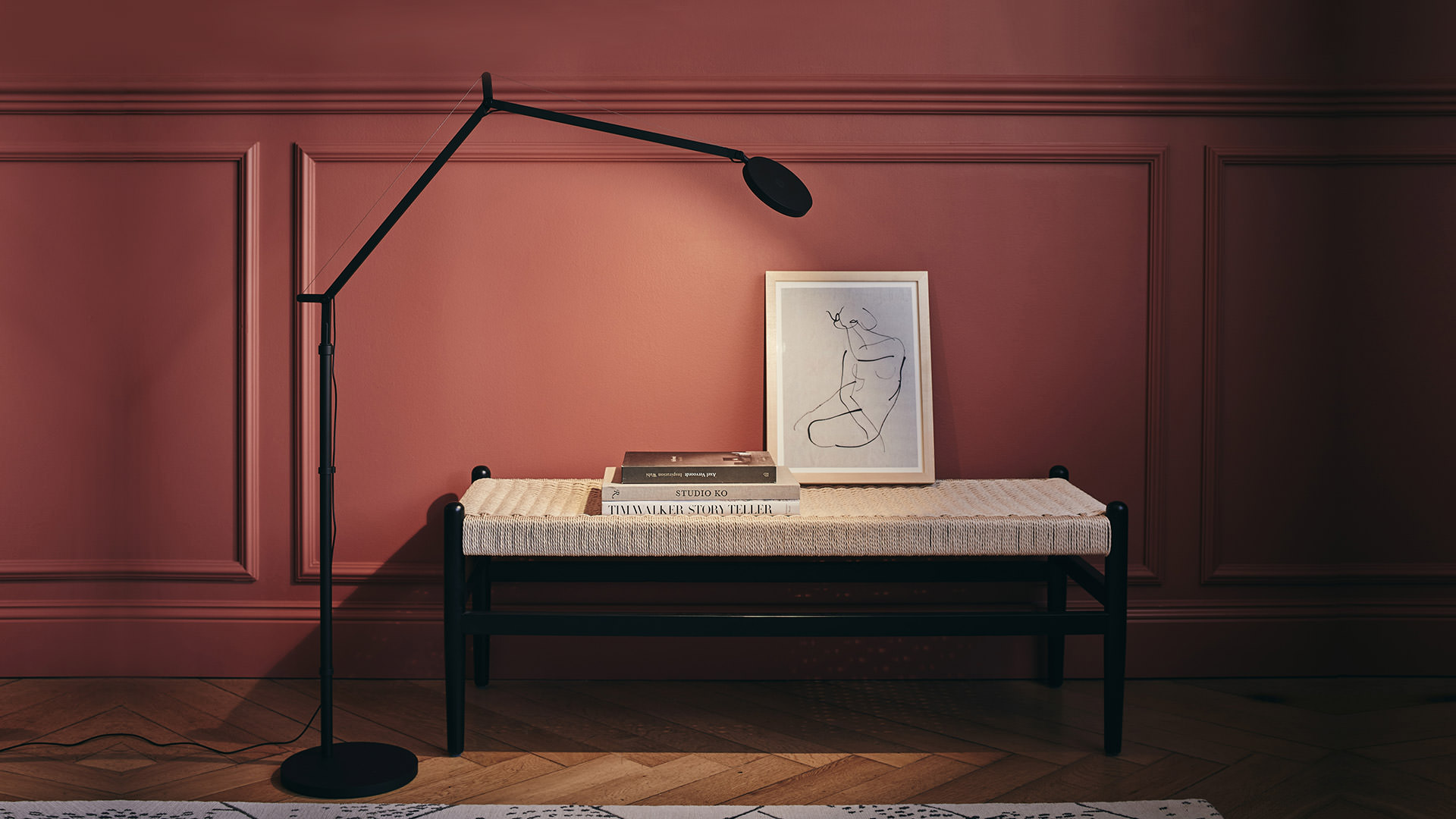
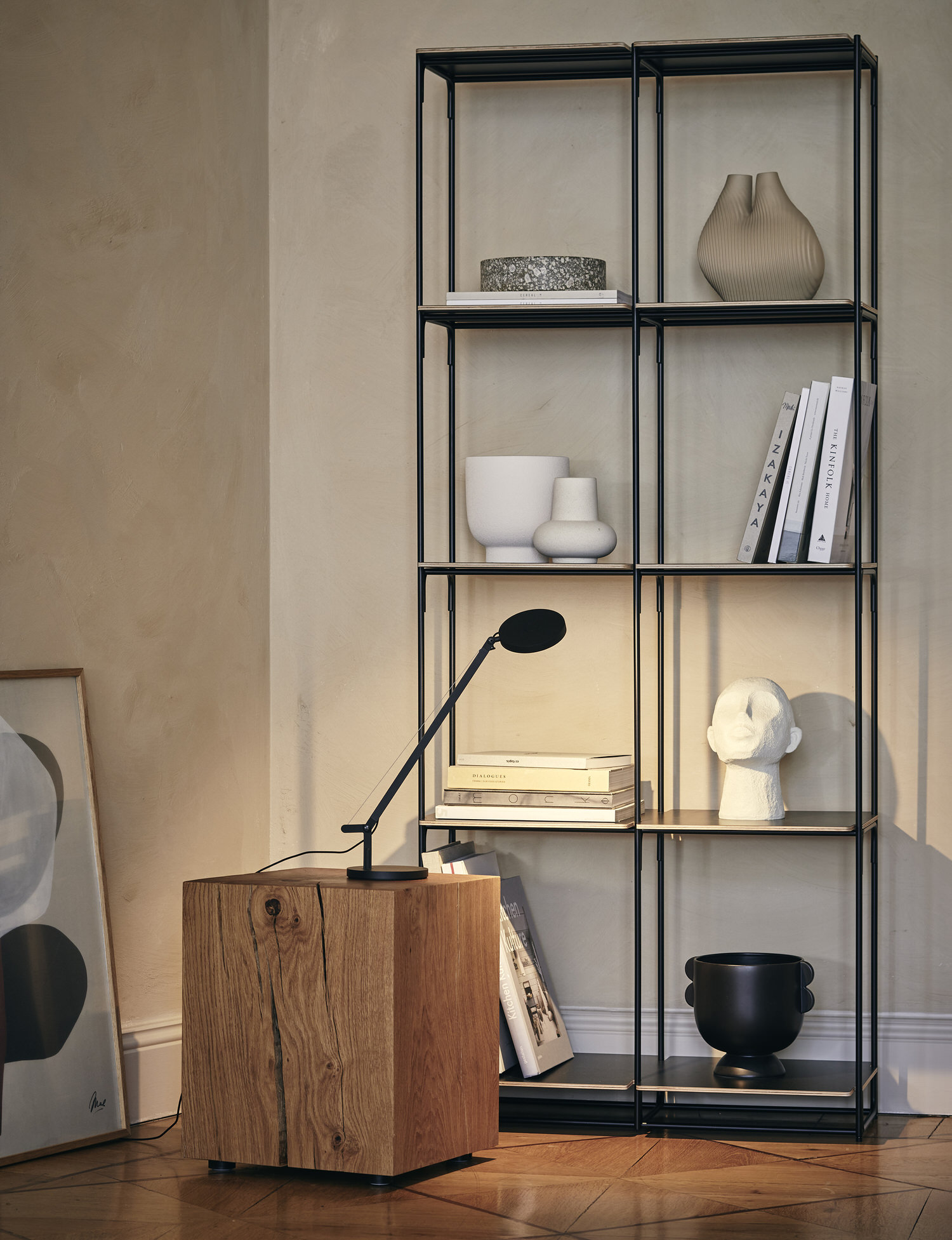
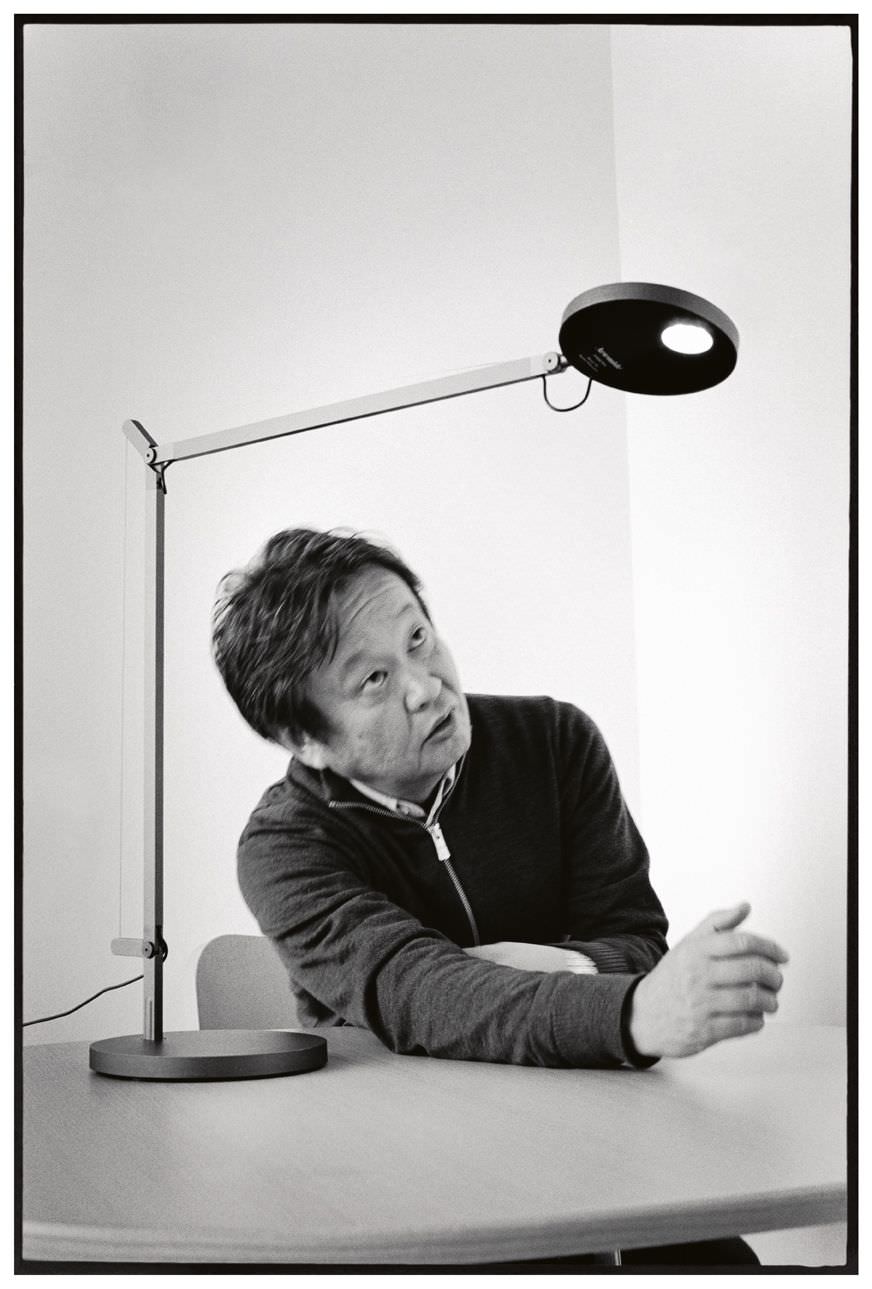
Answer three is Demetra, by Naoto Fukasawa, 2013, and the honest thing about Demetra is that it barely answers the question at all. The head is an LED. It weighs almost nothing and it runs cool. There is no bulb to change, so there is no need for a big cap you can get your fingers around, and there is no heat, so the head can sit an inch from the paper. The arms hold their angle with plain friction joints, the way a good drafting lamp did before anyone thought to make a fuss about it. No counterweight. No visible spring. Nothing in tension. The problem Sapper and De Lucchi spent their best years on has been removed from the world by a diode, and Fukasawa, who has built a career out of not decorating, declined to pretend otherwise.
Here is what we take from the three of them, standing in a row.
A mechanism can be the whole design only while the problem it solves is real. Tizio's counterweights are beautiful because a halogen head in 1972 was hot and heavy and had to be held up by something, and the something had to be moved by a fingertip. Tolomeo's cables are beautiful for the same reason. Take away the weight of the head and both lamps become costume: a lever with nothing to lift, a crane with nothing to carry. Both are still in production and people still buy them and we understand why, because they are handsome and famous and they photograph. But if you are specifying a lamp for a desk somebody will sit at for thirty years, it is worth knowing which part of the object is still doing work.
At Common Projekts we treat a task lamp as hardware, in the same category as a door lever or a faucet: an object the client will touch every day, whose entire quality is in the touch. The finish schedule does not capture this. A friction joint that is too stiff on day one and too loose in year three is a bad lamp regardless of who drew it. A counterweight that still balances after fifty years is a good lamp regardless of whether the physics is still required. That is the test we run, and it is a test you run with your hand, in a showroom, not with a catalogue.
So the three lamps are not a story about progress. They are a story about a problem that had a golden age, from the early seventies to the late eighties, when holding a bulb in the air was hard enough to be worth a designer's whole attention, and about what the good designers did when the problem quietly went away. Sapper made the mechanism the ornament. De Lucchi made the tension the ornament. Fukasawa, arriving after the bulb had turned into a chip, made nothing the ornament, and got out of the way.
The building does not care which one is on the desk. The person at the desk does, every single morning, with one finger.
Sources & Credits
- Fenina Acance, "Lighting the Way: A True Icon of Italian Lighting, Artemide, Arrives at Stylecraft," Yellowtrace, 30 August 2021. https://www.yellowtrace.com.au/italian-lighting-icon-artemide-arrives-at-stylecraft-design-classics/
- Photography: courtesy Artemide and Stylecraft, via Yellowtrace, https://www.yellowtrace.com.au/italian-lighting-icon-artemide-arrives-at-stylecraft-design-classics/
- Design dates (Tizio 1972, Shogun 1986, Tolomeo 1987, Demetra 2013) and designer attributions are from the Artemide catalogue record and are widely documented; the Compasso d'Oro for Tolomeo was awarded in 1989.