Florence Knoll Asked for a Basket of Pillows
Knoll's newest sofa is a stack of cushions, and the firm that invented the Planning Unit is the last one that should be embarrassed about it. The argument was never hardness. It was authorship of the whole room.

In 1948 Florence Knoll went to Eero Saarinen and asked him for a chair like a basket full of pillows, something she could curl up in, and he came back with the Womb Chair, and it has been in production ever since. Yellowtrace tells that story in a piece on the Knoll collection at Living Edge in Australia, and then it tells a second one: in 2023 Knoll released the Perron Pillo Sofa by the Los Angeles designer Willo Perron, which is low and deep and modular and built from cushions so oversized that it reads as a stack of pillows rather than a sofa. Seventy-five years apart. Same brief. More pillows.
The easy post writes itself from there, and it is the wrong post. It goes: the company that put Breuer and Mies and Bertoia into production now sells you a pile, and this is what became of modernism, and somebody should be ashamed. We are not writing that one. It gets the history backwards.
Start with the Wassily, because everybody does. Marcel Breuer drew it in 1925 while he was teaching at the Bauhaus, after looking at the bent tubular steel of his bicycle and wondering, per Yellowtrace, why nobody had yet made a chair out of it. What he built was an upholstered armchair with the upholstery taken away: a frame of chrome-plated steel, a handful of leather planes stretched across it, and no place left to hide a joint or a web strap or a block of foam. A hundred years on it still reads as pure structure, which is why it refuses to date, and why sitting in it still tells you exactly how you are being held up.
Now the part people skip. Florence Knoll studied under Mies, interned with Gropius and Breuer, came out of Cranbrook alongside Saarinen and Harry Bertoia, and in 1946 she set up the Knoll Planning Unit so the company could design whole interiors instead of selling chairs into rooms other people had already finished. Yellowtrace puts the idea in a single clause, and it is the right clause: furniture as "a component of space rather than something placed in it afterwards."
Notice what it does not say. It does not say furniture must look like structure. It does not say cushions are a moral failure. It says the chair and the room are one drawing, made by one hand, at the same time, for the same purpose. The Wassily satisfies that test. So does a pile of cushions, as long as somebody drew the room the pile is going to sit in.
That is where it usually falls apart, and it has nothing to do with taste. Deep soft seating is dimensionally greedy. It wants a floor plate that can give up nine hundred millimetres of depth and still leave a circulation route behind it, and a datum low enough that the window head stops making sense, and a light level set for people who are lying down rather than sitting upright with a drink. Draw none of that and then deliver the Pillo anyway, and what arrives is a very good object marooned in a corridor. Draw it properly and the thing becomes architecture, which is what the Planning Unit was arguing in the first place.
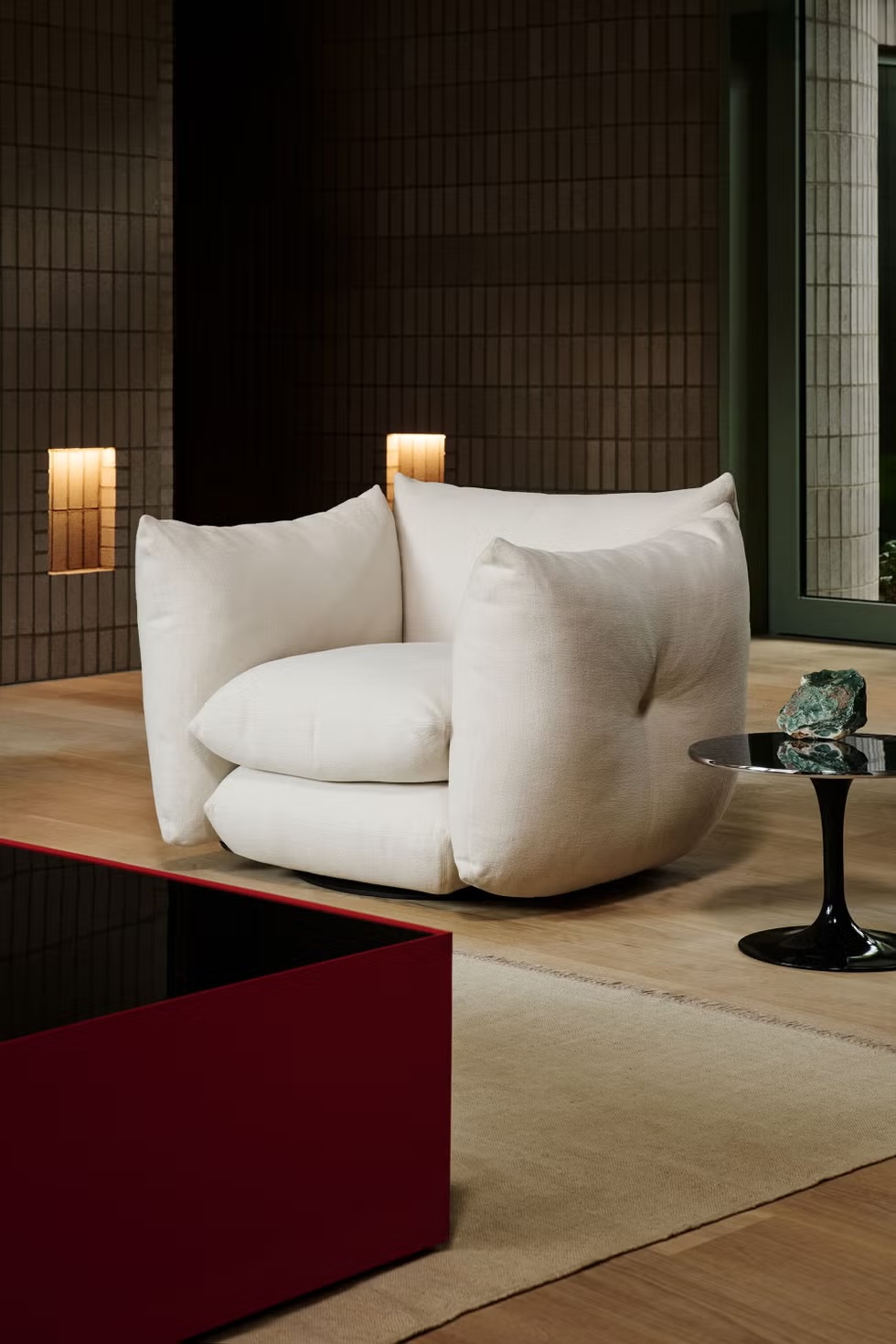
Yellowtrace is blunt about why the sofa exists: it is "Knoll acknowledging that living rooms are now used for lying down, working, eating and not much formal sitting." That is not a surrender to softness. That is a specification, written against an observed condition, which is exactly how the good pieces in this catalogue got made.
Consider the 1966 Collection. Florence wanted outdoor furniture for her house in Florida that could survive salt air and sun "without falling apart or looking like it belonged on a motel pool deck," and Richard Schultz answered with cast aluminium and woven mesh carrying the indoor proportions outside, and sixty years on it is still the reference. Breuer specified a bicycle tube. Schultz specified salt. Perron specified the way people actually sit now, which is to say barely. Somebody looked hard at a real condition and then drew for it.

There is a small joke in all this, and it is nobody's fault. A hundred-year argument about whether furniture is architecture reaches most people the way this piece did, as partner content for a dealer, under a button that says discover more. That is the plumbing. Chairs have to reach houses somehow, and a showroom carrying 1920s classics beside work from the last few years is doing more for the argument than another monograph would.
Here is the test, and it has nothing to do with whether a thing looks hard or soft. Did somebody draw the room and the object together, or did the object get carried into a room that was finished without it. The first one is the Planning Unit. The second one is shopping.
People come home tired. They want to put their back against something and stop holding themselves up. A chair that will not let a tired person lie down loses that argument eventually, no matter how beautifully it declares its structure. Florence Knoll knew that in 1948. It is why she asked for the basket of pillows. Yellowtrace lands on a line we would happily steal: "Design history is more useful when it is still in use."
The drawing is where the cushions earn it.