The Pavilion You Visited Opened in 1986
Ciro Najle and Josep Ferrando have filled the Barcelona Pavilion with glass. The more useful fact is that the Pavilion itself is a reconstruction, and a reconstruction is not allowed to get old.
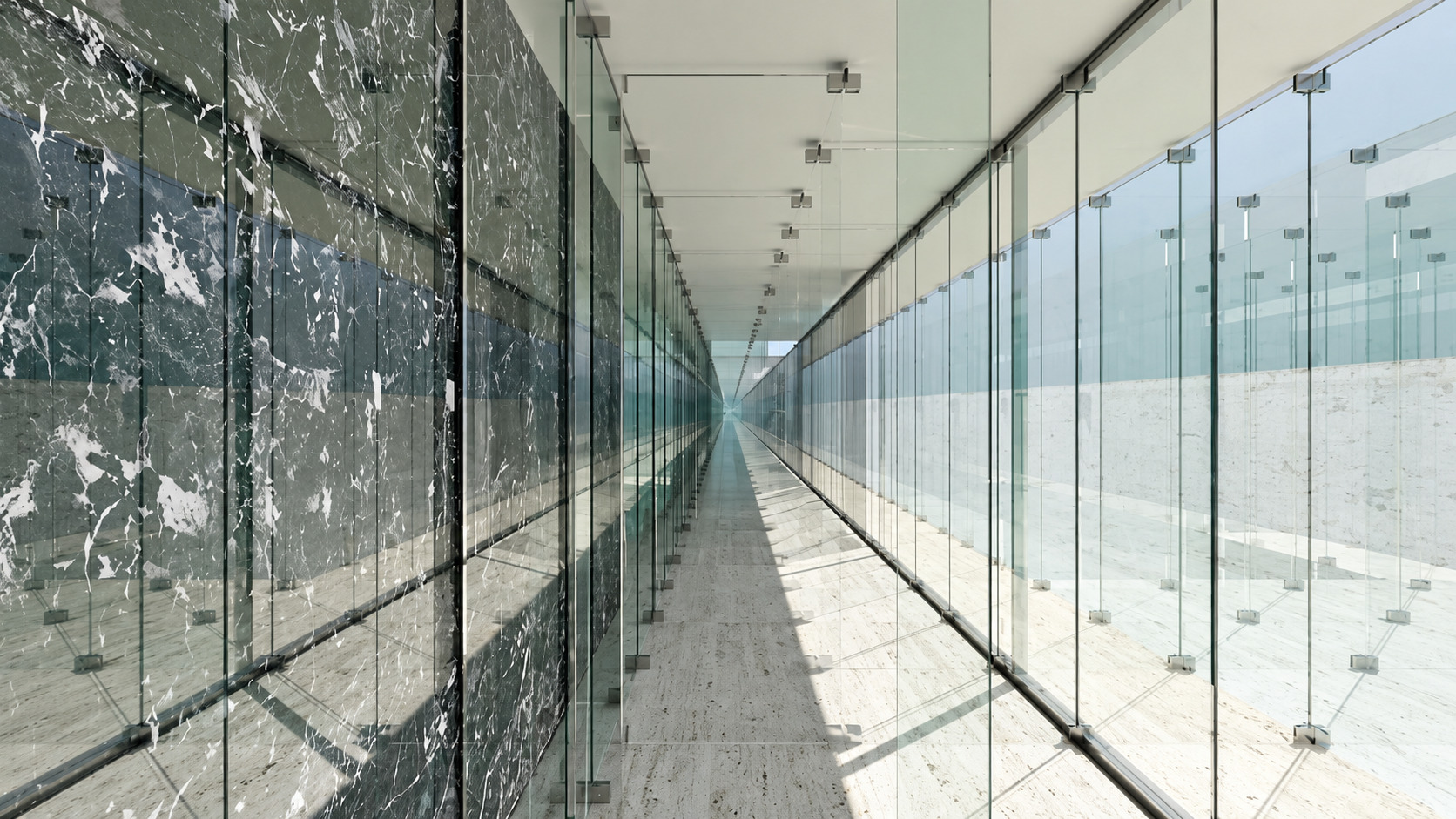
Ciro Najle and Josep Ferrando have set a glass labyrinth on the travertine podium of the Barcelona Pavilion, where it will stand until 22 November, after which it will be taken down and the Pavilion will go back to being the most photographed empty room in Europe. ArchDaily's Antonia Piñeiro reported the opening on 12 November. The curatorial line is "transparency as an unsettling boundary," and the stated ambition is to "redefine transparency not as neutrality, but as a dense, living, and profoundly contemporary condition." That is a great deal of language for some glass standing up.
The glass is doing something, though, and it is doing it better than the sentence does.
Start with the fact that makes the rest of it legible. The building holding the labyrinth is not from 1929. It is from 1986.
Mies van der Rohe and Lilly Reich built the German Pavilion on Montjuïc for the 1929 International Exposition, and it stood for a season, and it held a reception for a king and queen, and when the fair closed they took it apart in 1930 and the stone went wherever stone goes. For fifty years the most influential building of the century existed as a handful of black and white photographs, most of them taken before anyone had walked through it. Then in 1980 Oriol Bohigas, running Barcelona City Council's planning department, decided to build it again, and he handed the research, the drawings and the site supervision to Ignasi de Solà-Morales, Cristian Cirici and Fernando Ramos. Work began in 1983. It opened on the original site in 1986. The Fundació Mies van der Rohe lists what they used: glass, steel, Roman travertine, green Alpine marble, ancient green marble from Greece, and golden onyx from the Atlas Mountains, matched to the originals in character and in provenance.
So they went back to the quarries and matched a photograph. Somebody stood in the Atlas Mountains in the early 1980s holding a picture of a wall, looking for a block of onyx with the right weather in it. That is a devotional act and an absurd one, and we admire it without reservation.
But it leaves the building in an odd position, and the labyrinth is the clearest illustration of that position anyone has managed yet.
A real old building earns its forgiveness by weathering. The stains are a record, the settlement cracks are a record, the worn step is a record, and we read all of it as truth and let the building off. A reconstruction does not get that. A copy that weathers does not look ancient, it looks badly maintained. The patina reads as a defect because there is no century underneath it to explain the mark. Which means the Pavilion is never permitted to age, and a building that cannot age has to keep doing something instead. So it gets an intervention almost every year: an artist, an installation, a piece of furniture placed where the Barcelona chairs are not. It performs for a living. It is the only job left to it.
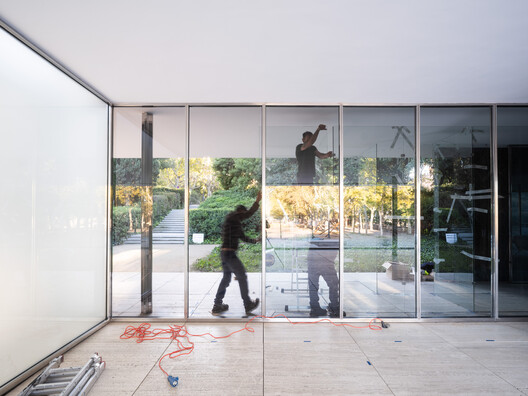
Most of those interventions arrive as contrast. Something soft, something coloured, something warm, placed against the cold stone so that a photograph has an event in it. Najle and Ferrando did the opposite, and that is why the piece is worth the trip. They did not contrast with the Pavilion. They overdosed on it. They took the building's own defining material and gave the building more of it than it can metabolise.
This punctures something our profession repeats without examining. Glass is not honest. Glass is not neutral, and it is not openness, and it never was. Glass is the most controlling material in the catalogue: it decides exactly what you see, from where, in what light, at what hour, and it does all of that while pretending it is not there at all. Mies knew this better than his followers did. The plan of the Pavilion is a sequence of withheld views. You are walked around the pool, past the onyx, toward a reflection of the thing you came for, and you are never once allowed to simply stand and take it in. The free plan was never freedom. It was choreography with the walls pulled apart far enough that you could not see the hand on your shoulder.
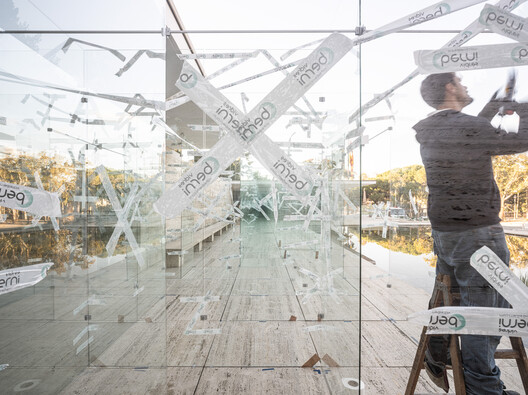
A labyrinth is that hand made visible. Put enough planes of glass into the sequence and the choreography stops being tasteful and starts being obvious, and a visitor who has spent the morning being gently steered now walks into a pane and stops. You learn where a glass wall is by failing to pass through it. This is also how you learn a Mies building, just slower, and with better manners.
The honest part is what the installation costs the myth. Everyone who teaches this building teaches openness, flow, dissolved boundaries, the wall becoming a screen. Ten days of a glass labyrinth, and a travertine slab that was laid in the year Top Gun came out, and the lesson arrives at something harder and more useful: the Pavilion is not open. It is exact. Every one of those planes is placed to the millimetre and every sightline is spent on purpose, and the reason it still works after a demolition, a fifty year absence and a full reconstruction is that the drawing was good enough to survive being lost.
That is the thing to take from it, if you specify stone and glass for a living. The building people make pilgrimages to is thirty-nine years old. It is a very good copy of a lost original, made by three architects who went looking for the right onyx, and it has spent four decades carrying an argument that its author never got to see built properly in his lifetime.
And still it stands.