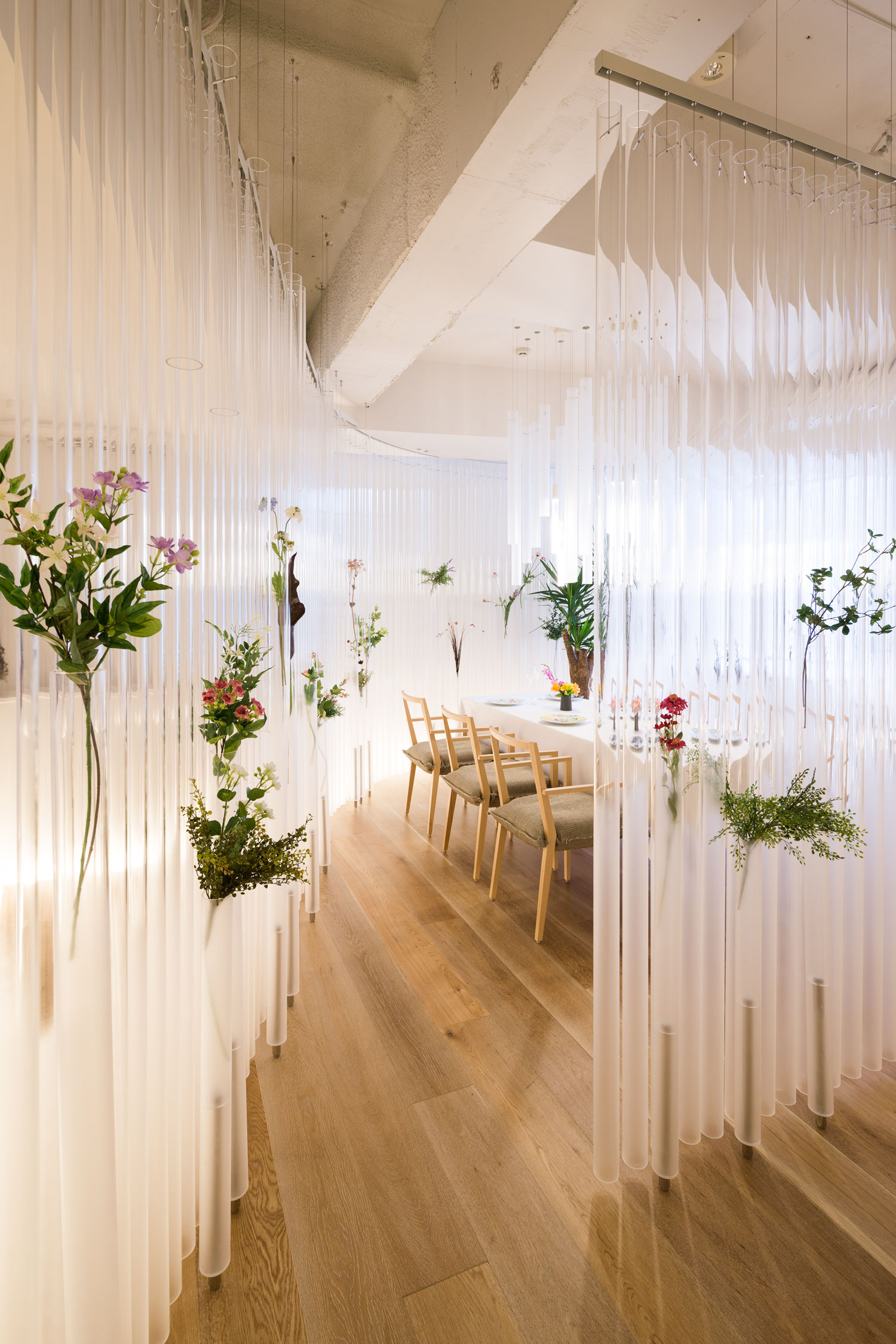
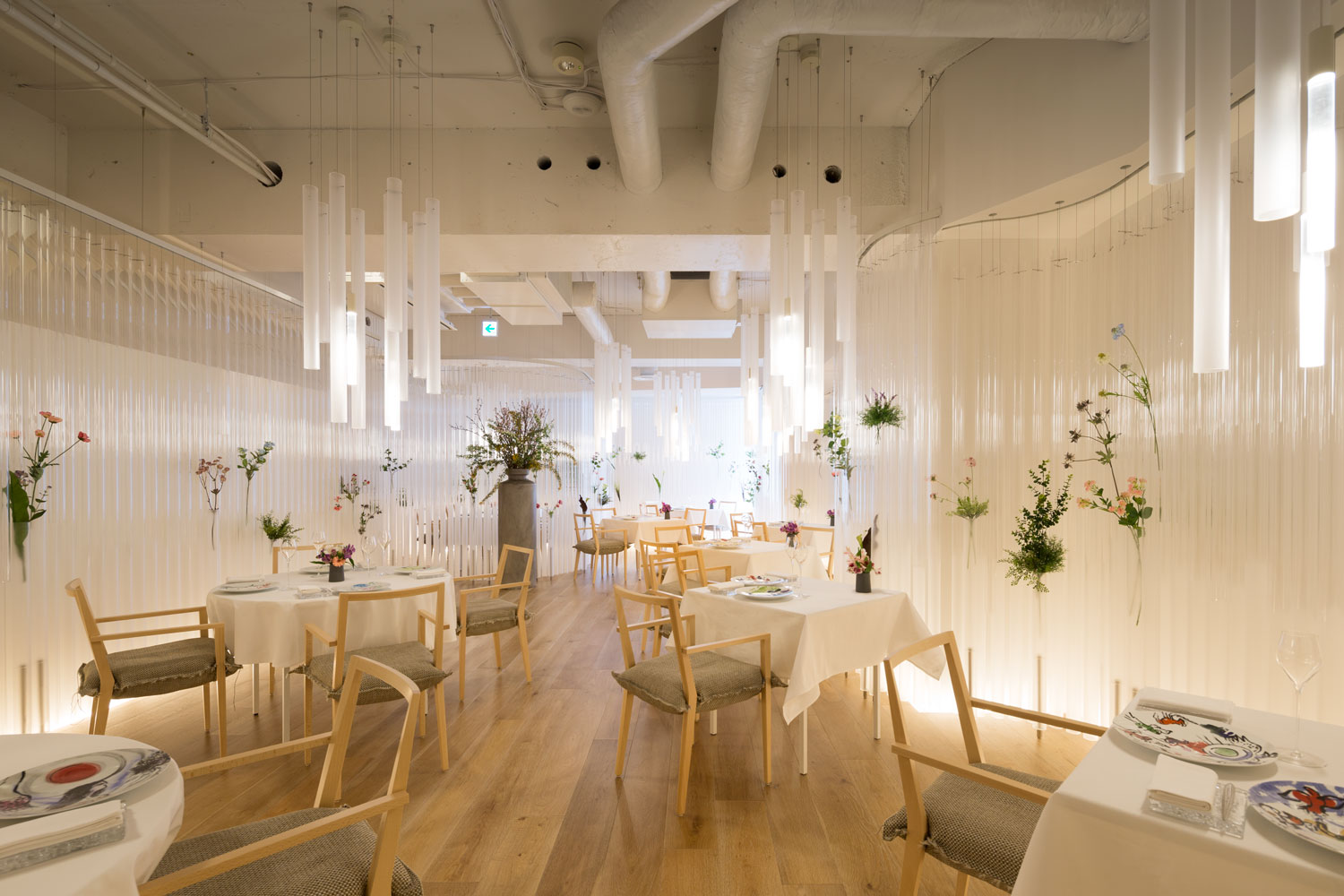
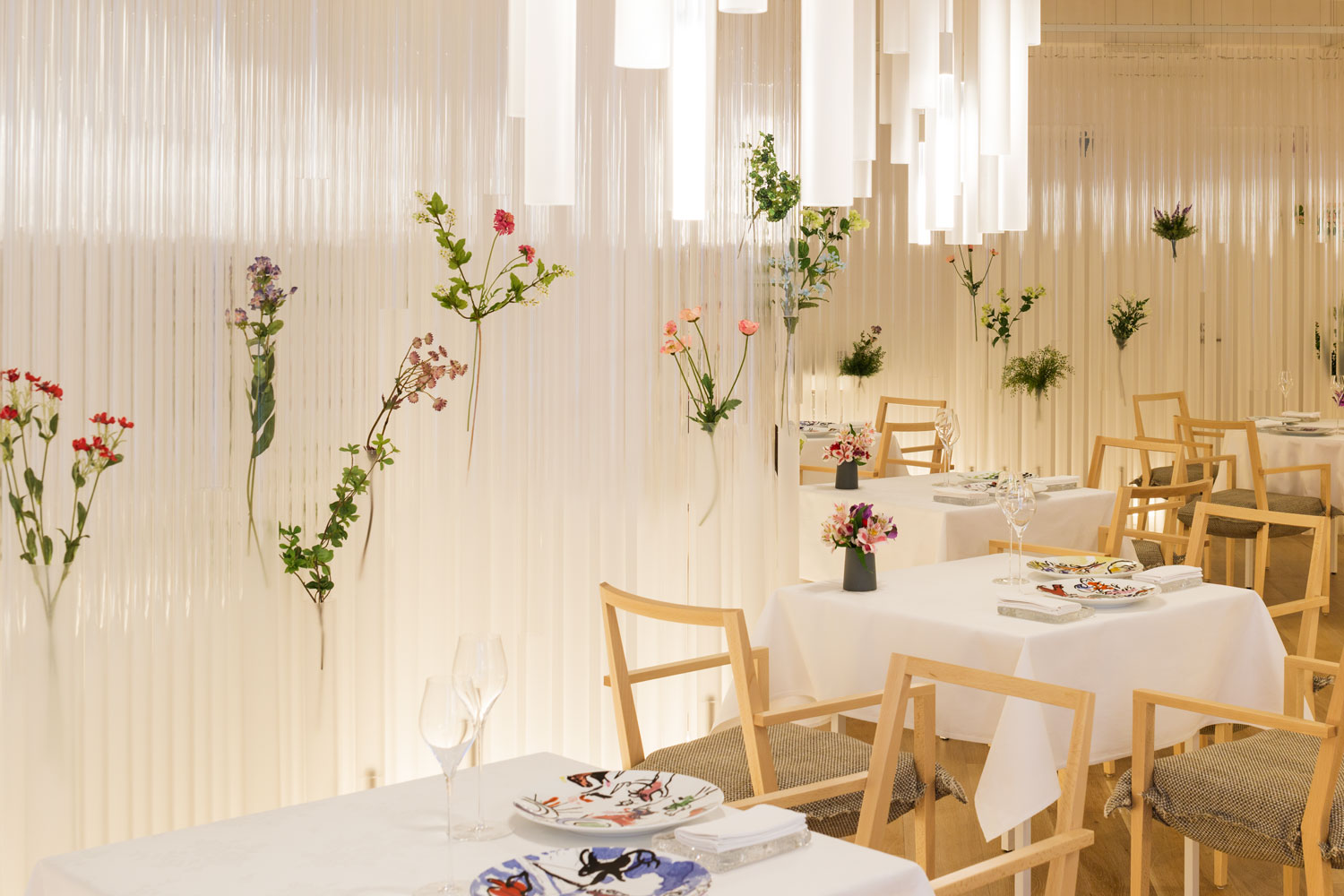
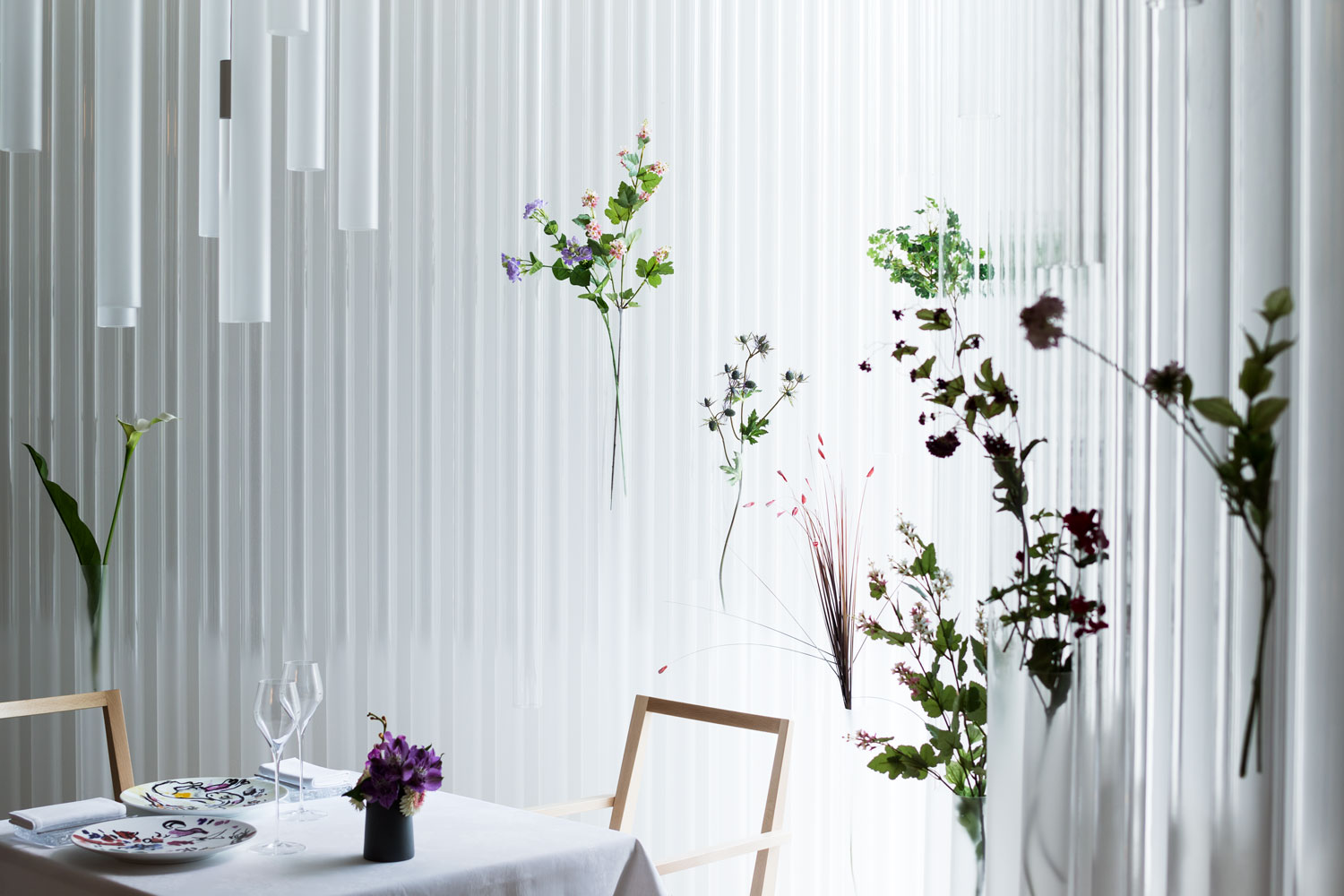
Hundreds of acrylic cylinders hang from a ceiling in Miyagi prefecture, and inside each one somebody has placed a flower that was never alive, and together they make a wall you could put your hand straight through. Kengo Kuma & Associates built it for a French restaurant called Nacree, inside an existing industrial shed that somebody had the sense to paint white and otherwise leave alone. Yellowtrace published it in July 2016, and Sally Klopper described the result as "a completely stand alone world for whimsical leisure and dining," which is about right. The photographs are by Masao Nishikawa and they are very beautiful. They also do not tell you how a single one of those tubes is fixed.
That is the part we cannot stop thinking about.
Kuma has spent most of his working life arguing that the wall should go away. He has written against the object, and he has built louvres and fins and stacked sticks and strung tiles on wire, and the point every time was that a building ought to break up into particles, into something closer to weather than to masonry. The theory has an endpoint, and Nacree is pretty clearly it. Here is a wall made of a material that cannot support anything, not even itself over any useful span, hung from the one element in the room still doing honest structural work, which is the roof of the shed somebody else built first.
So let us be plain about acrylic, because the renderings never are. Acrylic is extruded. It scratches if you breathe near it. It yellows under ultraviolet light on a schedule you can look up. It is the material of sneeze guards and trophy plaques and the sliding case over the cured meats at the deli counter. For about a decade starting in the early 1980s it was going to be the future, and showrooms filled with clear furniture and clear partitions and clear telephones, and then the future arrived and acrylic went back to being the cheapest honest way to make something see-through. There is nothing wrong with any of this. It is simply not a noble material, and Kuma has used it here the way a jeweller uses glass, which takes some nerve.
Now the part a drawing has to answer. Hundreds of tubes is not a light detail. Each one weighs almost nothing and all of them together are a real dead load applied to a ceiling that was never asked to carry one, which means a secondary frame, which means fixings into an existing industrial roof whose capacity somebody had to go up and verify. Acrylic burns, and when it burns it drips, so a fire officer will want to know the spread rating and the suppression layout before anyone gets to talk about flora and transparency. The tubes are horizontal and the room is a kitchen, so grease and dust will settle on every upper surface, and a cleaning regime for several hundred individually suspended parts is a line item somebody pays for forever. Crack one and the replacement has to match a batch bought years ago. And the flowers cannot be laundered, and they will fade at different rates depending on how near each one sits to a light fitting, so in eight years the wall will be a gradient map of the lighting plan.
None of that is an argument against the room. It is just the bill, and the bill is always separate from the idea, and the firms that pretend otherwise are the ones whose work looks thin in year three.
Because here is the thing we have to concede. It works. You can see it working in Nishikawa's photographs: some of the cylinders are opaque and some are clear, so light goes soft in some places and hard in others, and the effect is less like a screen than like being inside a thicket at the hour when the light gives up. A solid partition in that shed would have made two rooms. A sheet of glass would have made one room with a line through it. This makes something stranger, which is a boundary you agree to. You can see the next table. You can see the people at it reaching for bread. You just do not go there, because a few hundred plastic tubes have told you politely where your dinner ends.
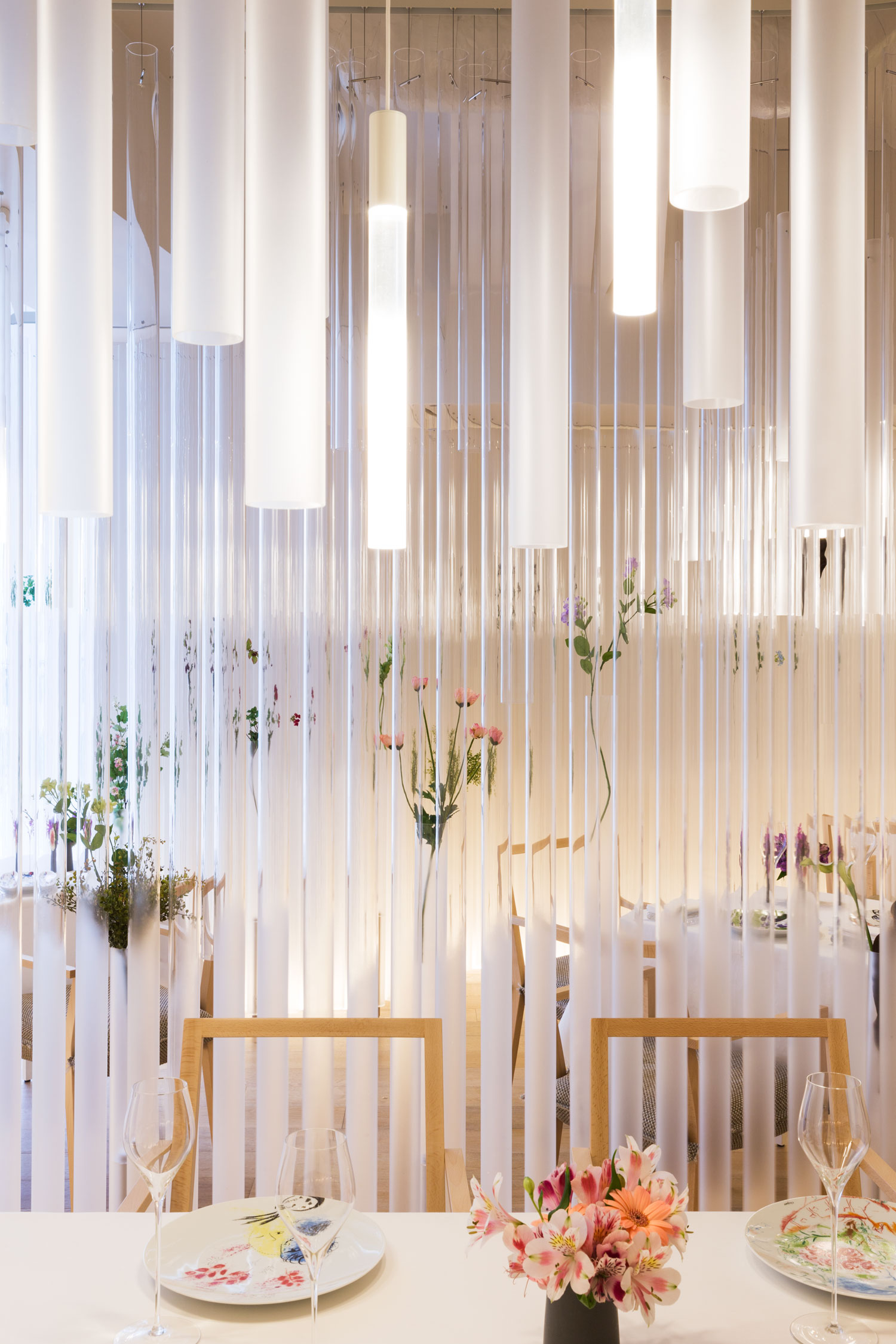
That is a very old trick wearing a new material. A shoji screen does it with paper and a cedar frame and an understanding between the people on either side. A curtain does it in a hospital. Ando does it with a slot of light across a concrete floor, and the slot is not a barrier at all, and you still stop at it. Kuma's whole career has been a long argument that the wall is a failure of nerve, and the funny thing about Nacree is that it does not abolish the wall. It builds one out of nothing and proves the wall was never about mass in the first place. It was about agreement.
Which leaves us somewhere slightly uncomfortable, and we may as well say so. If a wall can be made of extruded tube and artificial flowers and still do the one thing a wall is for, then the honest conclusion is not that walls should disappear. It is that most of them are doing far more work than anybody asked of them, and have been for a century, and the mass was mostly for us.
The flowers in those tubes will never need water. Somebody still dusts them.
Sources & Credits
- Sally Klopper, "Nacree Restaurant in Tokyo by Kengo Kuma & Associates," Yellowtrace, 24 July 2016. https://www.yellowtrace.com.au/kengo-kuma-nacree-tokyo-acrylic-cylinders/ (Yellowtrace's headline places the restaurant in Tokyo; the article text places it in Miyagi prefecture, and we have followed the text.)
- Architect: Kengo Kuma & Associates.
- Photography: Masao Nishikawa, via Yellowtrace, https://www.yellowtrace.com.au/kengo-kuma-nacree-tokyo-acrylic-cylinders/
- No CP photography appears in this post.