No Submittal Required
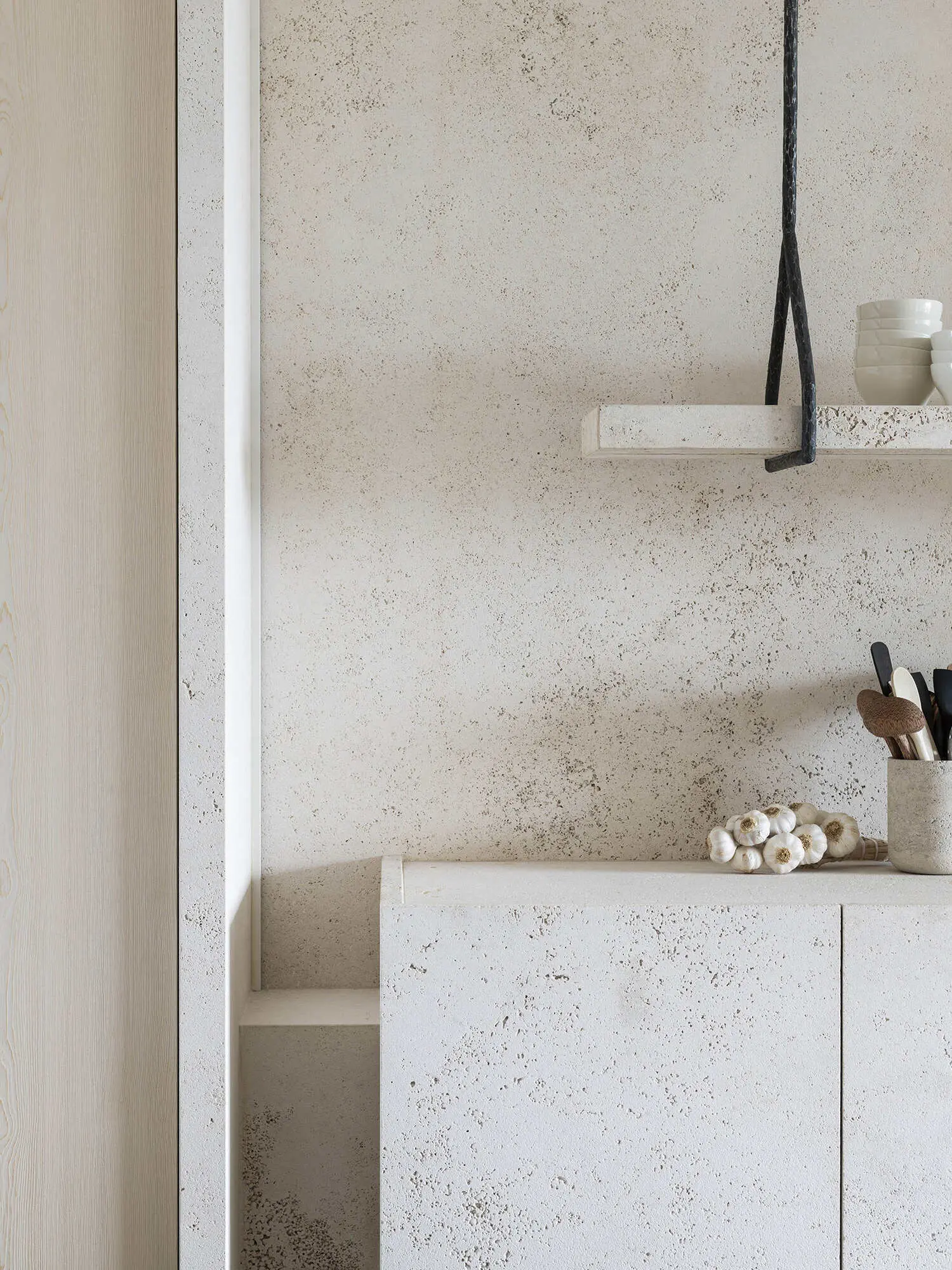
Est Living recently ran a list of nine salad servers, which it introduced as objects "designed to elevate the everyday" (Est Living). We would like to put the phrase down gently and then pick up the objects, because the objects are more interesting than the sentence, and because the everyday does not especially need elevating. The everyday needs a tool that will not scratch the bowl.
Still, a list of salad servers is worth more attention than it usually gets, and here is why. Think about everything that stands between a designer and the thing you eventually touch. On a building there is a general contractor, and three subcontractors, and a submittal log, and a shop drawing that comes back wrong twice, and a substitution request filed on a Friday, and an inspector, and a punchlist, and a warranty that describes in careful language what nobody is responsible for. Every one of those is a place where a decision gets softened, delayed, negotiated or quietly replaced with something cheaper that meets the same written description. By the time a door lands in its frame, forty people have had an opinion about it and most of them were right.
A salad server has none of that. There is no code for a salad server. There is no rough-in, no inspection, no rated assembly, no manufacturer's rep, no value engineering meeting, and no clause anywhere that lets somebody swap it for an equivalent. There is a person who decided, a maker who made it, a box, and your hand. That is the entire chain. Which means the object cannot hide behind process, and neither can the designer, and after fifteen years of being taken in and out of a drawer it is either good or it is not, and you will know.
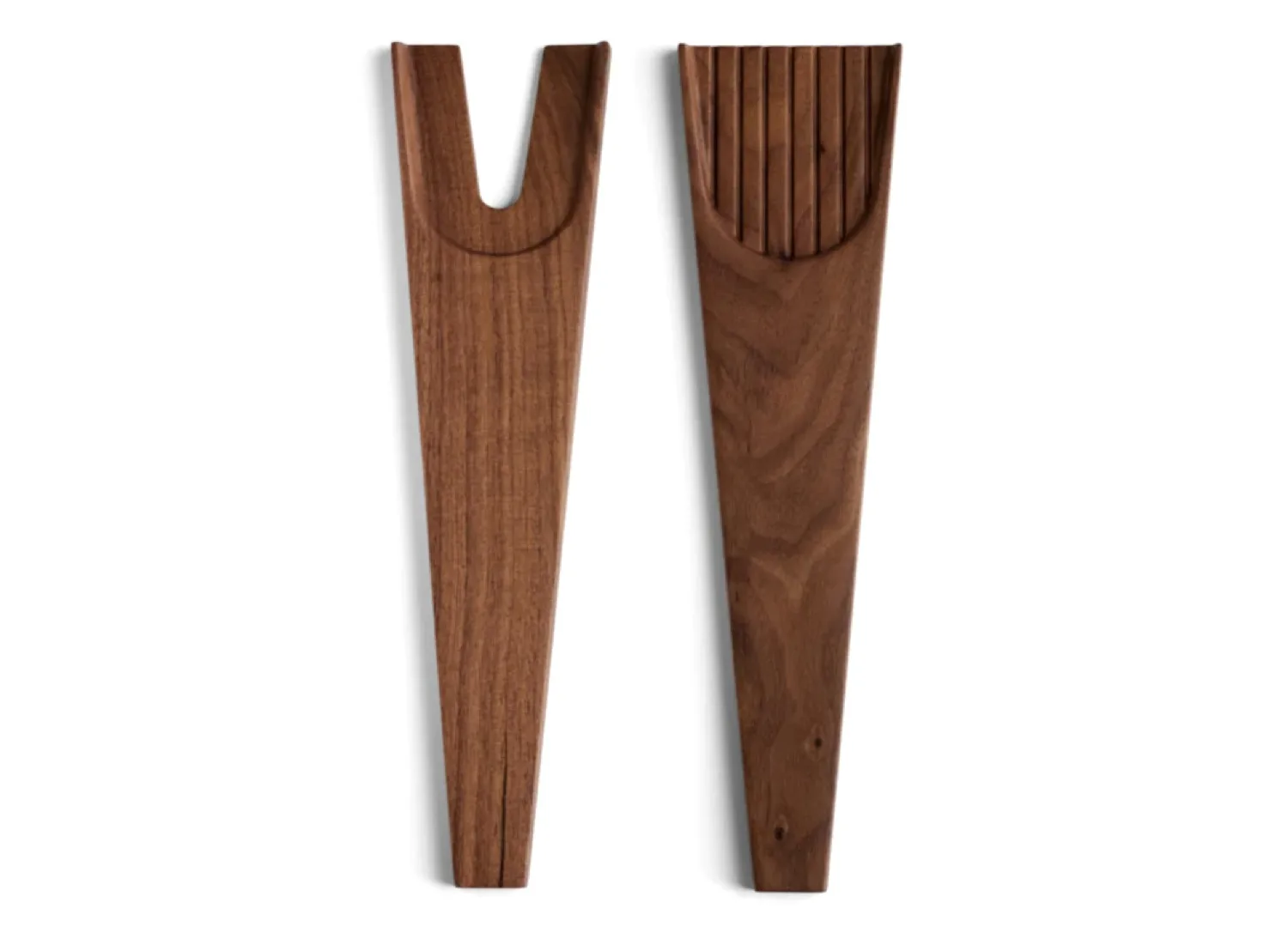
Look at what is actually going on in the set. The first entry is a pair of dark wood servers by When Objects Work with the Belgian architect Nicolas Schuybroek, which is an architect designing a thing you put in a bowl of leaves. People treat this as a vanity move, a small indulgence between large commissions, and we think it is close to the opposite. It is the only situation in a designer's working life where the distance between the drawing and the object is the same distance it was in his head. No wonder they keep doing it.
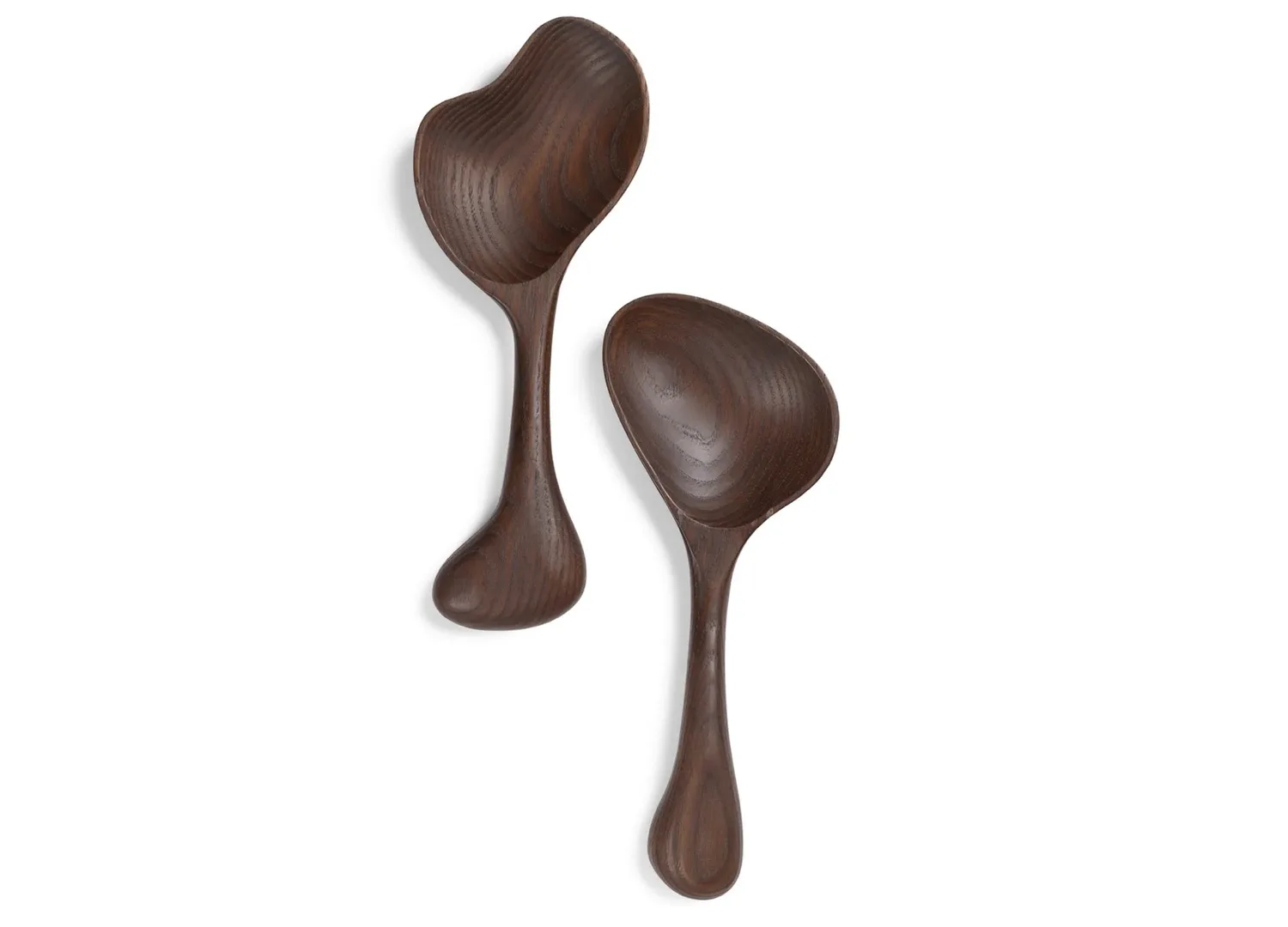
The second is Ferm Living's Os, cut from FSC-certified ash and named for the French word for bone, which is a nice piece of copy and also, we would argue, an accurate description of a structural problem. A serving fork is a cantilever with a very short root. It gets loaded at the far end, sideways, by somebody in a hurry, and the thin part where the handle meets the head is the whole design. A bone is a good reference because a bone is exactly that shape for exactly that reason.
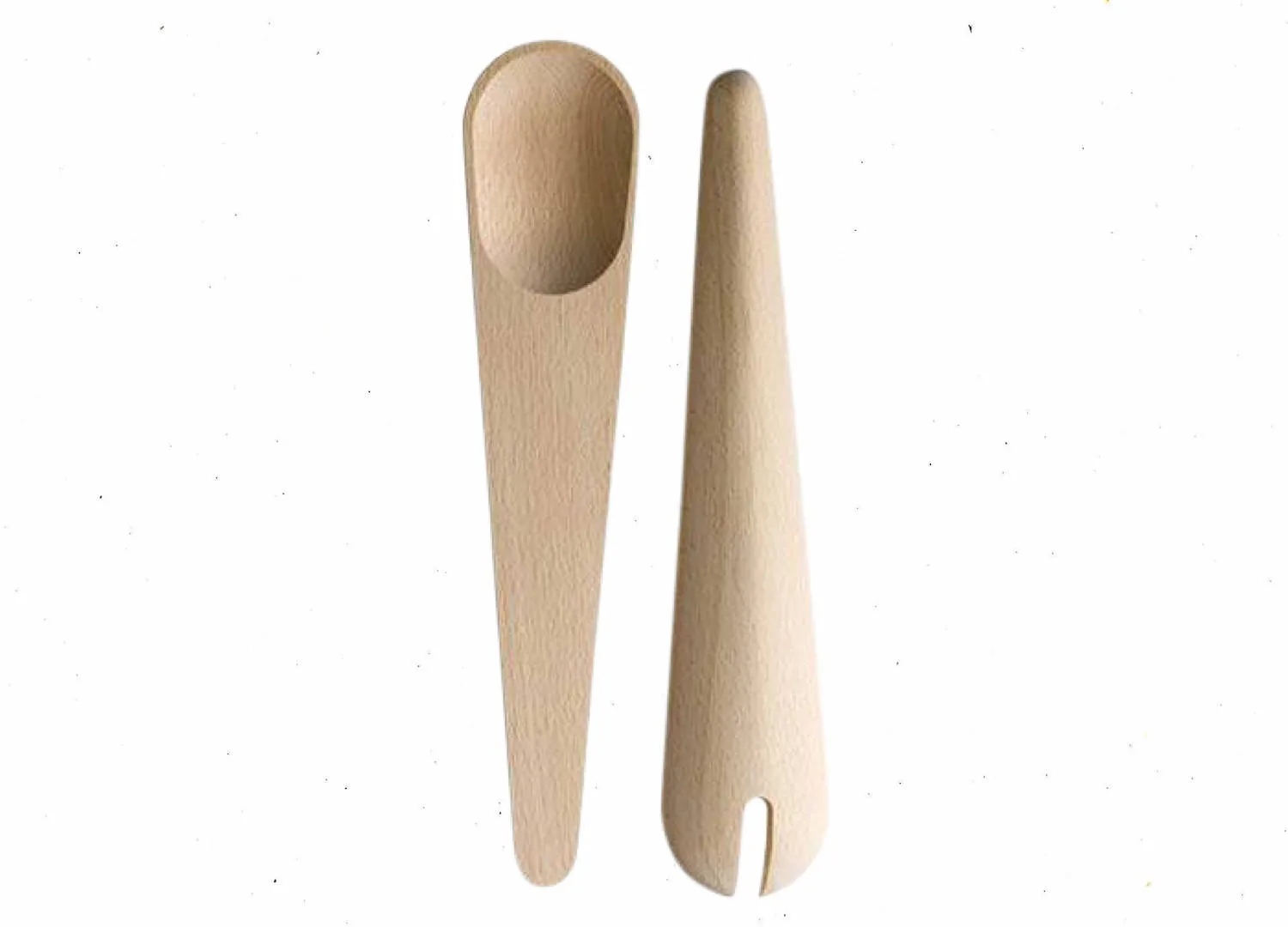
Then Muuto's Toss Around, which Est Living describes as "a contemporary interpretation of the 'wooden tools' we've used for centuries," and this is where the material argument stops being decorative and starts being the point. Nobody makes these from wood because wood is warm and photographs well, although it is and it does. Wood is there because it will not scratch the glaze on a bowl, and will not conduct heat into your palm out of a warm dish, and will not react with vinegar or lemon or oil, and will not taste of anything, and can be worked to a thin section that is still stiff enough to lift a wet handful of leaves without flexing. Four constraints and a stiffness requirement. Everything you find beautiful about the shape is downstream of those.
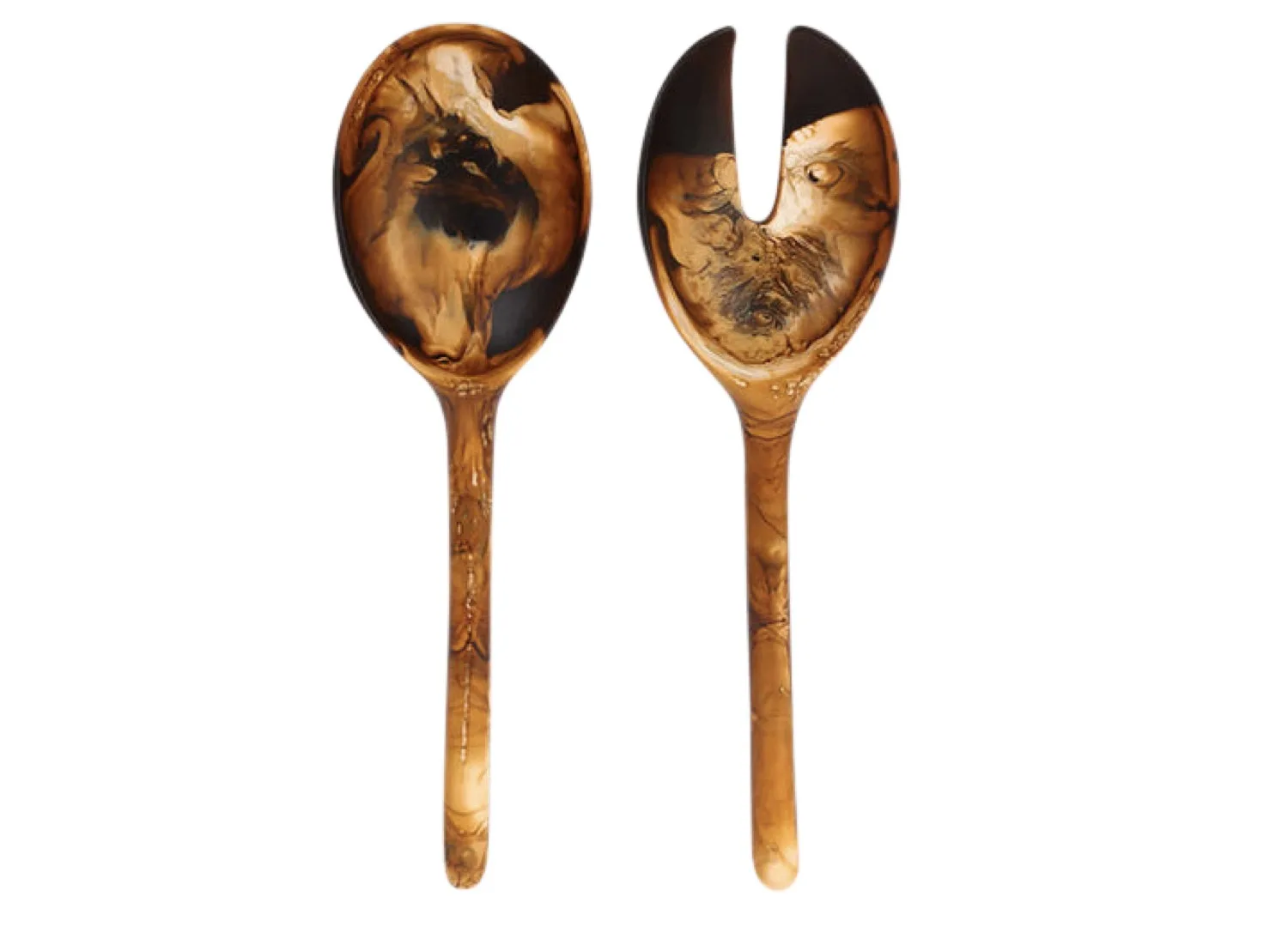
Which is why the resin entry in the list, from Dinosaur Designs, reads as an argument rather than an alternative. Cast resin gets you a colour and a translucency that no wood will ever hold, and it gives up almost everything else on the list, and the studio knows that perfectly well. That is a legitimate trade and it is a trade, and it is more honest than most of the trades we make on a job, where the substitution arrives at the last minute and the reason given is that the two things are equivalent, which they never are.
The reason any of this belongs on an architecture blog is that the building has its own salad servers and we tend to treat them as an afterthought. They are the door lever, the pull, the switch plate, the tap, the handrail, the edge of the counter where your forearm goes. Those are the only parts of a building most people ever touch. A person can live in a room for twenty years and never once put a hand on the structure, the envelope, the waterproofing or any of the systems that consumed ninety percent of the coordination effort. They will touch the lever four thousand times a year, and they will know, in a way they cannot articulate and never mention, whether it was chosen by somebody who cared.
And that line item is always the first one called in value engineering, because it is small, because it is late, because the alternate meets the same written performance, and because nobody has ever successfully explained the difference in a cost meeting. So the lever goes, and the building performs exactly as specified, and it feels like a rental.
Here is the plain part. The salad server survives because there is nothing between the decision and the hand. In a building there is everything, and the only defence is to decide early which touched parts are not negotiable and then be tediously, unreasonably stubborn about them, in writing, before the meeting where somebody arrives with a spreadsheet. Not because a door lever is important the way a foundation is important. Because it is the only piece of the argument the person in the room will ever hold.
Buy the wooden ones. Oil them once a year. They are the only things in the kitchen that will look better in fifteen years than they do today, and everything else in there is already losing.
Sources & Credits
- Livia Toscano, "Nine to Know | Salad Servers," Est Living. First featured in est magazine issue 48, "Kitchen Confidential." All quoted material is from this piece.
- Photography: Est Living, via Est Living. Opening image: Residence Blanke Top by Eline Ostyn, photography by Verne.
- Objects shown: When Objects Work with Nicolas Schuybroek, Dark Wood salad servers; Ferm Living, Os salad servers; Muuto, Toss Around salad servers; Dinosaur Designs, Resin Short Stone servers.