Nobody Bought a Typewriter Here
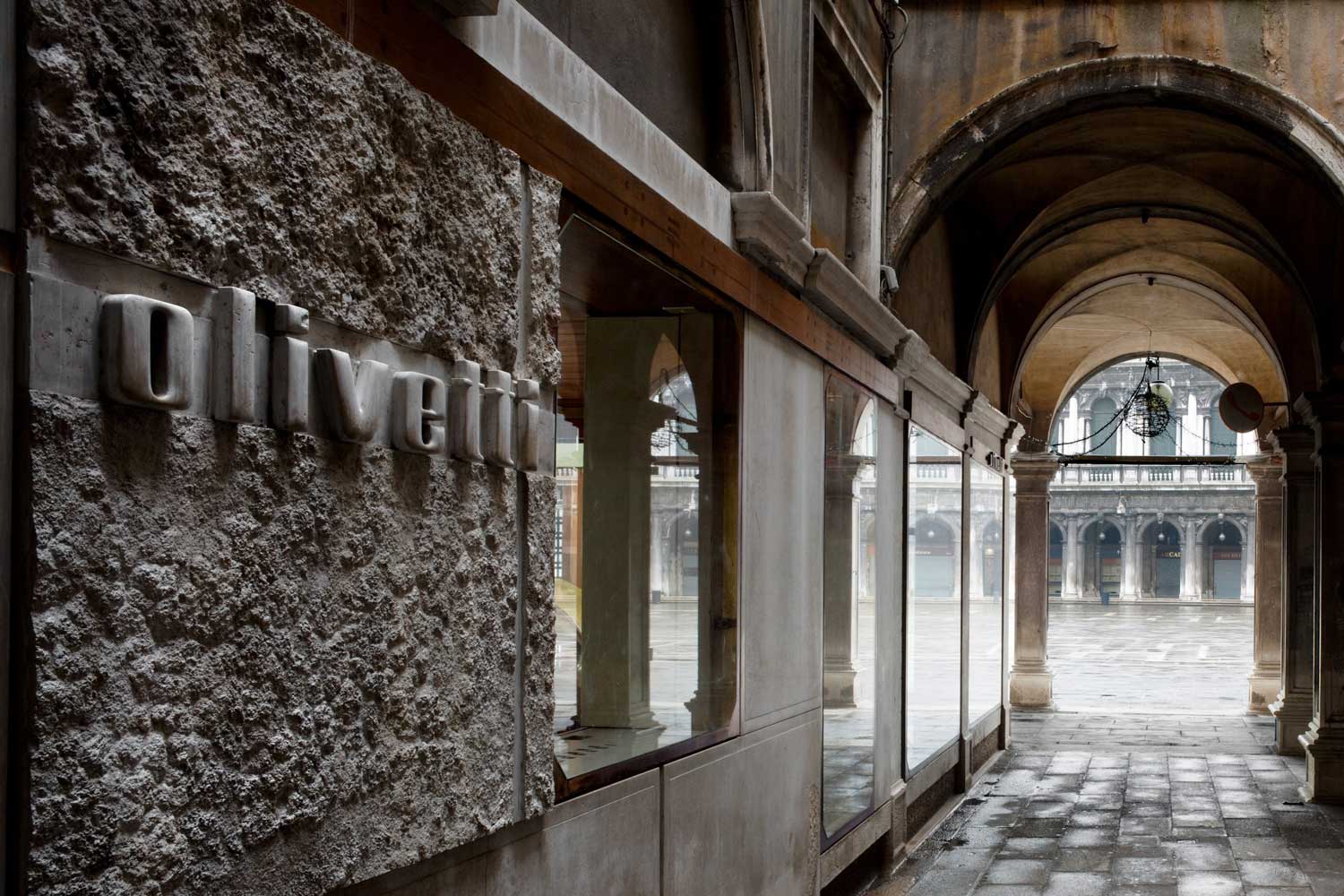
Olivetti made typewriters and calculators in Ivrea, and by the late fifties they were good enough and famous enough that the company did not really need a shop on Piazza San Marco to move product. What the company needed was to be looked at. So it took a narrow slot under the cloisters, and it hired Carlo Scarpa, and between 1957 and 1959 Scarpa built a room that is still being visited almost seventy years later by people who have never typed a word on an Olivetti and never will.
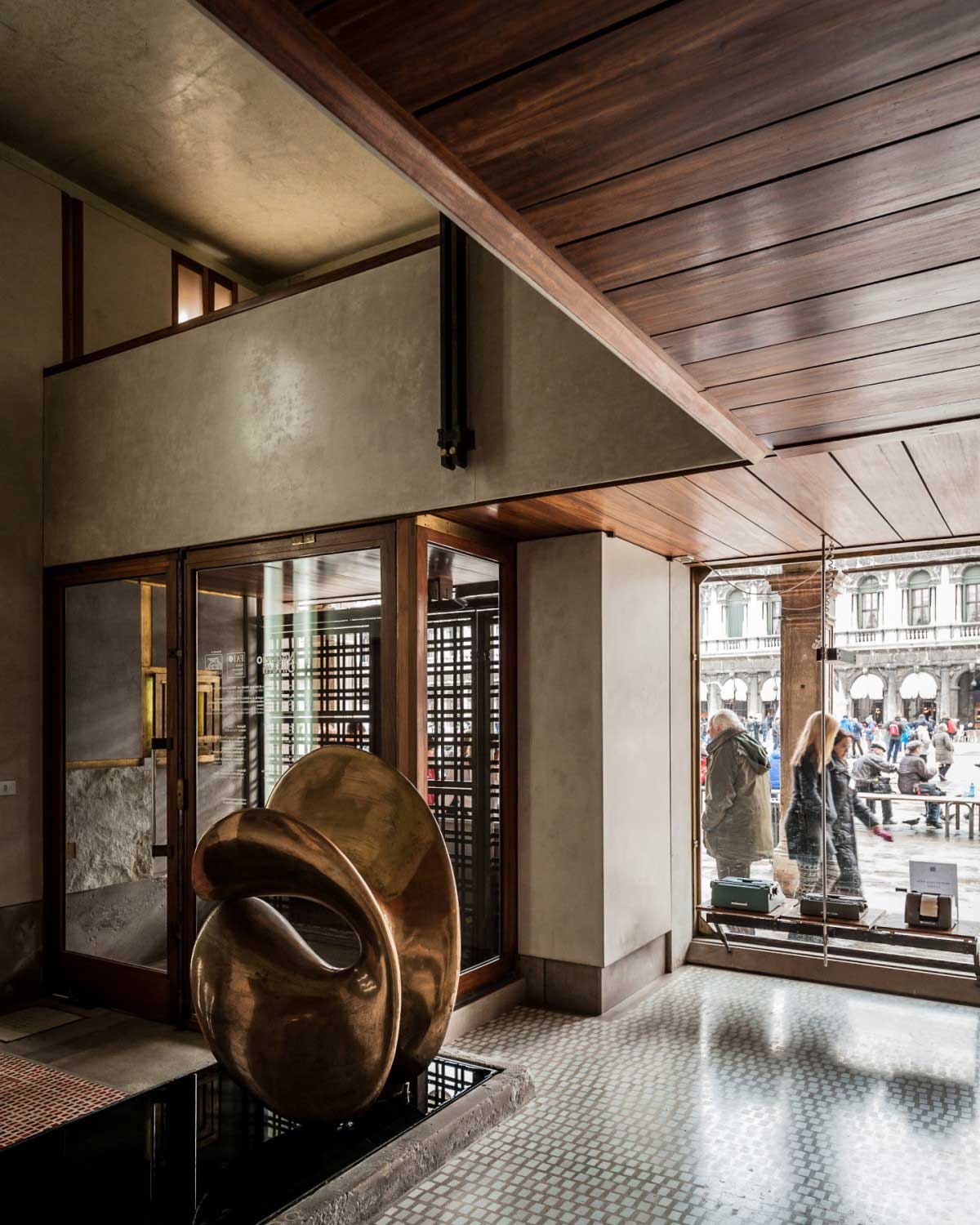
Yellowtrace's write-up of the showroom gets one thing exactly right in passing. Describing the entry, Bronwyn Marshall notes that you come in "through what seems like a hidden door," and then adds the parenthetical that gives the whole game away: "note, concealed hardware will do that to a person" (Yellowtrace).
Concealed hardware will do that to a person. Hold onto it.
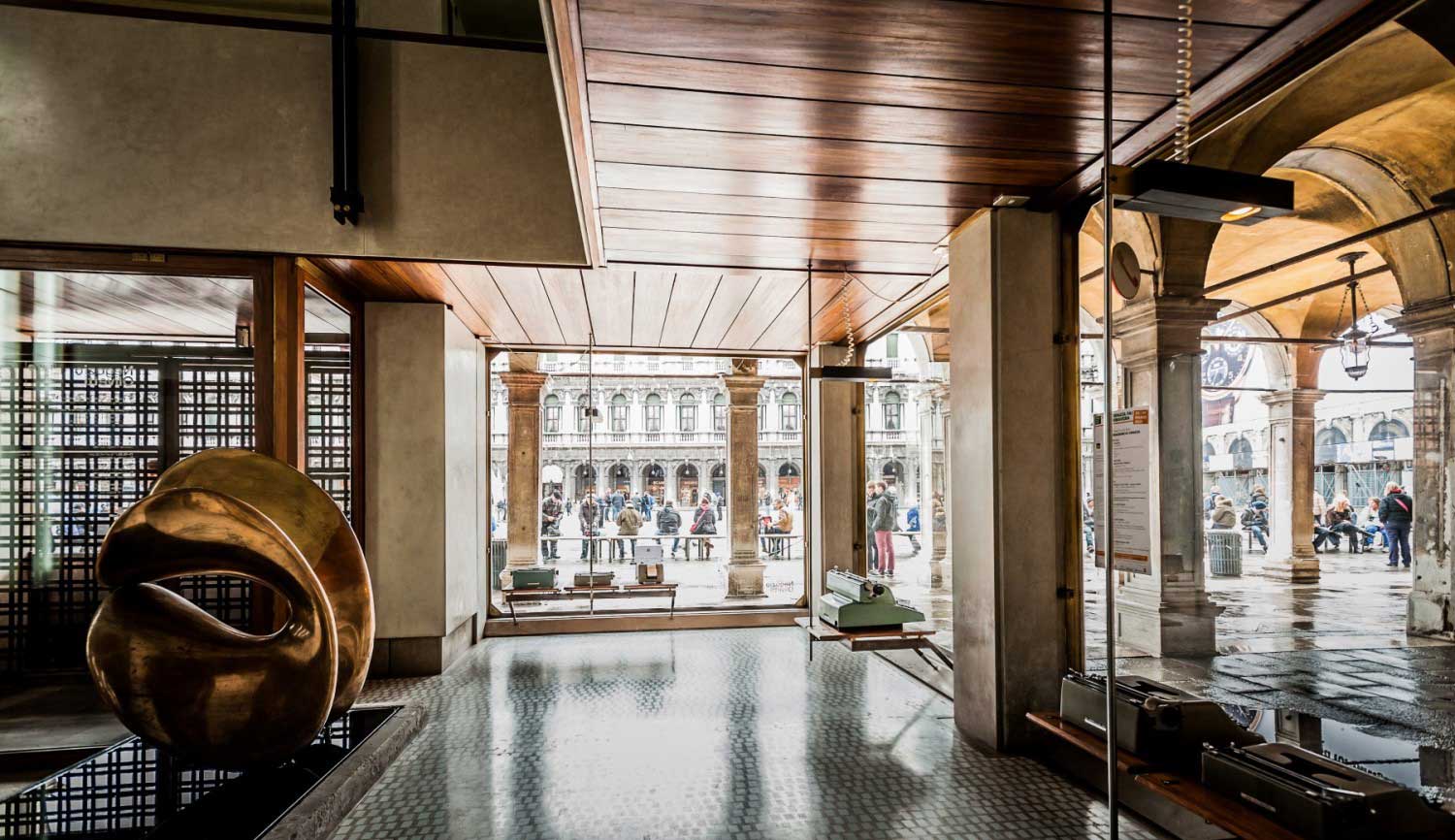
Here is the thing about a showroom, and we say this having drawn a few. A showroom has almost no program. It needs a door, a floor, some light, a place to put the merchandise, and a person to stand near the merchandise and answer questions. There is no kitchen to plan around and no bathroom stack to chase and no client sitting across the table explaining that the children need to be near the stairs. A showroom is the closest an architect gets to being handed a blank room and a budget, and the terrifying part of a blank room and a budget is that the result is entirely your fault.
Scarpa spent it on the floor. Murano glass tesserae, cut and laid in shifting fields of colour, a surface that costs more than the ceiling and the walls put together and that most visitors register as nothing more than a feeling that the room is warmer than it should be. He spent it on the stair, treads of Aurisina stone stepping up through the volume without a visible stringer, each slab reading as its own object rather than as part of a flight. He spent it on the corners, mitred and returned so that a plane looks like a plane and not like two boards meeting. He spent it on the door hardware, which he hid.
None of that sells a typewriter.
We think about this constantly, because the money conversation on a real project runs in exactly the opposite direction. A client walks a job and points at the things that show. The stone at the entry shows. The kitchen shows. The bathroom fittings show, and photograph, and get discussed at dinner. So the budget migrates toward the visible, and the reveal at the base of the wall gets value engineered out, and the flush door becomes a door with an architrave, and the shadow gap becomes a piece of trim, and every one of those decisions is individually reasonable and defensible and small.
Then the job is finished and it feels ordinary and nobody can say why.
The reason is the invisible work. A room does not feel expensive because of what you notice. It feels expensive because of what your eye tries to catch and cannot. When there is no line where the wall meets the floor, when the door swings and there is no visible hinge, when the stone corner returns without a seam, your eye keeps running and finds nothing to stop on, and the brain reads that as calm and reads calm as quality. You cannot point at it. It cost more than the thing you can point at.
Scarpa understood that a shop for a machine company is not a place that sells machines. It is an argument, standing in the most looked-at square in Europe, that this company thinks carefully. And an argument about thinking carefully cannot be made with a nice sign. It has to be made in the joints, because the joint is where care is either present or absent and no amount of money applied later can fake it.
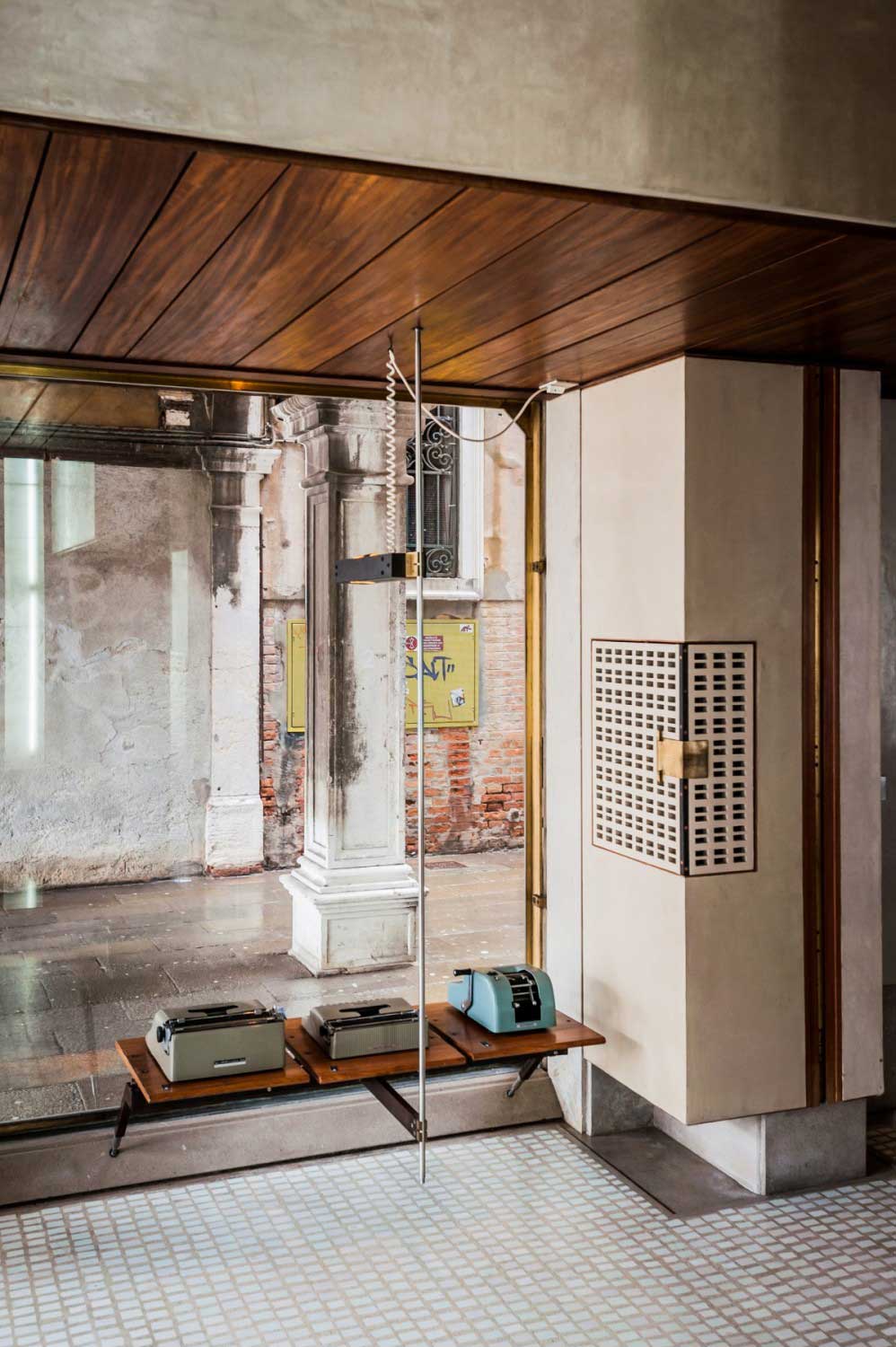
The showroom closed in 1997, which is what happens to shops. The Italian environmental foundation FAI took it on and reopened it as a place to visit, so a room built to sell calculators is now a small museum of itself, and the typewriters that sat in it are collectibles, and the company that paid for all of it no longer exists in the form that paid for it. The room outlasted the product, the brand and the business model. That is not a moral. It is just the arithmetic of building well: the fit-out was the only part of the operation designed to last, so it did.
We would push back on one thing, and it is the thing that gets said about Scarpa most often. The work is routinely described as jewel-like, as if the value were decorative, as if he were a man who liked pretty edges. He was doing something plainer than that. He was refusing to let a piece of construction resolve itself with a caulk line. Every mitre and every reveal and every dropped shadow in that room is a decision to make the meeting of two things explicit and correct rather than approximate and covered. That is not jewellery. That is an attitude about work, and it happens to be expensive.
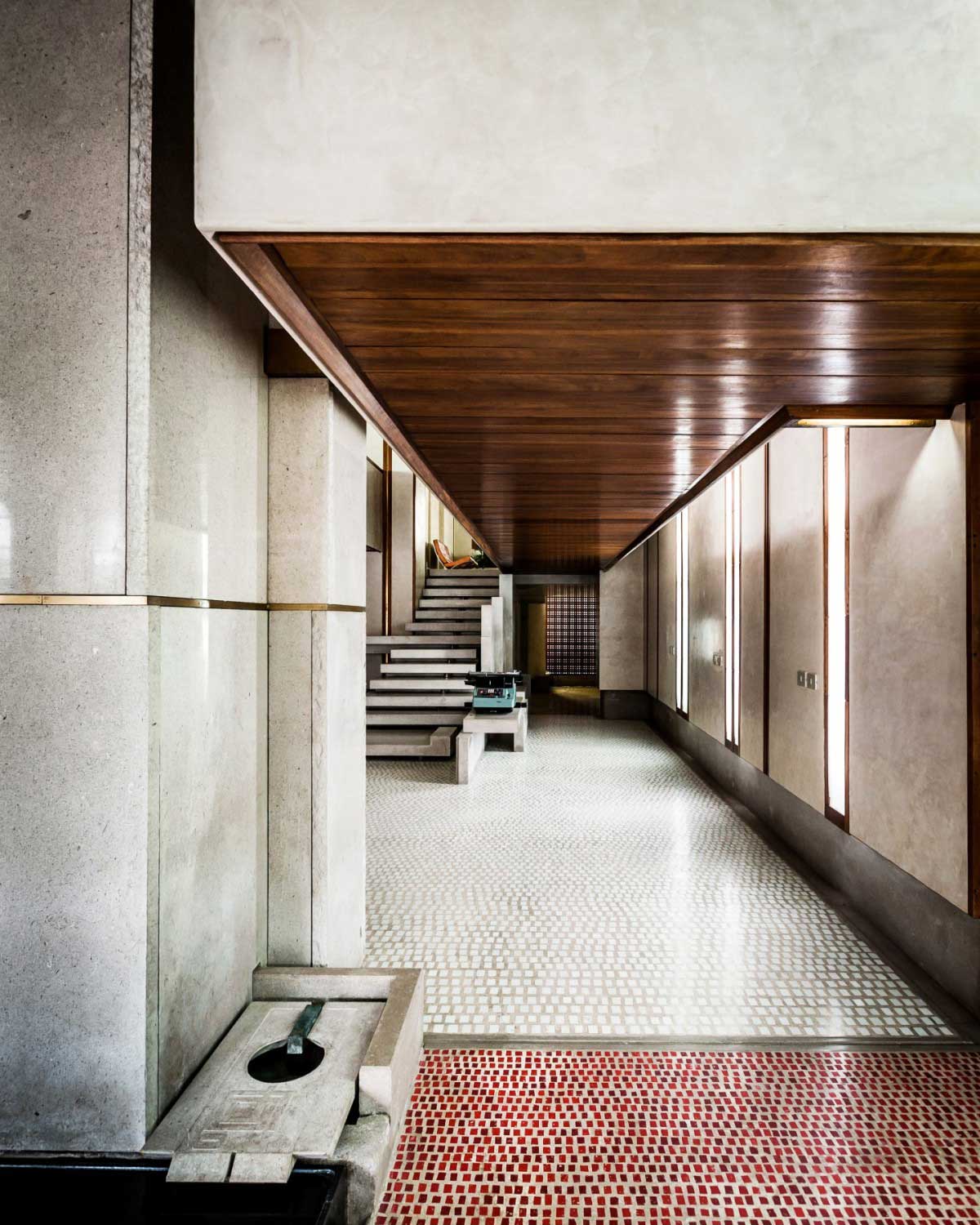
So the next time a fee gets questioned, and it always does, here is the honest answer. A large part of what an architect is paid for is decisions no one will ever see, made on drawings no one but the fabricator will ever read, about conditions that will be buried behind finish before the client walks in. If we do it well, the room feels resolved and nobody knows why. If we skip it, the room feels fine and nobody knows why, and it will keep feeling fine, in the way that most rooms feel fine, forever.
Nobody bought a typewriter here. That was never the job.
Sources & Credits
- Bronwyn Marshall, "Olivetti Showroom in Venice by Carlo Scarpa," Yellowtrace, 17 March 2016. All quoted material is from this piece, which is also the source for the design dates (1957 to 1958), completion in 1959, the Ivrea-made typewriter and calculator collections, the 1997 closure and the FAI reopening.
- Photography: credited by Yellowtrace to George X. Lin, via Yellowtrace.
- Building: Negozio Olivetti, Procuratie Vecchie, Piazza San Marco, Venice. Carlo Scarpa, 1957 to 1959.