The Drawing Cannot Fail
A drawing has never let anybody down. It does not sag in the middle after four years, and it does not develop a squeak at the back left leg, and it does not arrive from the shop with a radius that is technically within tolerance and visibly wrong, and it does not get sat on by a large man in a hurry. This is the reason architects love drawings, and it is also the reason a great many beautiful unbuilt things stay beautiful. Nothing has been allowed to happen to them.
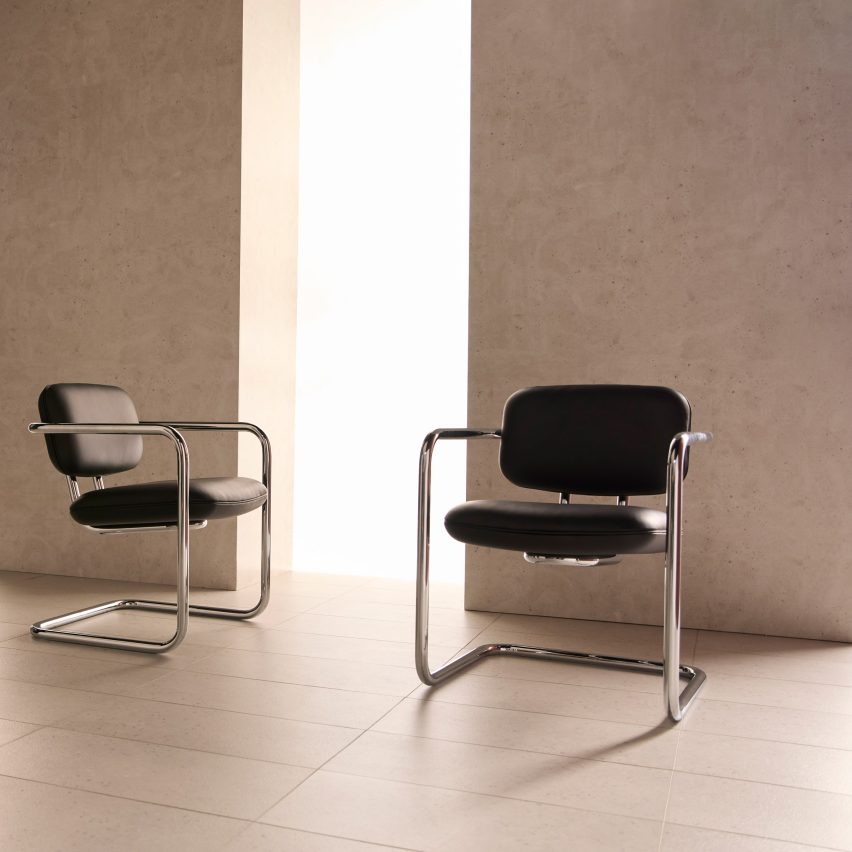
Louis Kahn drew furniture. He drew it for the Radbill Oil Company building in 1953 and he drew it for the M.L. Weiss House, and then, per Ikonstudio, the pieces were never actually made in his lifetime. They sat in the archive being perfect. Now a Canadian outfit called Ikonstudio has produced them, working with the Kahn foundation and with Form Portfolios, which manages his intellectual property. Ikonstudio says this is "the first time design pieces from the titan of modern architecture have ever been made available through contemporary production" (Dezeen).
So this is not a reissue. Everyone will call it one, because reissue is the word we have, and because the same company also brought back the SOM79 chair, which Charles Pfister at SOM designed for Halston's atelier and which genuinely did exist. But the Kahn pieces are a first issue. There is no original to be faithful to. There is a set of lines, and a shop, and a gap of seventy-three years in between.

We say this with some feeling, because we live in that gap on every project. A drawing of a piece of joinery is not the piece of joinery. It is a compressed instruction that leaves out a hundred decisions, and the shop makes every one of them: the exact radius where the arm meets the back, which way the grain runs across a wide face, how the joint closes when the timber has been sitting in a heated building for a month, what tolerance the machine actually holds as opposed to what the machine claims to hold, whether the fastener is bedded or bridged, and what happens at the one corner where two profiles meet that the drawing shows in plan only. On a normal job you resolve this by making a prototype, sitting in it, and telling the fabricator what is wrong. Kahn died in 1974. He is not available for the mock-up review.
David Feldberg, who owns Teknion and founded Ikonstudio, is careful about this. "Ikonstudio is not about revisiting the past, but extending it," he told Dezeen, and the collections were produced "collaborating with archives and estates to produce them through today's materials and technologies." That is an honest description of what has to happen. It is also an admission that somebody, in a room in 2026, decided what a Kahn table joint looks like when it is real. That person's name is not on the piece.
We are not scandalised by this. It is the ordinary condition of making anything from a document. But it is worth saying out loud, because the marketing of archive furniture runs on the idea that the object is being recovered, when in fact the object is being decided.

The SOM half of the story carries the other half of the argument. Ikonstudio describes the SOM pieces as rooted in the studio's idea of total design, where every aspect of a building was considered "down to the ashtrays," and says the furniture was "purely bespoke, designed for specific buildings and clients, never intended for mass production until now."
Total design is a phrase that gets said with reverence, and it deserves some, and it also has a cost that nobody puts in the caption. If you draw the ashtray, you have made an orphan. It has no part number and no price list and no second production run and no replacement when it cracks, because it exists in a quantity of forty, in one building, for one client, and the mould went in a skip in 1981. The SOM79 survived because it was good and because it lived in Halston's studio, which is to say because somebody photographed it. Most of what total design produces does not get photographed. It gets thrown out during the second fit-out by a contractor who has no way of knowing that the ashtray was drawn.
We do this at our own scale, constantly. Every custom pull, every purpose-drawn light fitting, every one-off bracket is a small orphan we are creating on purpose, and the discipline is not to stop drawing them. The discipline is to know which two or three of them are worth the orphanhood, and to write down where they came from, so that in 2049 somebody can find the shop instead of guessing.

Here is where we turn around and give the thing its due, because we think Feldberg is doing something better than nostalgia, and the word "extending" is doing real work.
A drawing cannot fail, and that is not a compliment. It means a drawing cannot be judged either. For seventy-three years, Kahn's furniture has enjoyed the safety of every unbuilt project, which is the safety of never being sat in by a person with a bad back at the end of a long day. Making it is the first time it becomes available for criticism. Somebody will now sit in a Kahn chair and find that the seat is too shallow, or that the arm catches a jacket cuff, or that it is exactly right, and any of those is more useful than another decade of the drawing being lovely. Production is not a tribute. It is a test, and the estate agreed to take it.
That is a braver decision than it looks. Steelcase reissued Frank Lloyd Wright designs in 2024 and the industry has generally learned that archive IP is a low-risk product line. It is only low-risk while the objects stay theoretical. The moment a Kahn table exists at a real price, in a real showroom in Chicago, next to a chair somebody actually likes, the drawing has to answer for itself.
The choice runs through every project we have. We can protect an idea by never building it, and the idea will stay clean, and we will have preserved a small nothing very carefully. Or we can hand it to a fabricator who will call at ten in the morning with a question we did not anticipate, and take the phone call, and make a decision, and be wrong sometimes.
Kahn is not around to take the call. Somebody took it for him. We would like to know who.
Sources & Credits
- "Ikonstudio releases historic furniture by Louis Kahn and SOM," Ben Dreith, Dezeen, 11 May 2026. Source for the Radbill Oil Company (1953) and M.L. Weiss House provenance, the Form Portfolios and Kahn foundation collaboration, the SOM79 chair and lounge, the "total design" and "down to the ashtrays" framing, and all quoted material from David Feldberg and Ikonstudio.
- Photography: David Peterson, via Dezeen.