Big concrete buildings are cheating, a little. Not lying, exactly, just getting help. Stand in any vast poured room with a slot of light coming in high and you will feel something solemn, and you will credit the architect, and some meaningful fraction of what you felt was supplied by the size of the room and would have been supplied by a parking garage or a grain silo or a cave. Scale is a special effect. It works on everybody. It is very hard to tell, inside a large concrete building, whether you are moved by the architecture or merely by the volume of air.
Which is why the interesting Tadao Ando building is the small one.
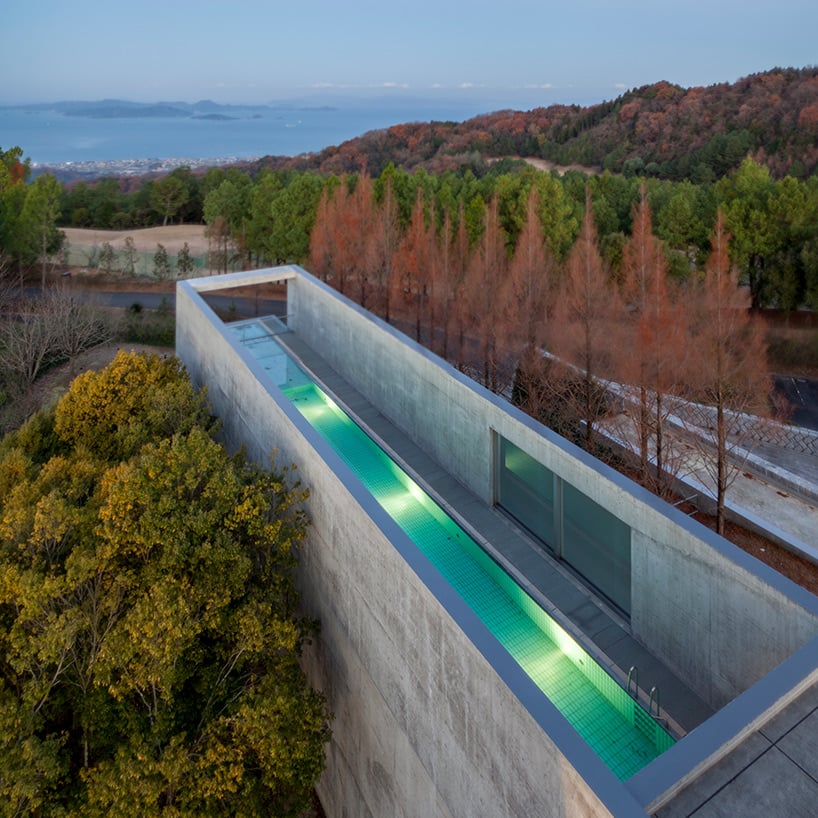
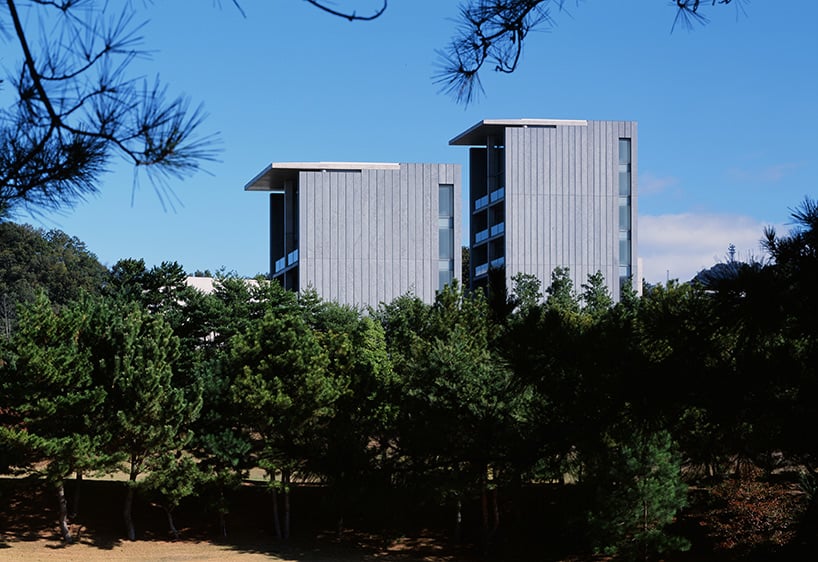
Near Matsuyama, above the Seto Inland Sea, Ando took a private art museum he had built years earlier and remade it as a hotel with seven rooms. Ignant covered it in 2016, noting that the area had grown busy on the back of its international art festival, and that Ando converted the museum to receive some of those people. Seven rooms. A building that used to hold objects now holds sleeping bodies, which is a much harder brief, because objects do not wake up at three in the morning and objects do not need a place to put a wet towel.
The method, stated plainly
Ando's architecture is usually described in a vocabulary of silence and spirit and emptiness, and that vocabulary is not wrong so much as it is useless to anyone trying to build. Stated plainly, the method is three things.
One: a very small number of materials, held to a tolerance most projects never attempt. The concrete is cast with the form-tie holes left visible and regular, so the wall reads as a measured grid rather than as a smooth nothing. The panel joints line up with the openings. That alignment is the whole game, and it is a coordination problem, not a spiritual one. It costs money in shop drawings and it costs the contractor his patience.
Two: light admitted at specific times rather than continuously. Ando does not light rooms evenly. He puts an opening where the sun will arrive at a particular hour and then leaves the rest of the wall shut, so the room has a schedule, and you notice the day passing through it.
Three: a walk. You do not arrive directly. You go around something, or along a wall, or down before you go up, and by the time you get to the room you have been slowed to the building's speed.
None of those three require a museum's budget or a museum's volume. They require decisions and tolerance and somebody willing to hold the line on site when the schedule gets tight. That is why a seven-room building is the fair test. Take away the awe that scale supplies for free, and either the method still produces a room worth being in, or it turns out the awe was doing the work all along.
What water does that a wall cannot
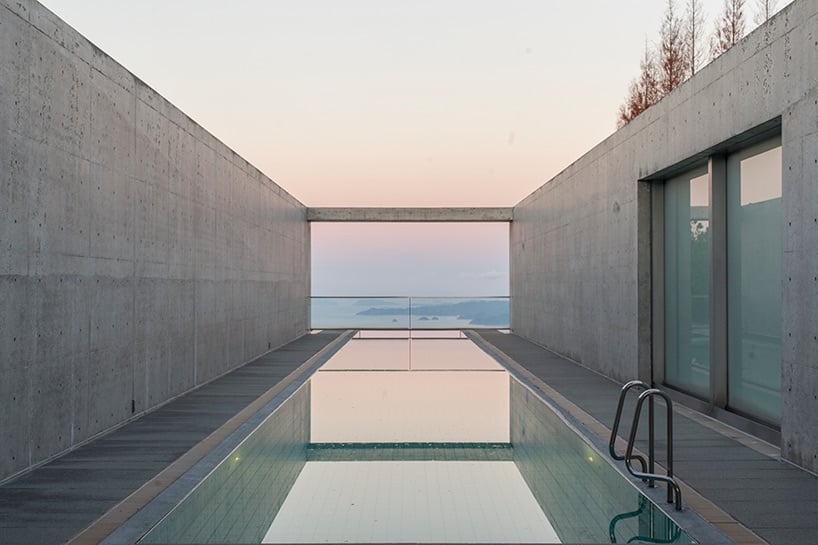
The move at Setouchi Aonagi that we keep thinking about is the simplest one: the building faces the Seto Inland Sea and it has a reflecting pool, and Ando has been doing versions of this for decades. It is easy to file under serenity. It is more useful to file it under lighting design.
A hard flat sheet of water outside a window is a second light source. It throws moving light onto a concrete soffit, and concrete is the ideal receiver for that, because a slightly rough grey surface holds the ripple pattern the way a white painted wall never does. The pool also gives the eye a foreground, so the sea reads as far away instead of as a flat band, and the room feels sited rather than merely oriented. And it puts a moving thing in an otherwise entirely still building, which is the only reason the stillness registers as a choice.
That is not mysticism. That is a designer knowing what a material does when light hits it.
The part we would argue with
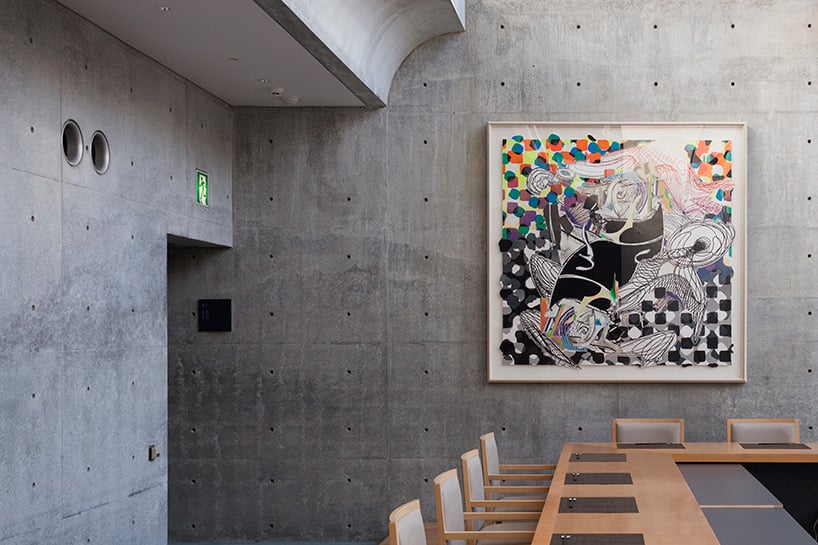
We are not going to pretend the small Ando building is uncomplicated. Seven rooms at that level of finish is an expensive way to house very few people, and the emptiness that reads as generosity in a museum can read, in a hotel, as a place where you are slightly afraid to leave your shoes. Bare concrete is loud: it reflects sound rather than absorbing it, and a bedroom is one of the few rooms where a person is entitled to soft edges and a lamp they can move. There is a version of this architecture that treats the guest as an intruder in a composition. Ando is better at avoiding that than his imitators, who reliably deliver the concrete and forget the light and the walk and leave you in a grey box with nowhere to sit.
But the conversion itself is the argument, and it is a good one. A private museum is close to the least useful building type ever invented: one program, one client, no second act. Ando took one and made it a place where strangers sleep. He did it without covering the concrete and without apologizing for it, and the thing that let him do it is the same thing that lets Breuer's frames absorb new lives, which is that he built the permanent part properly and left the rest negotiable.
Seven rooms. The sea does the middle distance, the pool does the ceiling, the wall keeps the time. And still it stands, doing a job nobody designed it for.
Sources & Credits
- Ignant, "The Setouchi Aonagi Hotel By Tadao Ando," 1 September 2016. <https://www.ignant.com/2016/09/01/the-setouchi-aonagi-hotel-by-tadao-ando/>
- Photography: © Setouchi Aonagi, via Ignant, <https://www.ignant.com/2016/09/01/the-setouchi-aonagi-hotel-by-tadao-ando/>