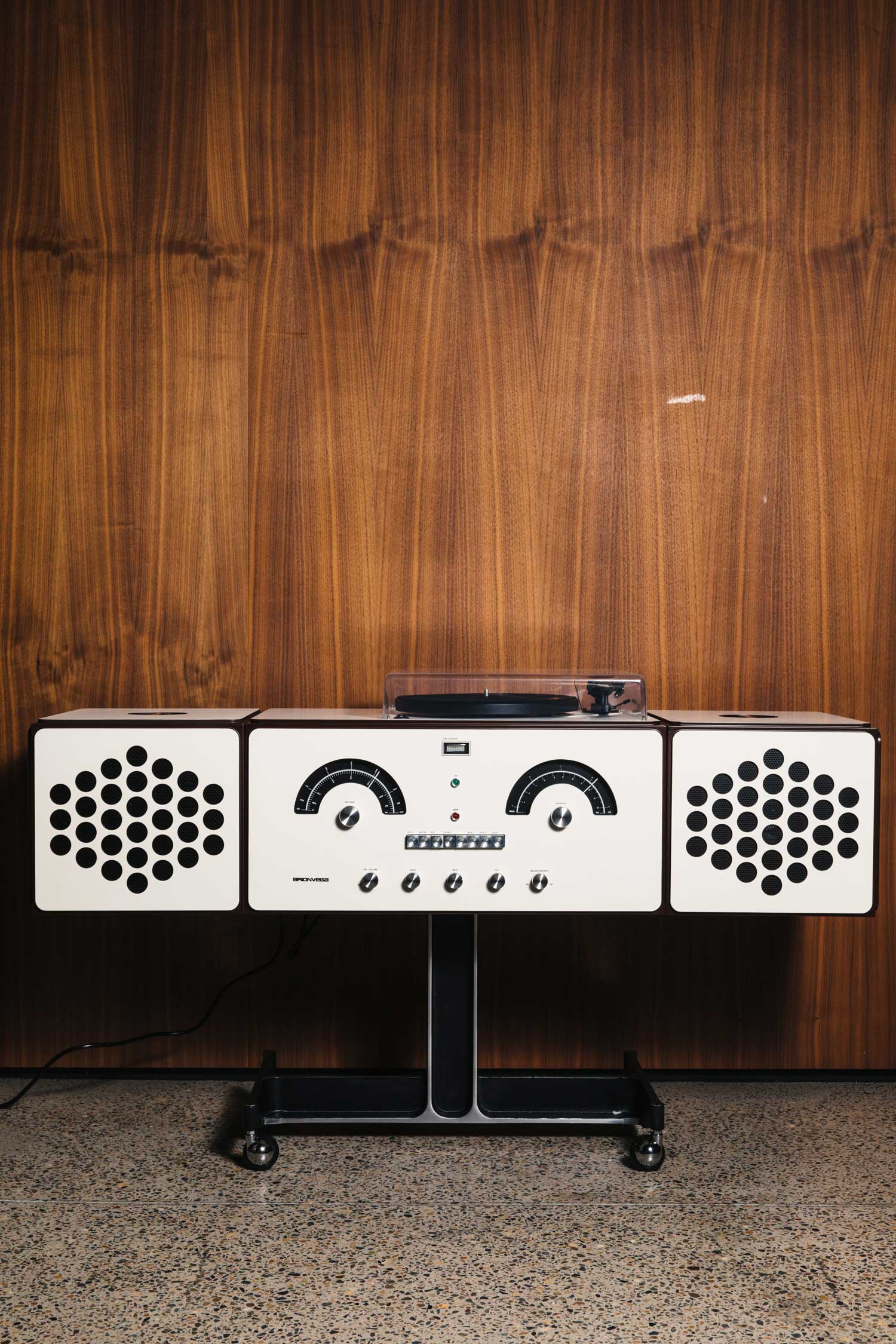
Two speakers sit on either side of a cabinet like ears. Below them, a row of round dials arranges itself into something a two year old would identify instantly as a face. Underneath the whole thing there are castors, because Achille and Pier Giacomo Castiglioni assumed that the object would need to be pushed from one side of a room to the other, the way you push a chair, and they made that easy instead of making it invisible. The V&A, which holds one, notes that the speakers detach and can be set beside the body or stacked on top of it. This is a radio and a record player from 1965 and it behaves like a large friendly animal.
The nickname that follows it around is "musical pet," and the nickname is not a marketing invention laid on afterward. It is a fair description of the design decision. The Castiglionis looked at a box containing an amplifier, a tuner and a turntable, and they decided the honest thing to do with it was to admit it was a piece of furniture with a personality, and then give it one.
Consider what else was happening in 1965. In Germany, at Braun, a different set of designers were working extremely hard in the opposite direction, taking the object down to a grey rectangle with the smallest possible number of controls, on the principle that a good appliance recedes. Both answers are right. Both are still with us. But only one of them won, and it won so completely that we now live in rooms where the sound comes out of a ceiling and nobody in the room can point at the thing making it.
That is worth sitting with, because in our work the request arrives constantly and always in the same words. Can we hide it. Hide the speakers, hide the thermostat, hide the return air, hide the outlet, hide the television behind a panel that costs more than the television. We do a great deal of this and some of it is right. A poorly placed grille will wreck a plaster wall you spent four months getting flat. But hiding has become the reflex rather than the judgment, and the cost of the reflex is a room where nothing is allowed to be an object. Everything is a surface with a secret behind it. You end up with joinery whose entire job is concealment, which is a lot of oak and a lot of hinges spent on the proposition that the room would be better if you could not see how it works.
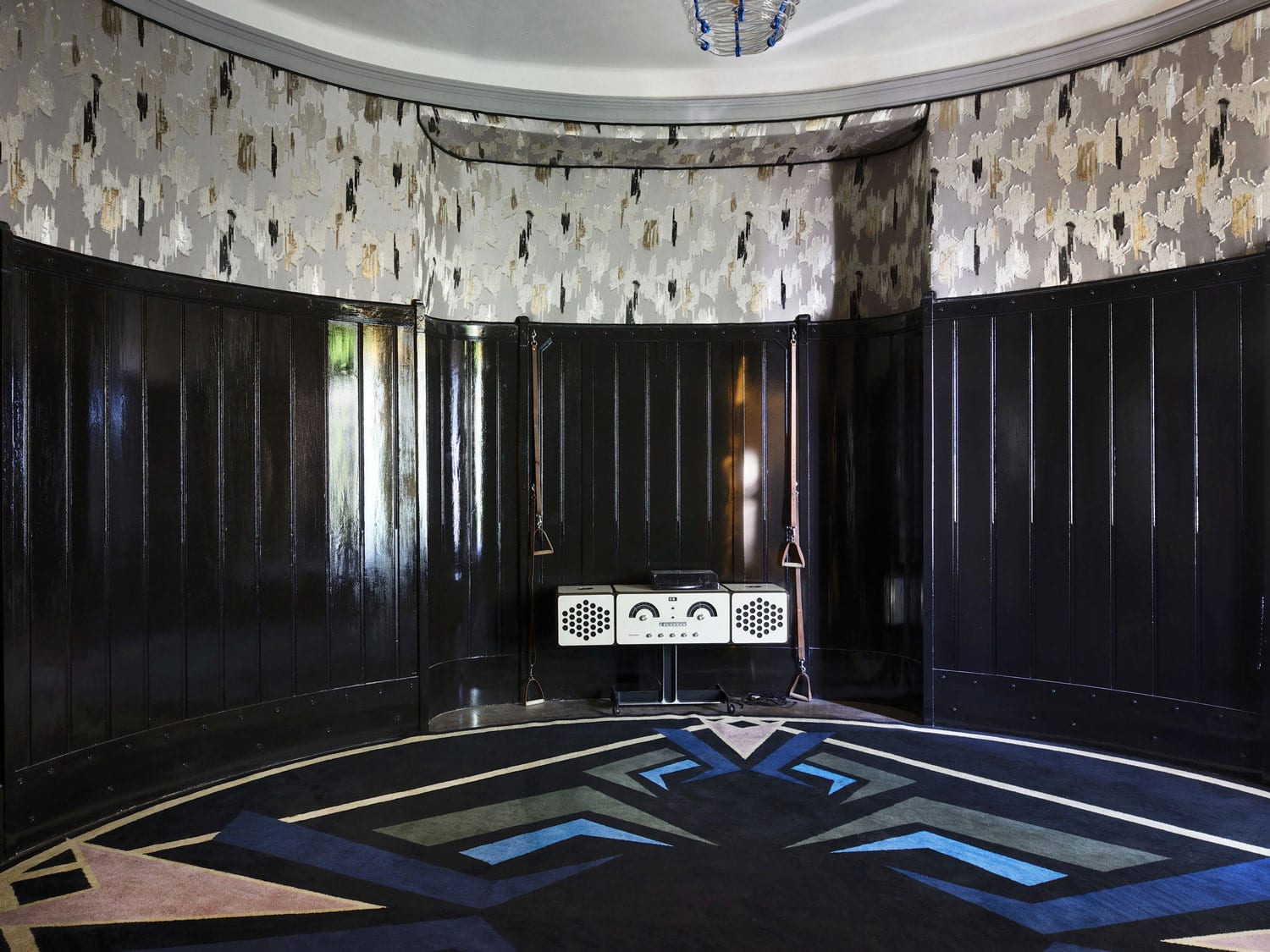
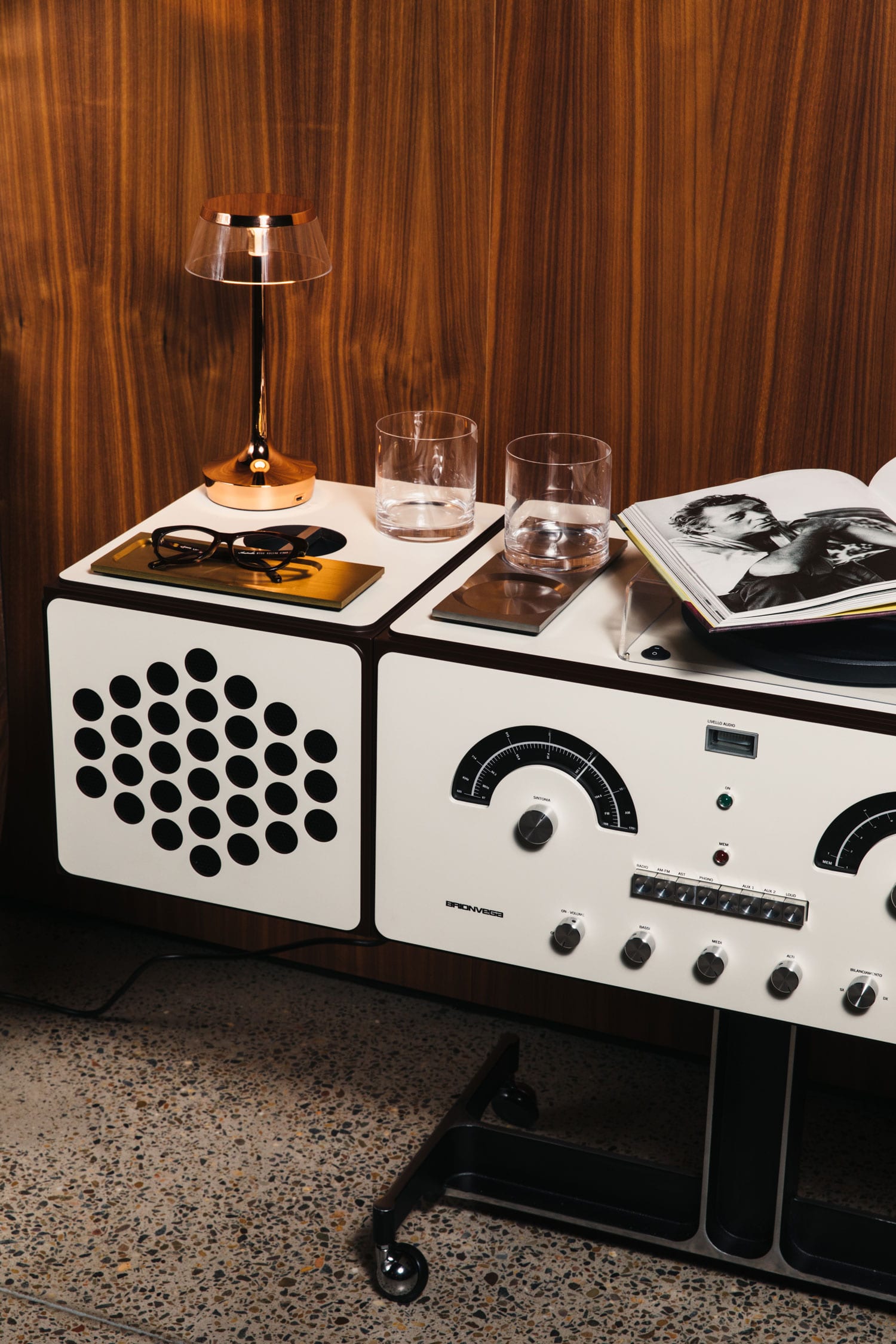
The RR126 makes the other case, and it makes it cheerfully. It puts the mechanism in the middle of the room on wheels and lets you look at it, and the looking is part of the use. You can see which dial does what. You can see where the sound is coming from. A child can operate it without being told. There is no app, and there is nothing to pair, and there is no moment where the object fails to respond and you cannot tell whether the fault is yours or its. It is a machine that explains itself, and that turns out to be a rarer quality than restraint.
Achille Castiglioni was a founding member of the ADI and won eight Compassi d'Oro, and his line on all of this, quoted by Yellowtrace, is short: "Design shouldn't be trendy. Good design should last over time, until it wears out." Note where he puts the endpoint. Not until it goes out of style, and not until the platform stops being supported. Until it wears out. That is a material claim about a physical object, and it is a claim almost nothing manufactured since 2010 could survive being measured against.
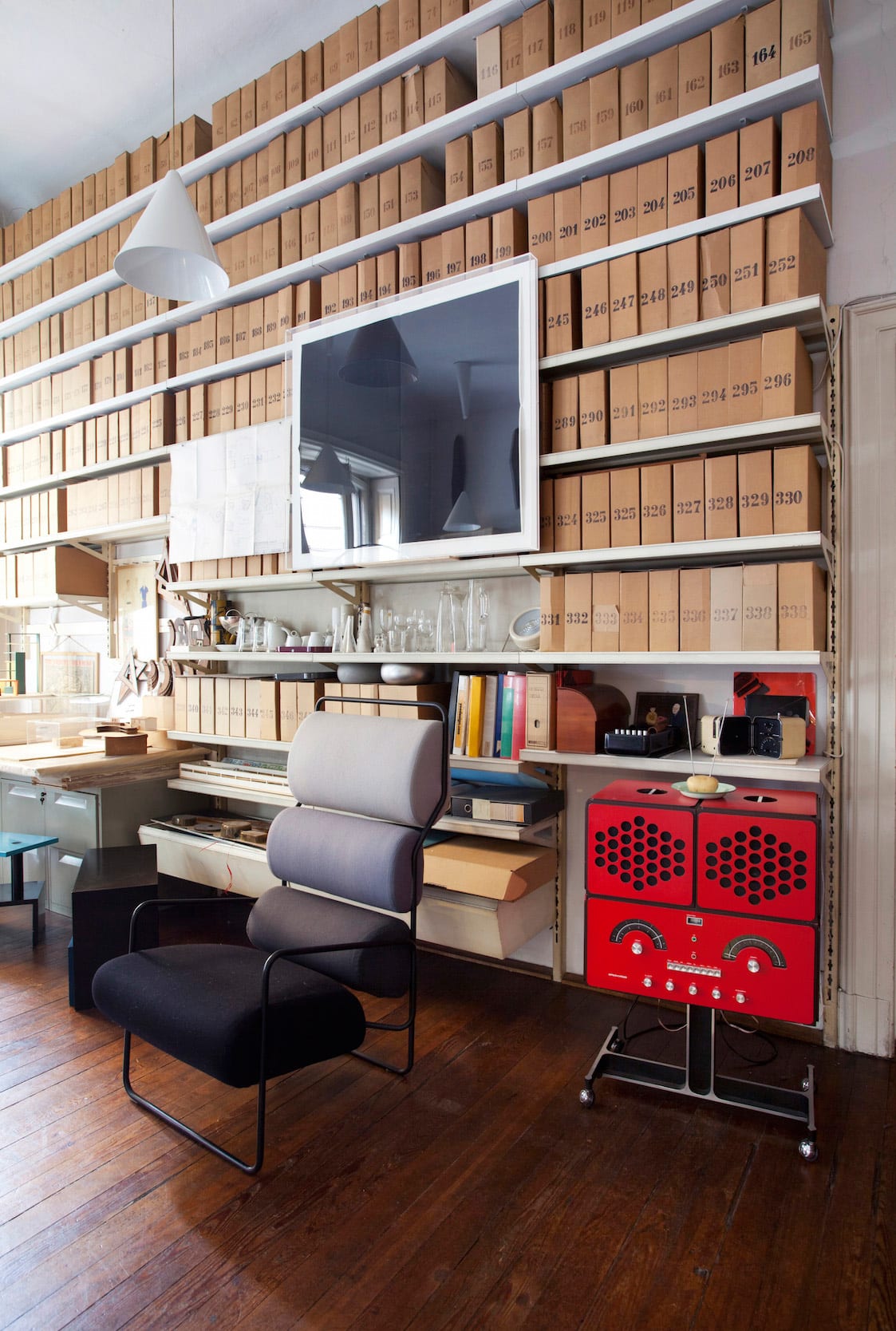
Which brings us to the reissue, and to the detail in it we find most persuasive. Brionvega marked Achille's centenary with a limited run of one hundred, handcrafted and individually numbered, and the current version is still built in Italy to order, with a lead time of six to eight weeks. Six to eight weeks for a stereo. Every instinct trained by the last twenty years reads that as a defect in the supply chain. It is not. It is the product. A lead time that long means the object does not exist until somebody specifically wants it, which means nobody is warehousing a thousand of them and discounting the remainder in eighteen months, which is the mechanism by which most objects become landfill. Slowness at the front end is what buys the long life at the back end. We make the same argument to clients about millwork every month and lose it about half the time.
None of this is an argument for nostalgia. Reissues can be lazy, and a centenary edition of anything is partly a sales occasion, and we would be the last people to pretend that a numbered run of one hundred is a democratic object. But the thing being reissued is genuinely strange, and it is strange in a direction the market has spent sixty years abandoning. It sits in the room. It has a face. You can push it. When it breaks, a person can open it.
The wall is flat and the speakers are hidden and the room is very quiet. Somewhere in it, something is playing.
Sources & Credits
- "Brionvega Celebrates Achille Castiglioni's Centenary with Limited Edition Radiofonografo RR126", Yellowtrace, 3 December 2018: https://www.yellowtrace.com.au/brionvega-radiofonografo-rr126-achille-castiglioni/
- "Brionvega RR126 radiofonografo", Victoria and Albert Museum collections: https://collections.vam.ac.uk/item/O1325746/brionvega-rr126-radiofonografo-radiogram-castiglioni-achille/
- Photography: via Yellowtrace, https://www.yellowtrace.com.au/brionvega-radiofonografo-rr126-achille-castiglioni/. One photograph in the source set is credited by Yellowtrace to Mikael Olsson for T Magazine.