Recycling is a promise about reversibility. You put the thing in the bin because somebody has told you that the thing can be taken back apart into the ingredients it was made from, and the ingredients can be used again, and the loop closes. It works for aluminium. It works, with losses, for steel and glass and clean paper. It does not work for a polyester shirt with a cotton blend and an elastane cuff and a printed logo and a polyester thread holding it all together, because that shirt is a composite, and a composite is a thing that has been decided permanently.
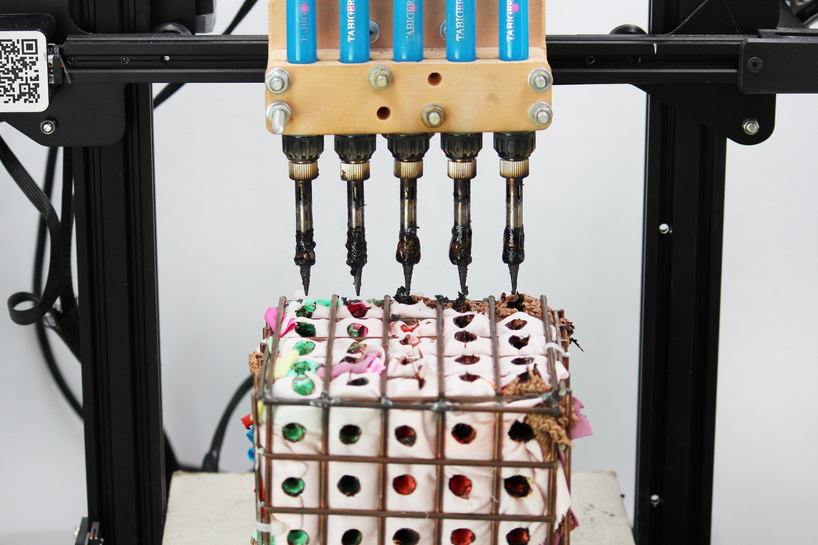
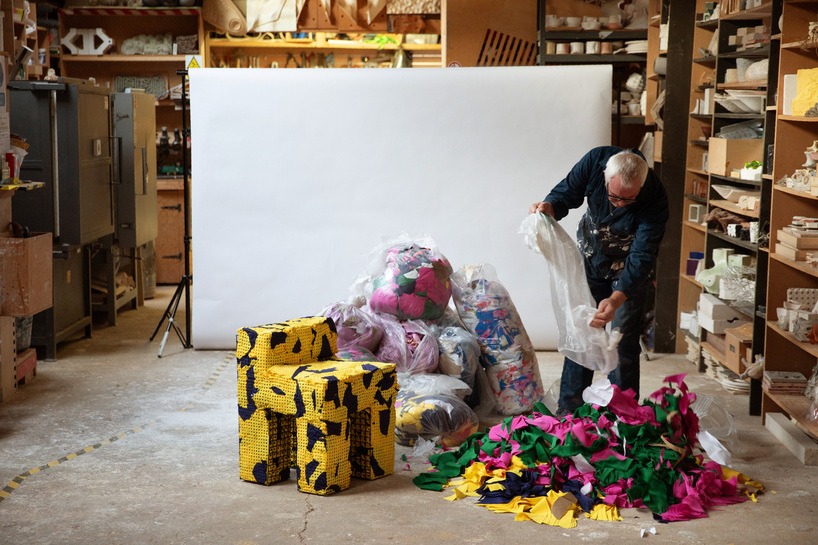
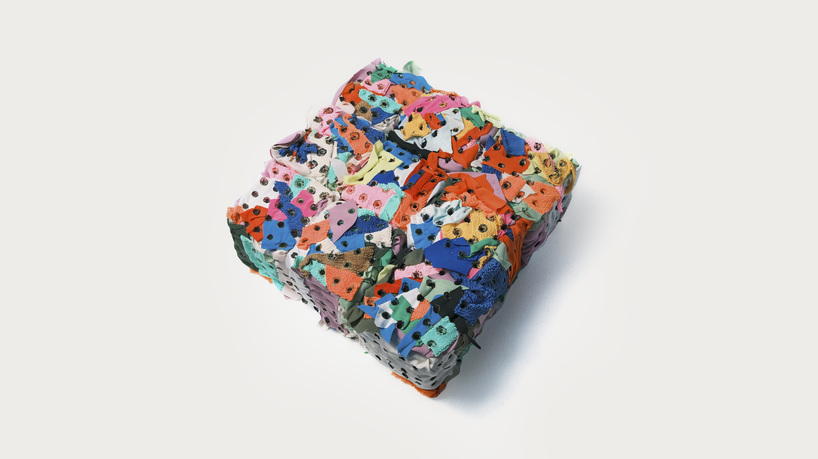
Fast Fashion Architecture, developed by London-based designer Taylor Leung of 12103 Design Studio with Chung Yin Jeffrey Kwong, Chao-An Chang, Chong Li and Jiali Yan at The Bartlett School of Architecture in 2022, does the sensible thing about this, which is to quit. As designboom reports, the project works with non-biodegradable synthetic garments and factory offcuts containing woven polyester fibres, and because those fibres "are difficult to separate or reprocess through conventional recycling methods," it uses heat to fuse them together instead. Garments are sorted and cut. They are packed into mild-steel cages. Then they are heat-treated, and what comes out is a porous material stiff enough to be proposed for furniture, structures and architectural space.
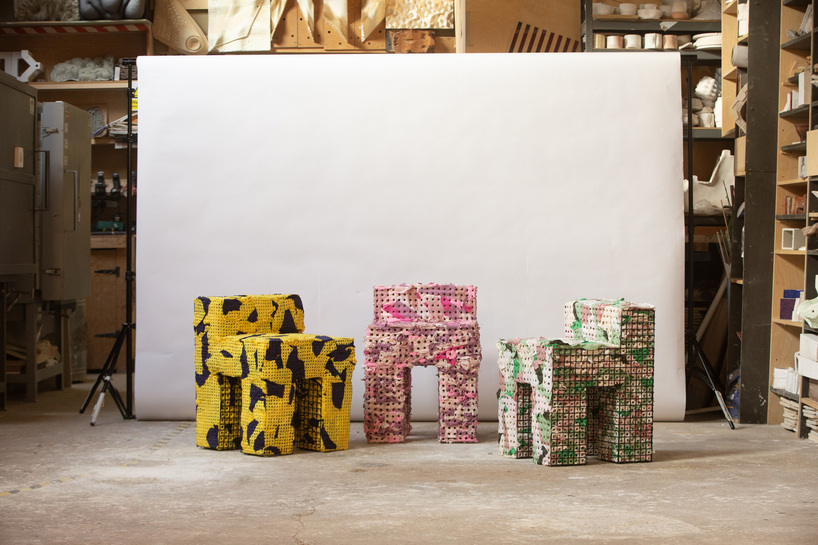
The mild-steel cage is the part we would put in a drawing. It is formwork. Somebody looked at a pile of clothes and understood that the pile had no shape of its own and no ability to hold one, and reached for the oldest answer in construction, which is to build a box, fill the box, and let the process inside the box decide what the material becomes. Concrete has been made this way for two thousand years. The heat here is doing what the water and the cement do there. The cage leaves marks, the way a form leaves marks, and the corners will be the honest part.
We like this project and we are going to be difficult about it anyway, because being difficult about materials is the job.
First, the word. This is downcycling, and it should be called that. The output is not a shirt again and it will never be a shirt again, and it cannot be separated any more easily than the input could, so the loop does not close, it just gets longer. That is not a criticism. A polyester garment made to be worn for one season and thrown away is going to exist for a very long time regardless of what anybody decides, and giving it four hundred years of employment as an acoustic panel is a better outcome than four hundred years of employment as landfill. But an honest material story says the permanence is the constraint, not the achievement.
Second, fire. Polyester melts, and then it drips, and a porous panel is mostly surface area, which is exactly the geometry that makes a plastic burn fast. Any real specification of this material begins and probably ends with a test report and a class rating, and the source does not mention one. That is not the researchers' failure. It is the gap between a Bartlett material project and a submittal, and it is the gap almost every beautiful new material story quietly leaves open.
Third, fixing. You cannot drive a screw into a void and expect it to hold, and a porous fused block is a field of voids with an unpredictable distribution. Which means backing plates, or cast-in anchors set while the thing is still in the cage, or a frame that carries the load and lets the panel be infill. All of those are decisions made at the beginning, not at the end, and all of them cost more than the material saved.
Fourth, off-gassing, at fusion temperature and again in a fire. Anybody heating mixed synthetics in quantity is running a process with a fume question attached, and the answer determines whether this is a factory product or a studio one.
None of that is a reason not to build with it. It is the actual work of adopting a material, and it is worth doing here, because the porosity points somewhere useful. Porous means air, and air means acoustic absorption and thermal resistance long before it means structure. That is not a demotion. A restaurant ceiling raft, a partition core, the inside of a bench: those are real jobs, they are jobs the construction industry currently fills with virgin mineral wool and virgin foam, and a material that can take one of them and cost nothing to make would matter more than a material that can hold up a roof.
There is a person in this story who does not appear in any of the photographs. Somebody cut the pattern and somebody ran the seam, at speed, for very little, on a garment everyone involved understood would be worn a dozen times. That is the strangest fact about fast fashion and it is the one that makes the project land: enormous skill and real human hours poured into objects designed to be forgotten within a year, and then the objects refuse to go. They are still here. They will outlast the building we might put them in.
Giving them a job is not redemption and nobody should sell it that way. It is just a better use of an afternoon than pretending the loop closed.
The garment was made to be thrown away. It declined.
Sources & Credits
- Project details, collaborators, institution and the quoted phrase "difficult to separate or reprocess through conventional recycling methods," from designboom, "discarded synthetic textiles become porous structural material through heat fusion," 10 August 2026. Project by Taylor Leung of 12103 Design Studio with Chung Yin Jeffrey Kwong, Chao-An Chang, Chong Li and Jiali Yan, The Bartlett School of Architecture, 2022.
- Photography: designboom, via designboom, https://www.designboom.com/design/discarded-synthetic-textiles-porous-structural-material-heat-fusion-fast-fashion-architecture-taylor-leung/