Show Me Where It Meets
A shelf held together by one cut, a shop in Venice where nothing runs into anything, and the question every joint answers whether its designer meant it to or not.
Walk up to any building you like, ignore the front of it, and find a corner where two materials meet. A window frame against brick. A stone floor against a timber stair. A steel beam going into a concrete wall. Stand there for a minute. Everything you need to know about the building is in that inch. You will learn whether anyone thought about water, and whether anyone thought about the fact that steel and stone and wood all move by different amounts in different directions for different reasons, and whether the people who built it were given a drawing or an apology. The facade is what the building says about itself. The joint is what it lets slip.
That is the whole idea, and it is older than any of us. A building is mostly made of things that are fine on their own. Concrete is fine. Oak is fine. The trouble always starts where they meet, because that is where the tolerance has to go. Nothing is ever exactly the size it was drawn. Every assembly carries a little error somewhere, and the only real question is where you put it and whether you are willing to let anyone see.
Two pieces of furniture from this autumn answer that question in opposite ways, and both of them are honest about it.
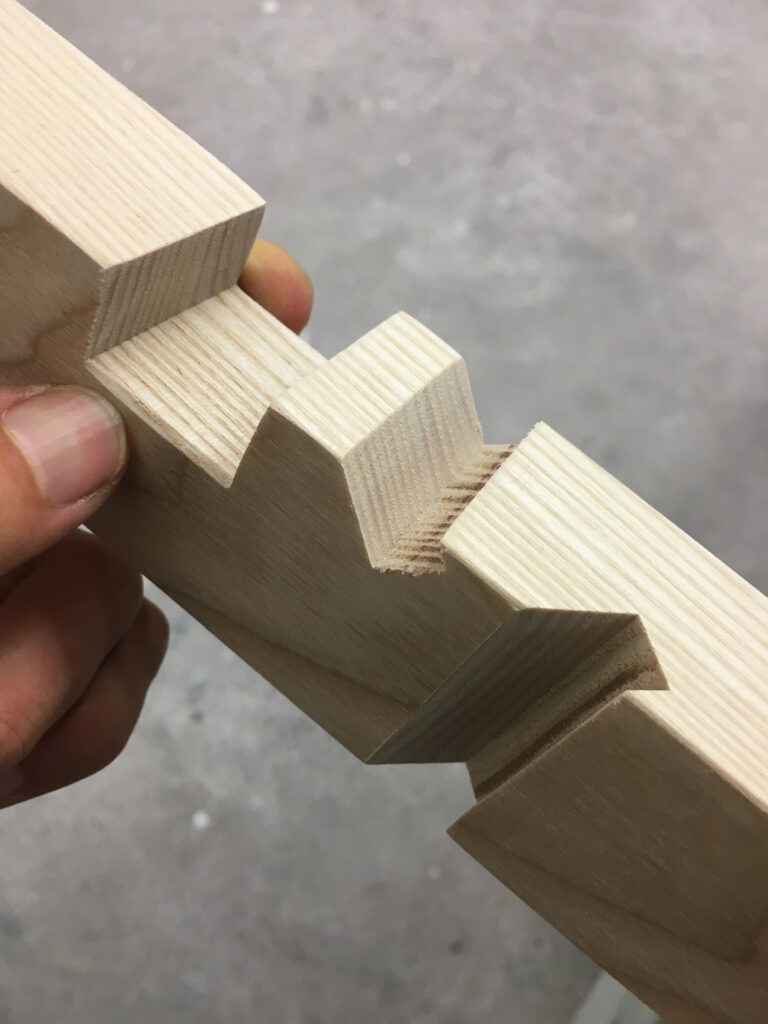
The first is Dado, by the Berlin practice Allen Kaufmann Architekten, which Dezeen readers have just voted furniture design of the year (Dezeen, 6 November 2026). It is a range of tables and shelves held together by nothing. No glue, no screws, no brackets, no little bag of fittings that goes missing in the second move. Just the dado, or housing joint, a groove cut across one piece of timber so another can drop into it, which carpenters have been using for thousands of years. Justin Allen's change was to turn the cut to 45 degrees, so that four pieces, an upright, a shelf and two diagonal braces, lock together at a single point. The whole thing flat-packs, goes up without tools, comes apart again, and can be repaired.
Here is the clever part, and it is a discipline more than a trick. For one cut to carry everything, every piece has to be the same, and every piece has to be exact. So the parts are CNC-milled, and a limited set of them repeats through the whole range. Dado puts all of its tolerance into the factory. By the time the wood reaches your living room there is no error left to hide, and so nothing is hidden. "The connection remains visible," Allen told Dezeen, "so the joint becomes the detail, the structure, the assembly and ultimately the design." He also said why: so that whoever owns it can see how it works and how to look after it.
That is the real reason to show a joint. Not because it is handsome, though this one is. Because a joint you can read is a joint you can fix.
A joint you can read is a joint you can fix.
The second piece goes the other way entirely. Omnibite, by the Milan designers Eugenio Costa and Nicolò Tallone, starts with branches, raw ones, gathered from local wood in Lombardy and used more or less as they come off the tree (designboom, 16 September 2026). No two branches are the same diameter and none of them meets another at a tidy angle, so Dado's answer is impossible here. Instead the joint does the thinking: a three-axis connector of metal and 3D-printed parts, with adjustable clamps and interlocking plates, that locks onto whatever it is given without a screw. At Paris Design Week this year, at Espace Commines, it became furniture for the first time, a chair, a table and a lamp.
And the joints are bright yellow. Of course they are. If the joint is the part doing all the work, it should not pretend to be bark.
Put the two side by side and you have the two honest answers to the same problem. Make the parts perfect and the joint can be simple. Leave the parts as they are and the joint has to be clever. What neither of them does is the third thing, the common thing, which is to let the parts be imperfect and the joint be imperfect too, and then cover the meeting with a bead of sealant, a strip of trim or a coat of paint and hope nobody kneels down to look. In building, that third answer has a name. It is called caulk, and it has done more to make modern buildings look alike than any architect.
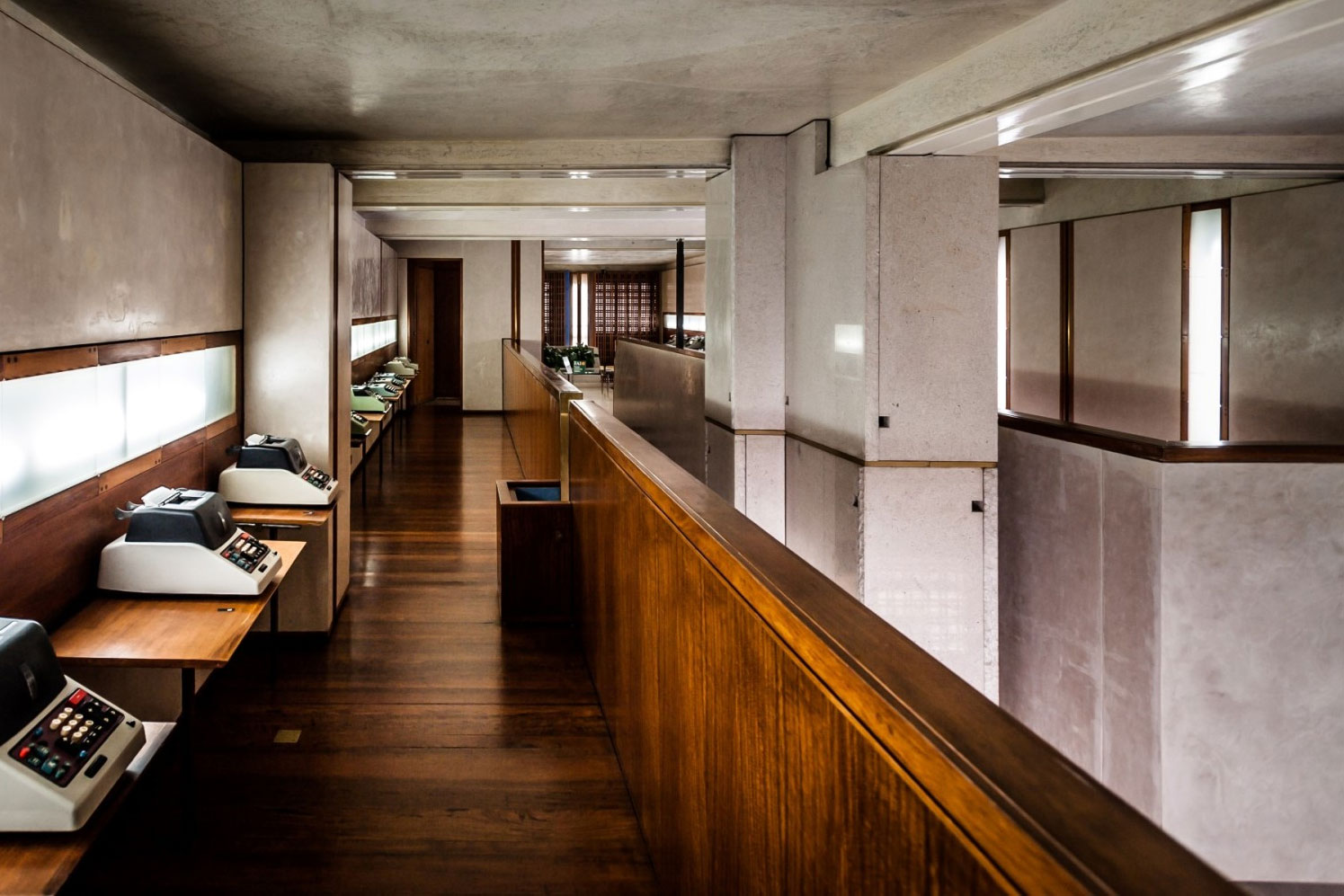

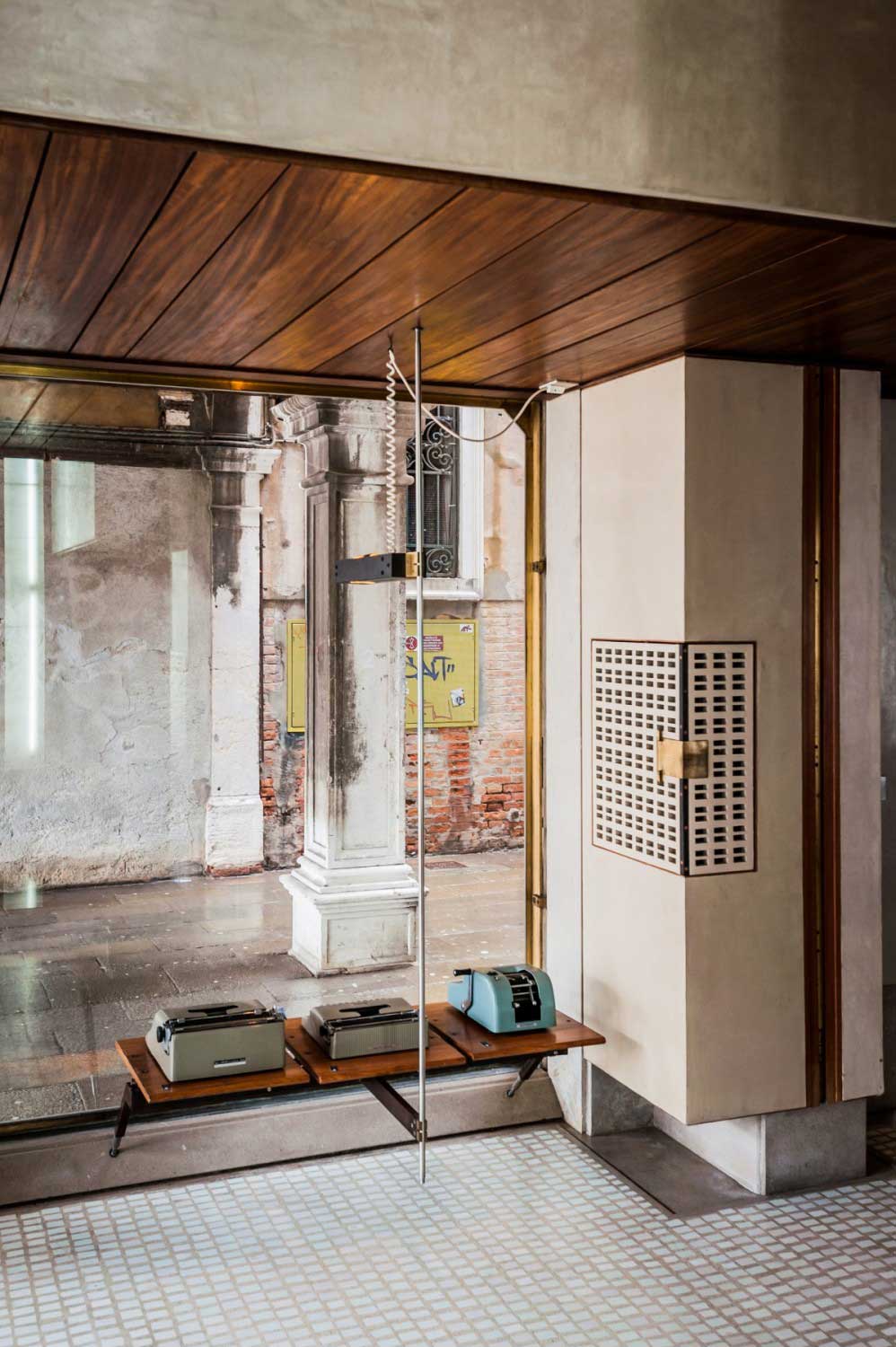
Carlo Scarpa understood this better than almost anyone. In the Olivetti showroom he designed on Piazza San Marco in Venice in 1957 and 1958, a shop built to sell typewriters, the concrete platforms of the stair step up through the room at deliberate offsets, the timber is mitred at its corners, and the hand-cut mosaic floor, the stone and the wood are layered so that each one visibly stops before the next begins (Yellowtrace). Nothing runs into anything. Every meeting has a gap, and every gap was drawn.
And here is the part people miss. The entrance door has its hardware hidden. Scarpa was not exposing everything on principle. He was deciding, one meeting at a time, which joints had something to say and which ones only needed to work. That is the discipline. An honest building is not one where every fixing is on show. It is one where nothing is pretending, and where the joints you can see are the ones that are actually doing the holding.
The exposed joint, of course, has already been discovered by the people who discover things. Core77 put it plainly: furniture designers once hid their joinery, but now "anything goes," and the joint itself has become the point of visual interest (Core77). That is how you end up with a decorative bolt head on a beam that is glued, a fake through-tenon on a flat-pack desk, and a steel plate on a café wall that holds up the idea of steel. A joint shown for its looks is ornament in work clothes.
The test is simple enough to do in a shop. Take it away. If something falls down or comes apart, it was a joint. If nothing happens, it was a decoration, and should be judged like one.
The other cost is less fun to talk about. Hidden joints exist because hiding is forgiving. A concealed fixing can be a bit off, a shadow gap can swallow a crooked wall, and the sealant will cover the rest. An honest joint forgives nothing. It needs tighter drawings, better trades, more time on site and a client who understands why the corner took a week. It is more expensive, every single time. The only argument for it is the one Dado makes: thirty years from now, somebody will need to take this apart, and the joint will either tell them how or it will not.
Every building eventually gets taken apart by someone. The joint is the only part that was ever written for them.