The Bear Set the Price
Dek: An Asian black bear strips the bark off a Kyoto cedar, the tree heals crooked, and a grading table decides the log is now firewood. A Kyoto lacquer house has been buying those logs since 2022.
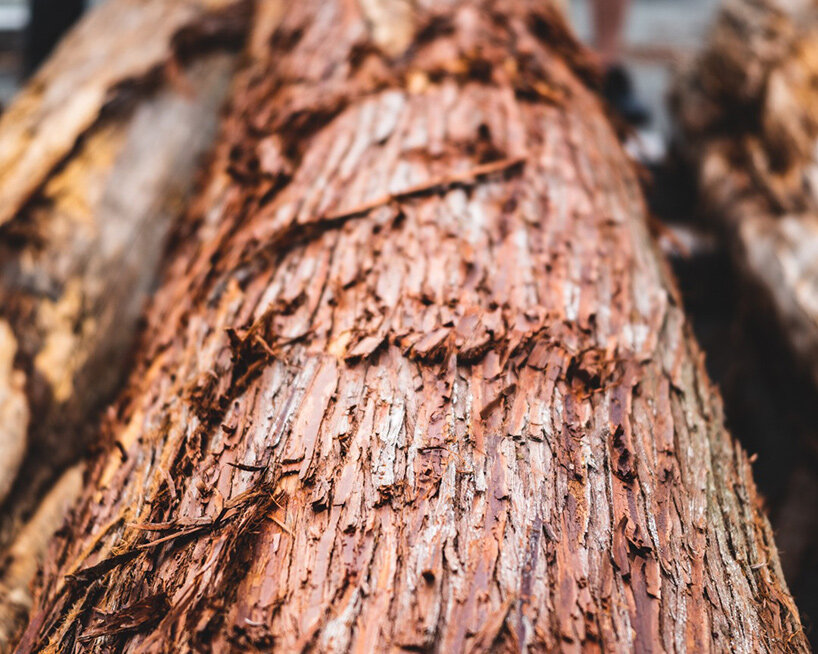
In the forests of Keihoku, north of central Kyoto, Asian black bears strip bark from cedar and cypress, and the trees keep growing, and new tissue closes over the wound, and the wood comes back warped and irregular through the whole section. The behaviour has a name, kumahagi. According to designboom, those marks "can sharply reduce the timber's commercial value," and Kyoto City says the damaged trees are often chipped for fuel or left in the mountains to rot (designboom).
The tree is fine. The tree is doing exactly what a tree does after an injury, which is heal around it and carry on for another forty years. What failed is a grading convention.
This is worth sitting with, because we hand grading conventions an enormous amount of authority and almost never look at what they are actually measuring. A timber grade is not a judgement about strength or beauty or how a board will behave at a threshold in August. It is a bet on predictability. Straight, clear, even grain is valuable because it lets a mill quote a number, and lets a specifier repeat an order in six months and get the same thing, and lets a joiner cut a hundred pieces without stopping to think about any of them. Repeatability is the product. Kumahagi does not fail the wood. It fails the paperwork.
What they made, and what it proves
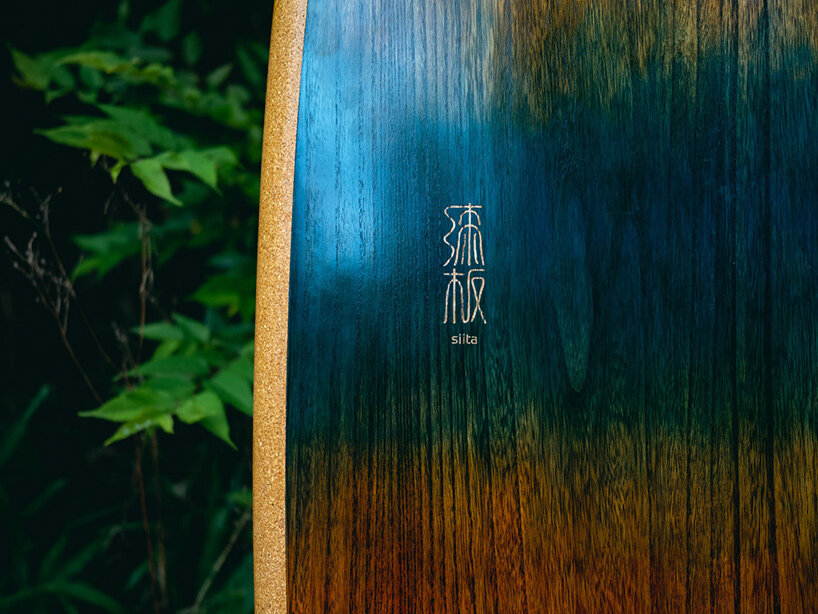
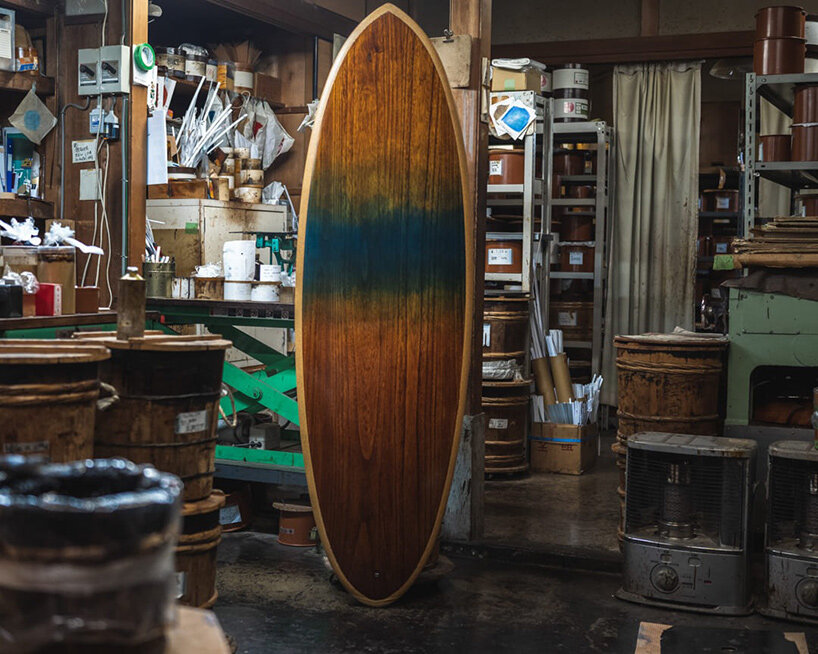
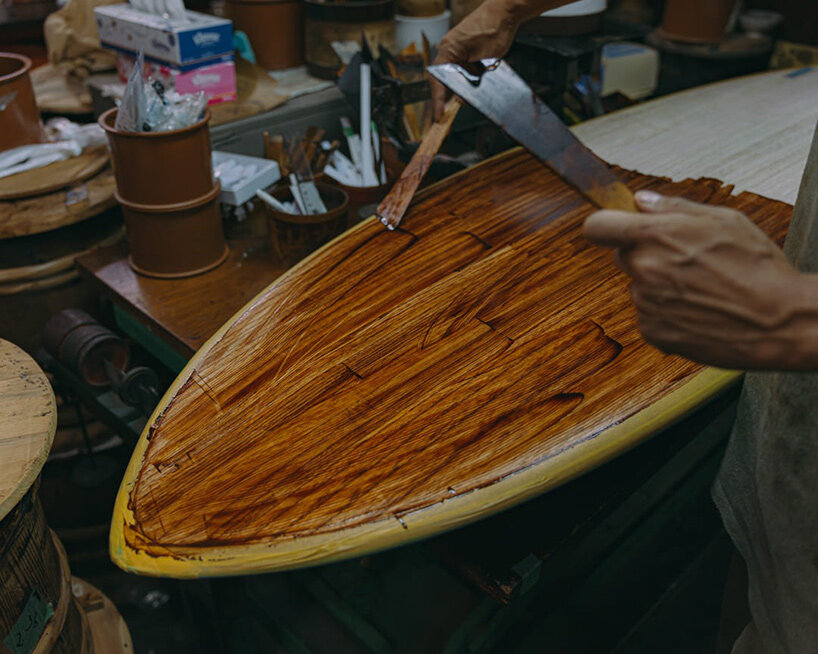
The BEARS WOOD PROJECT started in February 2022 out of Tsutsumi Asakichi Urushi, a Kyoto lacquer house now in its fourth generation under Takuya Tsutsumi, working with foresters and woodworkers in Keihoku including Yoshida Woodworking, Yotsuji Wood and Lasca Woodworks. Their stated aim is to "turn kumahagi, which has always been seen as a negative factor, into a positive value" (Tsutsumi Asakichi Urushi). Under the siita brand, launched in May 2023, the damaged cedar becomes surfboards, shaped in a workshop in Keihoku and then lacquered with urushi back at the Tsutsumi works, so the crooked grain runs straight through the finished gloss where everybody can see it.
The surfboard is the easiest object here to love and the least useful part of the argument. A board is a one-off by nature, made for one person who wants this particular piece of wood with this particular history in it, priced accordingly, and sold on the story as much as the ride. Nothing about it tests whether the material can carry a real order. We say this with affection, because the boards look serious and the craft is not in doubt. It is simply that a beautiful one-off proves a beautiful one-off.
The item in their list that matters is further down, past the skateboards and the lacquered drinking straws and the bouldering holds, and it is the floorboard.
The floorboard is the hard part
A floor is a quantity problem. To put this material into a drawing we would need a number of square metres agreed in advance, a tone range we can hold within a batch, a lead time that survives a construction programme, a fixing detail, and a named person to call in year three when three boards cup near a south window. A bear is not a supply schedule. You cannot order four hundred square feet of irregular grain for March, because the feedstock arrives when an animal decides it arrives, in the quantity the animal decided, in a species and a section you did not choose.
That is not a criticism of the project. It is the actual frontier of every material like this, and the reason so much circular design never leaves the exhibition stand: the stand needs one good object and a drawing set needs a consistent supply. The way through is boring and commercial. Somebody has to aggregate several seasons of damaged logs, sort them into tone bands, hold stock, publish a data sheet, and accept that the interesting variation has to be sold as a specified range rather than as a surprise. The projects that survive turn into slightly dull businesses with a warehouse. We would specify a bear-scarred cedar floor tomorrow if somebody could tell us what arrives in March.
Now the part to admire
Urushi is the serious material in this story and it is not there for looks. Tsutsumi Asakichi describe a coating whose cured hardness exceeds automotive paint, whose hydrophilic surface reduces resistance in water, and which has been in use in Japan for thousands of years, and they put it plainly: "Urushi is the perfect material for a surfboard that harmonises with the waves" (Tsutsumi Asakichi Urushi). Set the poetry aside and you still have a tree-sap finish, harder than car paint, going onto softwood that is going into salt water. That is a performance claim with a test attached, which is rarer on a sustainability stand than anyone admits. We have argued before that a craft stays alive on orders rather than on reverence, and this is the argument in its most literal form: a hundred-year-old lacquer works found a second product line, and the product line is what keeps the skill in the building.
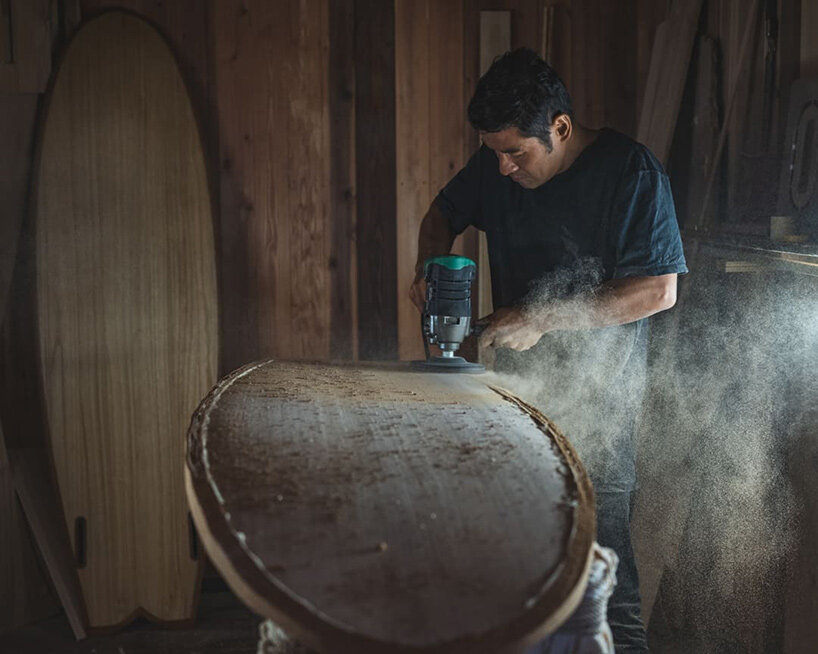
And there is the thing underneath all of it, which the project says out loud and which most waste-stream stories leave out. They do not blame the bears. They name what put the bears on the trunks: a changing climate giving the forest less to eat, and fewer people going up into the mountains than used to go. So the grain in that lacquered board is a record of a hungry animal in a thinning forest above a village with fewer hands in it than it once had, and a man whose great-grandfather ran the same lacquer works decided that was worth finishing to a mirror instead of feeding to a boiler.
The wood was never the problem. Somebody just had to want it.
Sources & Credits
- "scars left by bears ripple through these japanese cedar surfboards," kat barandy, designboom, 24 September 2026: https://www.designboom.com/design/scars-bears-japanese-cedar-surfboards-wood-project-tsutsumi-asakichi-urushi/
- "BEARS WOOD PROJECT," Tsutsumi Asakichi Urushi Inc.: https://www.tsutsumi-urushi.com/en/projects/bears-wood-project/
- "Urushi Board -siita-," Tsutsumi Asakichi Urushi Inc.: https://www.tsutsumi-urushi.com/en/projects/siita/
- Photography: designboom, via designboom, https://www.designboom.com/design/scars-bears-japanese-cedar-surfboards-wood-project-tsutsumi-asakichi-urushi/