Almost every lamp sold in the last decade that promised you control over the colour of its light delivered that promise as a slider inside an application on a telephone. Sixteen million colours, the box says, which is a number nobody has ever wanted. You pick one on a Tuesday, you never touch it again, the application asks you to create an account, the company gets bought, the firmware stops updating, and the lamp keeps doing whatever it was doing on the Tuesday. The colour was never a thing. It was a setting, held somewhere you cannot reach, in a format you do not own.
Billy Easter has made a lamp where the colour is an object you can hold in your hand and drop behind the sofa.
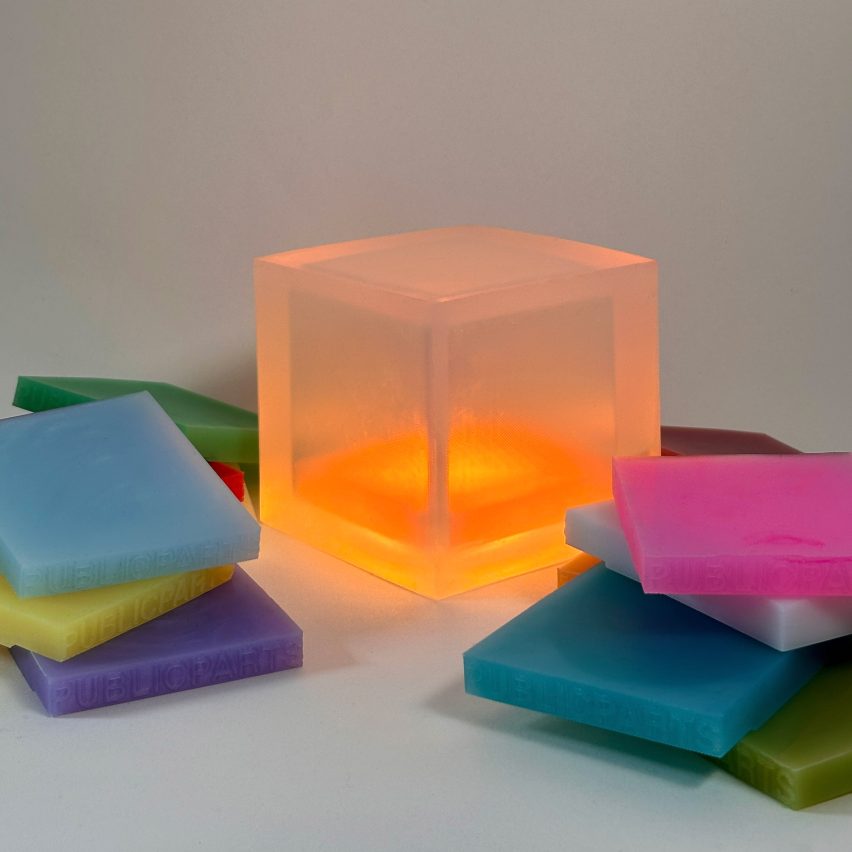
The Gel Lamp came out last month through Easter's London studio Public Parts. Dezeen describes it as a hollow cube of silicone, roughly 11.5 by 11.5 by 11.5 centimetres, with a dimmable LED sitting in the base. Near the bottom of the body there is a slim slot. Slices of translucent coloured silicone slide into it. The light changes colour. That is the whole mechanism, and there is no application, and there is nothing to log into.
Easter took the idea from the coloured gels used in photography, studio and theatre lighting, the thin films a gaffer clips over a lens to warm a face or cool a wall. Which is a good place to have taken it from, because theatre lighting is one of the few corners of the industry that never pretended colour was immaterial. On a stage, colour is a consumable. It comes on a roll, it has a number, it fades under heat, you reorder it. Everybody in the building knows it is a part.
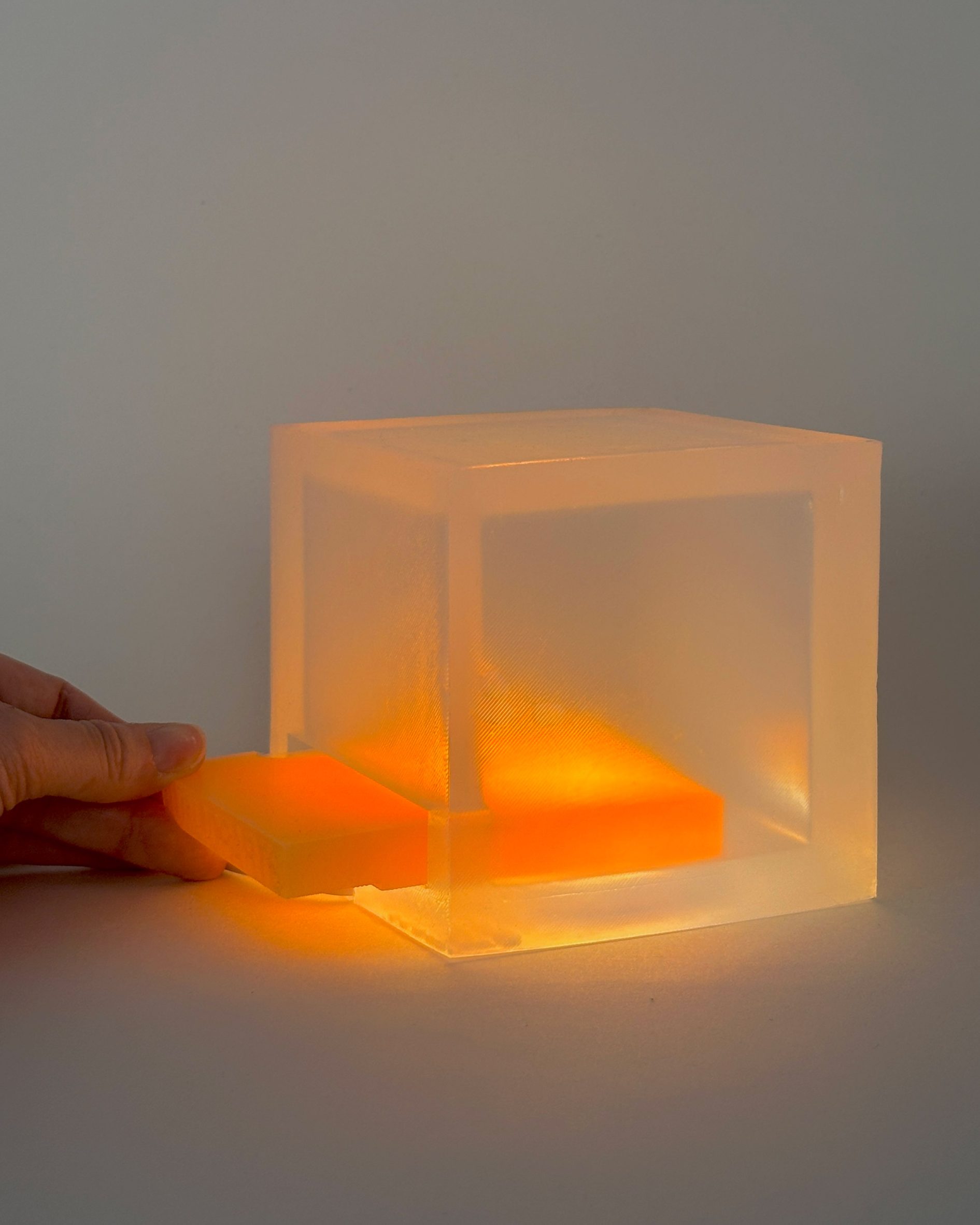
The making is slow and worth describing, because it explains the object's price and its softness at once. Easter printed moulds, poured liquid silicone into them, and cured and cast each face of the cube over a matter of days, then finished the lamps by hand. The slides get the same treatment. This is a production method with a real ceiling on it, and the result is a light fitting you could throw at a wall without consequence, which almost no light fitting is.
Then there is the detail that actually matters, and Dezeen puts it plainly: the light source sits "within a recessed void rather than being permanently embedded within the silicone", so the electronics can be reached.
We would like that sentence read out loud at every lighting rep presentation for the next ten years.
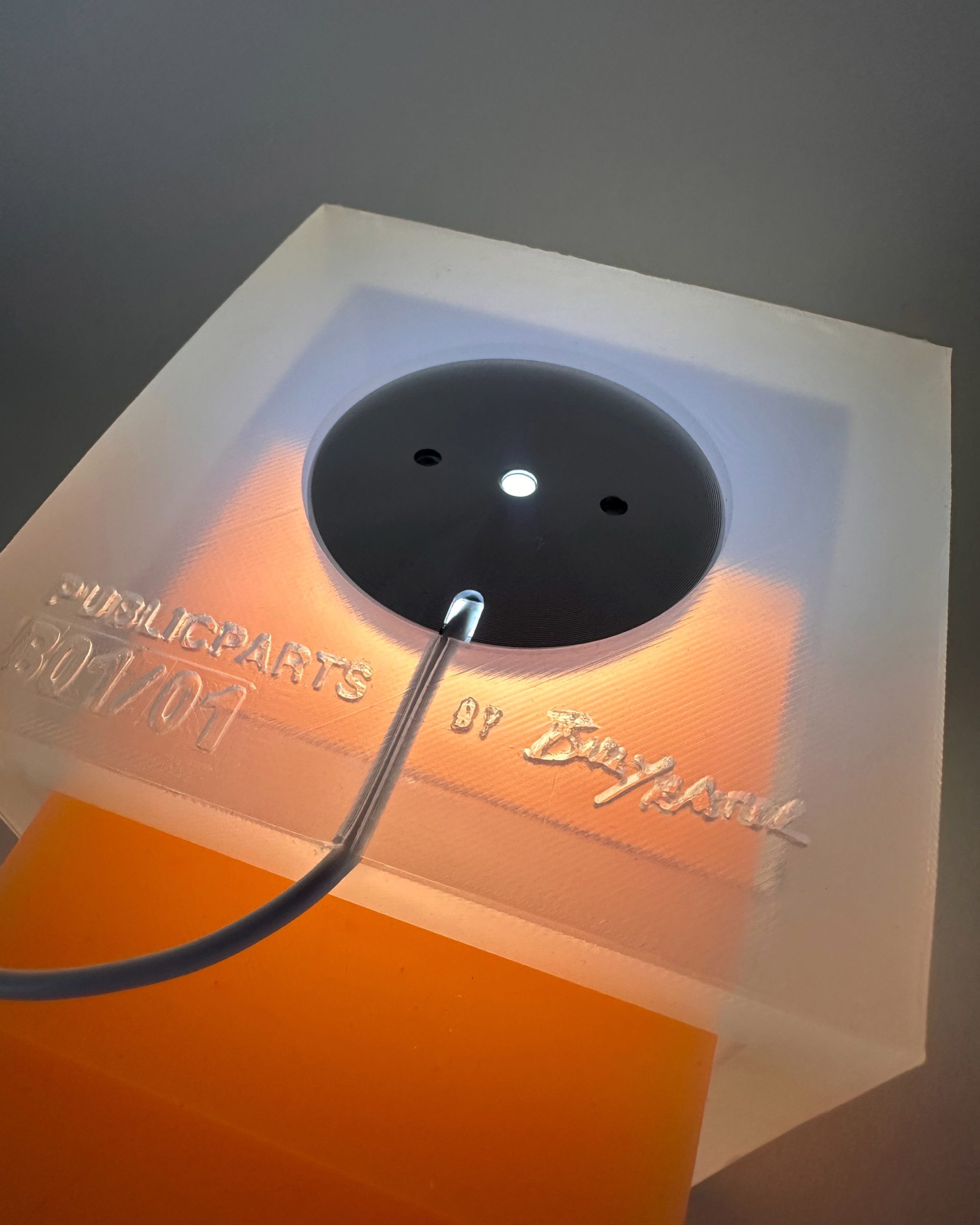
Because the standard move in contemporary lighting is the opposite one. The LED gets potted into the body, the driver gets glued behind it, the assembly gets sealed for the sake of a cleaner silhouette, and the fixture's life is now the life of its worst component. An LED array is rated for tens of thousands of hours. A cheap driver is not. So the beautiful sealed object dies of a part that costs a few pounds, and it dies uncut and unopenable, and it goes in a skip whole. We have specified fixtures like that. We have also specified the replacement fixtures, eighteen months later, and had the conversation with the client about why.
A recessed void is a small decision that undoes all of that. It is the difference between a lamp and a disposable, and it costs the designer one compromise in the silhouette, which is a bargain.
There is a second thing here that matters to anyone who specifies for a living. This lamp has no rough-in. No junction box, no driver hidden above a ceiling, no switch location argued over at framing, no coordination note to the electrician. It plugs in. That makes it furniture rather than architecture, and furniture is the part of a room a client can change their mind about later without a permit. We design a lot of rooms where the fixed light is deliberately dull and the interesting light arrives afterward, on a table, at eye level, warm, portable. This belongs to that category. It is a piece of specified light you can pick up and take to another apartment.
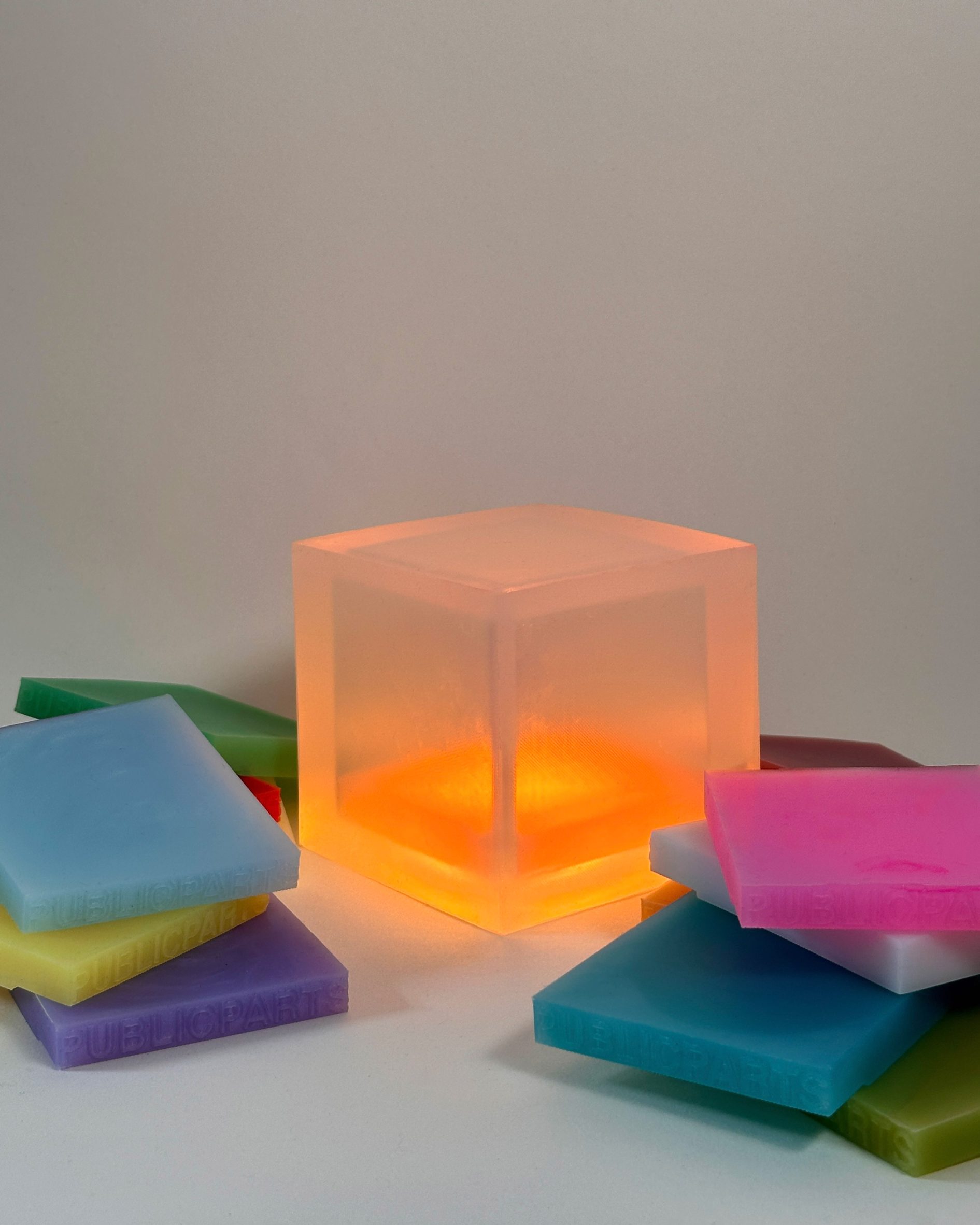
The honest criticism is that a swappable gel is also a small piece of silicone in a household, and small pieces of silicone in households go under things and stay there. A slide-in system is a system with a lost-parts problem, and a lost part here is a lost function, which is exactly what does not happen to a slider in an application. That is the real trade. You get a colour you own and can hand to somebody, and in exchange you accept that you can misplace it.
We will take that trade. A thing you can lose is a thing that exists.
Sources & Credits
- Alice Laycock, "Billy Easter's Gel Lamp shifts colour using transposable slides", Dezeen, 22 September 2026. https://www.dezeen.com/2026/09/22/billy-easter-public-parts-silicone-gel-lamp/
Photography: via Dezeen, https://www.dezeen.com/2026/09/22/billy-easter-public-parts-silicone-gel-lamp/