The Master Stopped Being Necessary
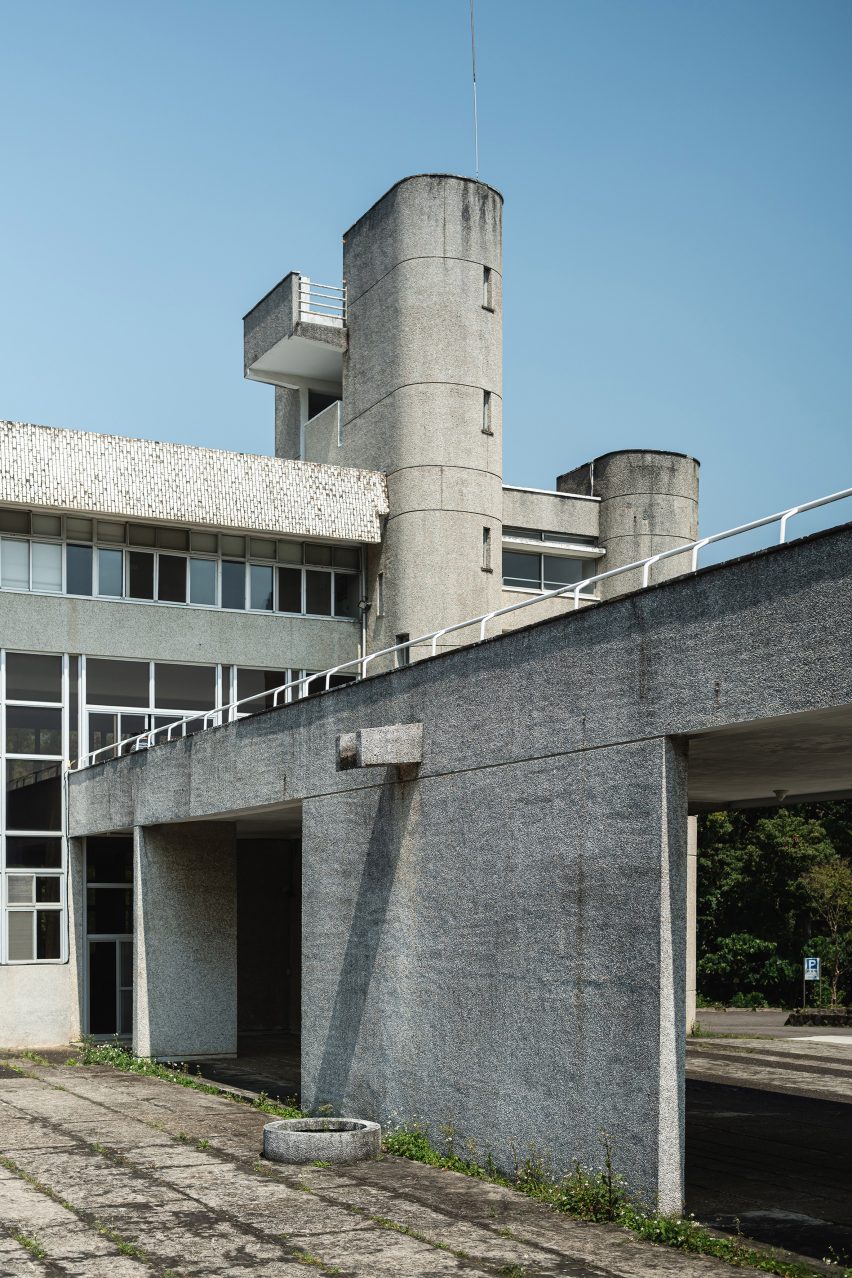
Takamasa Yoshizaka went to Paris and came home with a problem. He had worked in Le Corbusier's studio on the Rue de Sevres, alongside Kunio Maekawa and Junzo Sakakura, and he had watched the arguments get made, and all of the arguments were in French. So he sat down and translated them. Towards an Architecture, and then The Modulor, done by a man who had stood in the actual room, so that a whole country could read the thing without buying a ticket to Europe.
That is where Brutalist Asia begins, and the book does not quite seem to notice that this is what it is about.
Bob Pang and Derek Lamberton have put together 140 buildings across 28 countries for Blue Crow Media, and Pang has picked ten of them for Dezeen. The publisher's framing is that the book shows "the varying ways local and international architects interpreted the architectural style," which is a reasonable sentence and also the one thing in the whole package we would argue with. Brutalism was not a style that got interpreted. It was a method that got away from the people who thought they owned it.
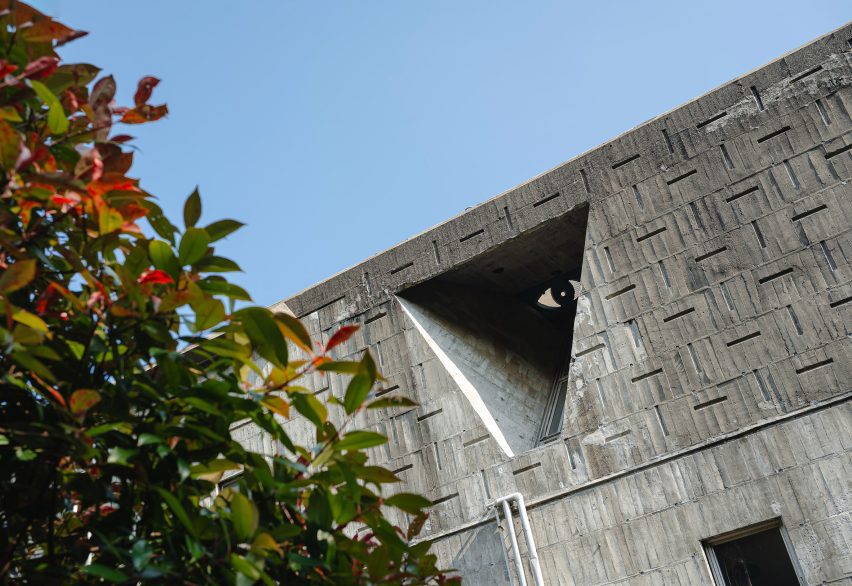
Watch how fast it moves. Yoshizaka finishes the Inter-University Seminar House in 1965, an inverted pyramid of a main hall with student pavilions scattered down the hillside, and it is still in use sixty years later. Two years after that, Kenzo Tange builds the Sacred Heart High School for Girls in the Bali District of New Taipei City. It is his first building outside Japan, and Pang notes that it is the only work of his left standing in Taiwan. A man who would go on to win the Pritzker, working out what the material would do, in a girls' school, on an island that was not his.
Then comes the part that should be taught.
In 1968, at Mahidol University in Thailand, the Round Building goes up at the Faculty of Science. It is a great inverted cone sitting on a single flared base, all cantilever and curve, and it was designed by Amorn Srivong. Pang's note on him is four sentences long and it undoes a century of architectural self-regard. Srivong grew up in a Chinese merchant family. He went out and worked as a general labourer on construction sites. The sites got him a job as a draftsman for a structural engineer. He had, in Pang's words, "received no formal architectural training whatsoever," and by the 1960s the new Thai universities had become his testing ground.
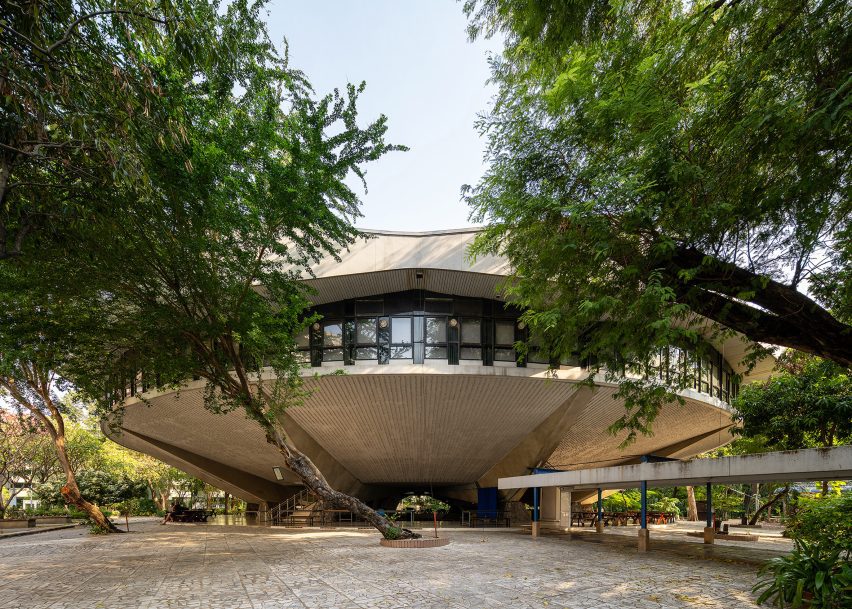
Nobody gave him the books. He got it off the job.
This is the thing a style cannot do. A style needs a master, and a lineage, and somebody to say whether you are doing it correctly, and it dies the moment the fashion turns. A method needs cement, formwork, reinforcement, and a lot of hands, and it will keep working in any country that has those four things whether or not anyone in Paris approves. Concrete is cheap where steel is expensive. Formwork is a carpentry problem, and carpenters are everywhere. Mass handles heat, which matters more at some latitudes than others. The reason brutalism shows up across 28 Asian countries is not that 28 countries read the same magazine. It is that the method answered the question those countries were actually asking, which was how to build a great deal of serious public building, quickly, with the materials and the labour on hand.
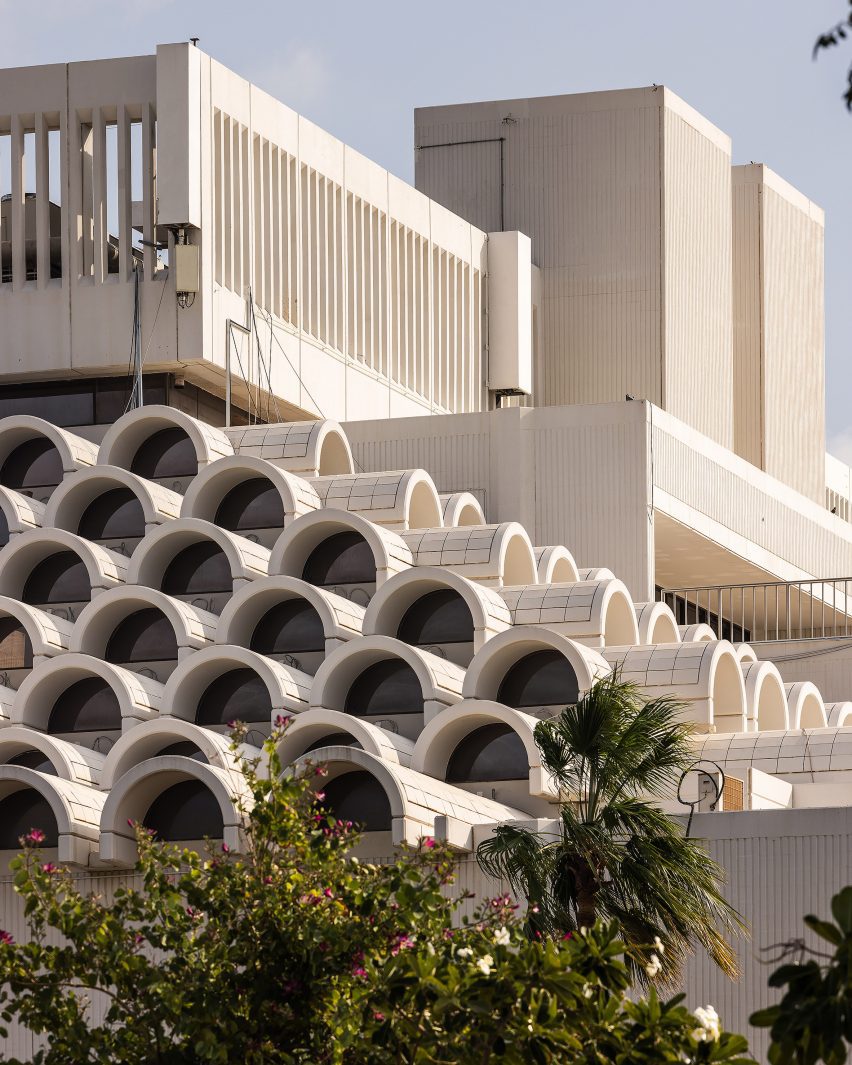
By 1980 Kuldip Singh is working with the structural engineer Mahendra Raj, who had worked on Chandigarh, and the lineage is still faintly visible. By 1985 it has gone somewhere else entirely: two British architects, Twist and Whitley, build the General Post Office in Qatar, and Pang describes a brutalism bent to Gulf climate and blended with the domestic language of Qatari building. By 1992 Le Huu Thang is making the Cua Tung Writers' House in Vietnam, during the early post Doi Moi years, and treating it as sculpture rather than architecture. The master has stopped being necessary. The material is doing the teaching.
We should be honest about what this costs. A method that travels without a master also travels without a critic, and a lot of concrete got poured in those decades that nobody should defend. Plenty of it was poured by governments who liked how permanent it looked. Plenty of it is hot, and stained, and hard to change, and sitting on a site that wanted something smaller. The method is not innocent just because it is honest.
But then there is Khalil Khoury's Interdesign Building in Beirut, which Pang lists as running from 1973 to 1997, because a civil war broke out in the middle of it. Twenty-three years to finish a building. And when it was finally finished it was never put into full use, so it stands there having been argued about, shelled around, waited on, completed out of sheer stubbornness, and then largely not needed. Pang still calls it one of the most remarkable brutalist and modernist structures in the Middle East, and he is right.
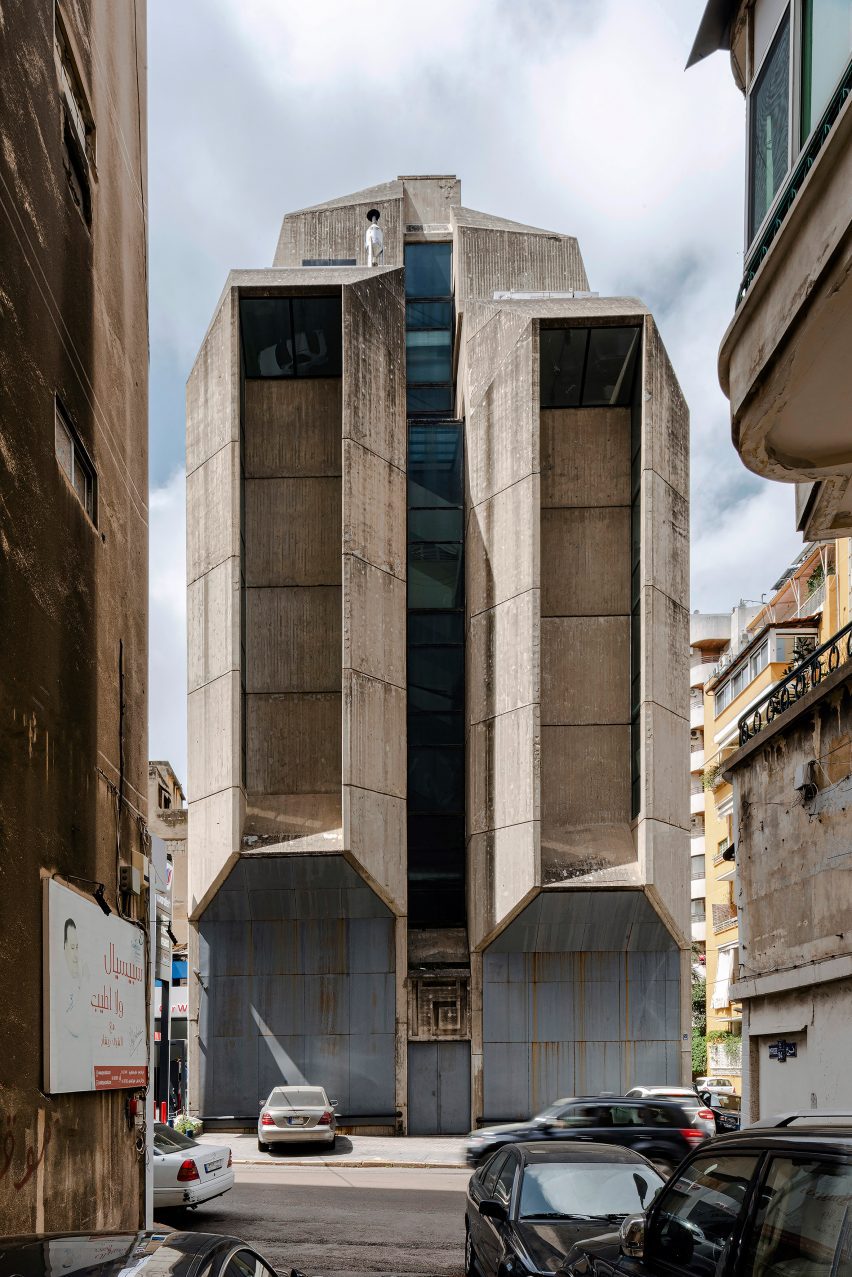
That is the whole argument for the material, sitting in one building. It was designed for a country that stopped existing in its old form halfway through construction, for an occupant who never arrived, in a style the rest of the world spent the 1980s deciding it was embarrassed by. The method did not require anyone's continued belief. It required cement and hands and someone willing to keep going.
And still it stands.
Sources & Credits
- Amy Peacock, "Ten monumental brutalist buildings in Asia," Dezeen, 3 October 2026. <https://www.dezeen.com/2026/10/03/brutalist-asia-book-roundup/> All quoted passages and all biographical detail on Yoshizaka, Tange, Srivong, Singh, Twist and Whitley, Le Huu Thang and Khoury are Bob Pang's, as published by Dezeen.
- Brutalist Asia, edited by Bob Pang with Derek Lamberton, Blue Crow Media.
- Photography: Kevin Mak, via Dezeen, <https://www.dezeen.com/2026/10/03/brutalist-asia-book-roundup/>
- Photography: Weerapon Singnoi, via Dezeen, <https://www.dezeen.com/2026/10/03/brutalist-asia-book-roundup/>
- Photography: Finbarr Fallon, via Dezeen, <https://www.dezeen.com/2026/10/03/brutalist-asia-book-roundup/>
- Photography: Walid Rashid, via Dezeen, <https://www.dezeen.com/2026/10/03/brutalist-asia-book-roundup/>